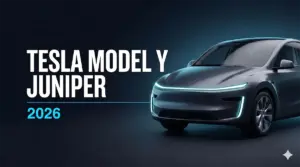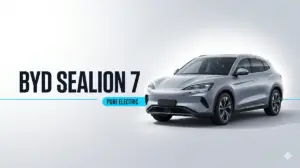
The Tesla Model Y vs BYD Sealion 7 question is one of the most common among anyone weighing up a genuinely well-priced electric SUV right now.
BYD has had a remarkable run in Britain: according to SMMT registration data it’s now the UK’s best-selling EV brand, with more than 12,700 electric cars sold in the first four months of 2026 and over 7% of the EV market.
The Sealion 7 is the model BYD has aimed squarely at the Tesla Model Y.
For years the Model Y had the mid-size electric SUV class more or less to itself, and it has finally met a serious challenger in BYD’s slinky coupe-SUV.
Here’s the twist worth flagging up front: with roughly £5,000 between them, it’s the Tesla that undercuts the BYD here, not the other way round.
So which is the better value electric SUV?
We’ll work through price, range and everyday use, one point at a time.
📌 At a glance
[Tesla Model Y — pros]
- Class-leading efficiency: more range from a smaller battery
- Agile, quiet and composed to drive
- A bigger boot and a proper frunk
- Stable residual values, plus the Supercharger network
[Tesla Model Y — cons]
- No Apple CarPlay or Android Auto
- Ride is on the firmer side
[BYD Sealion 7 — pros]
- A refined ride and a genuinely plush cabin
- Generous standard kit: heated and ventilated seats, wireless CarPlay/Android Auto and V2L
[BYD Sealion 7 — cons]
- Lower efficiency (around 3 vs 4.6 mi/kWh)
- Unproven residual values
[The verdict] If efficiency, driving engagement, practicality, resale value — and, in the UK, the lower price — matter most, the Model Y. If a plush, refined cabin and lavish standard equipment matter more, the Sealion 7 makes a decent case.
1. Tesla Model Y vs BYD Sealion 7: what sets them apart?
Both are mid-size coupe-style electric SUVs, so they line up closely, but the Model Y pulls ahead on efficiency and agility, while the Sealion 7 counters with cabin quality and a long standard-kit list.
Before we get into it, let’s be clear about what we’re comparing: the value heart of each range, the single-motor, rear-wheel-drive (RWD) trim.
That means the Model Y RWD (£41,990) against the Sealion 7 Comfort (£46,990) — the closest the two come on price, and the entry point into each line-up.
The pricier Long Range, AWD and Performance Model Ys sit in a different bracket, so we’ve left them out.
International head-to-heads tend to focus on driving dynamics and practicality.
In InsideEVs‘ comparison, the Model Y came out ahead on boot and frunk space and on driving fun.
On range, though, the two are line-ball: 314 miles WLTP for the Model Y against 300 for the Sealion 7.
Where the Tesla genuinely pulls clear is efficiency — it covers a near-identical distance from a much smaller battery.
The Sealion 7’s case lies elsewhere: a composed, comfortable ride, a smartly finished cabin, and a standard-kit list that shames cars costing rather more.
Reviewers consistently hand the Model Y the points for agility and pace of response, but give the Sealion 7 the nod for ride comfort and material quality.
So this comparison goes point by point.
For reference, the UK Sealion 7 comes in three trims: Comfort RWD (£46,990), Design AWD (£51,990) and the range-topping Excellence AWD (£58,990), the last of which swaps in a larger 91.3kWh battery for up to 312 miles WLTP and adds a head-up display and Nappa leather.
☑️ Model Y Juniper: the key changes
The 2025 facelift — the Model Y Juniper — was all about refinement: a quieter cabin and a more settled ride.
The old Model Y had the pace and the range, but ride and noise were perennial gripes.
Sharp inputs came straight through, and the cabin could get boomy at speed.
The Juniper update stiffened the body and added acoustic glass and extra sound deadening to tackle exactly that.
The drag coefficient also dropped from 0.23 to 0.22, nudging efficiency up in the bargain.
☑️ What makes the BYD Sealion 7 different
The Sealion 7’s calling card is its Cell-to-Body (CTB) construction, which integrates the Blade battery into the car’s structure.
As the name suggests, the battery cells effectively become the body: the pack forms the floor of the cabin itself.
That makes the structure stiffer and lowers the centre of gravity.
Because the pack and floor are merged into one layer rather than two, BYD can sit the battery lower and free up vertical space inside.
UK road testers have praised the Sealion 7 for a level of standard equipment you simply don’t expect at this price.
Even the entry Comfort gets heated and ventilated seats, a panoramic glass roof, wireless Apple CarPlay and Android Auto, V2L, a 360-degree camera and a 12-speaker Dynaudio system as standard.
(Step up to Excellence for Nappa leather and a head-up display.)
The 2,930mm wheelbase also stretches 40mm beyond the Model Y’s 2,890mm, so there’s a touch more room in the second row.
2. Sealion 7 vs Model Y price: what will you actually pay?
The headline of any Sealion 7 vs Model Y price comparison is that gap of around £5,000 — and in the UK it falls in the Tesla’s favour.
The Model Y RWD lists at £41,990, the Sealion 7 Comfort at £46,990.
Tesla introduced the new entry-level RWD (‘Standard’) at £41,990, around £3,000 below the old entry point, which sharpens the Model Y’s value case further.
The Sealion 7 Comfort, by contrast, opens at £46,990 — so despite arriving as the value-minded challenger, it’s the dearer car here.
| Tesla Model Y RWD | BYD Sealion 7 Comfort | |
|---|---|---|
| List price (OTR) | £41,990 | £46,990 |
£5,000 is far from trivial, so on the sticker the Model Y already has the upper hand.
And as we’ll see under residual values, that lead is unlikely to narrow over the years — if anything, the Tesla’s stronger resale tends to widen it.
The Sealion 7’s case, then, rests less on price than on what it gives you for the money.
Final on-the-road prices can shift with options and specification changes, and some sources quote slightly different list figures, so it’s worth confirming the latest numbers before you order.
3. Sealion 7 vs Model Y range: which goes further?
On a Sealion 7 vs Model Y range basis, the official WLTP figures are close: 314 miles for the Model Y, 300 for the Sealion 7 (per BYD UK’s official figures).
The Sealion’s battery is far bigger (82.5kWh vs the Tesla’s 60kWh), yet the Model Y still edges ahead — which tells you everything about efficiency.
Much as petrol cars have miles-per-gallon, an EV has miles per kilowatt-hour: how far it travels on a given chunk of energy.
Officially, the Model Y RWD manages around 4.6 mi/kWh; the Sealion 7 sits closer to 3 mi/kWh.
In other words, the Tesla goes further on noticeably less.
The Model Y’s 0.22 drag coefficient is among the slipperiest of any production SUV — well below the taller, boxier Sealion 7 (around 0.28) — and at roughly 1,900kg it’s lighter, so it simply uses less energy.
The Sealion 7, meanwhile, tips the scales at around 2,225kg, and that heft costs it energy over the same distance.
So even with a far larger battery, its range only matches the Tesla’s.
The big pack is effectively papering over lower efficiency, and on outright efficiency the Model Y is the clear winner.
☑️ Charging speed and V2L
Charging speeds are close, and the real difference comes down to V2L.
The Model Y RWD peaks at around 175kW, the Sealion 7 at 150kW, so the Tesla is fractionally quicker on paper.
In practice both take roughly 30 minutes for a 10–80% top-up, so there’s little to separate them in daily use. (Higher Model Y trims charge faster still.)
Where they part company is V2L — running external devices off the car’s battery. The Sealion 7 offers it as standard at around 3.3kW; the Model Y RWD doesn’t.
If you camp regularly or want a backup power source, that’s a tick in the Sealion 7’s column.
4. The real test of a best-value electric SUV: driving and practicality
When you’re choosing a best value electric SUV, how it drives and how usable it is matter just as much as the price.
Start with the driving.
Curiously, the Sealion 7 is the more powerful of the two, at 230kW (313PS) against the Model Y RWD’s 220kW (295hp).
And yet, on a 0–62mph run, the two are line-ball — the Sealion 7 actually nudges ahead at 6.7 seconds to the Model Y RWD’s 6.9.
Where the Tesla claws it back is in feel: at around 1,900kg it’s the lighter car by some margin over the 2,225kg BYD, so it’s keener to change direction and more eager through a series of bends.
| Tesla Model Y RWD | BYD Sealion 7 Comfort | |
|---|---|---|
| Max power | 295hp (220kW) | 313PS (230kW) |
| 0–62mph | 6.9 sec | 6.7 sec |
| Kerb weight | approx. 1,906kg | approx. 2,225kg |
The Juniper update’s acoustic glass and extra insulation have made the Model Y appreciably quieter.
The ride, though, remains on the firm side — not just against plush luxury rivals, but against the comfort-led Sealion 7 too.
Comfort is the Sealion 7’s home turf.
UK road tests have repeatedly praised a quiet, cosseting ride that smooths out scruffy surfaces in a way that belies the price — a few testers reached for saloon-class comparisons.
That said, the 2.2-tonne kerb weight and comfort-biased set-up mean it leans more in corners and trails the Model Y for driver engagement (and a handful of reviewers find it a touch unsettled around town).
In short: for an agile, engaging drive, the Model Y; for a comfortable, refined one with an upmarket cabin, the Sealion 7.
☑️ Which leads on cabin quality and cargo space?
For sheer cargo, the Model Y leads — though its headline 854-litre boot figure comes with a catch.
Tesla measures boot capacity from the floor all the way to the ceiling.
BYD, like most manufacturers, measures only to the load-cover line (the shelf beneath the rear window).
So that 854 litres is a roof-high figure, and lined up against rivals it flatters the Tesla.
Auto Express makes the same point.
Measure the Model Y to the window line, as everyone else does, and you’re nearer 650 litres.
| Tesla Model Y | BYD Sealion 7 | |
|---|---|---|
| Boot (to roof, Tesla’s method) | approx. 854L | — |
| Boot (to window line) | approx. 650L | 520L |
| Frunk | 117L | 58L |
| Seats folded | approx. 2,041L | 1,789L |
Even on a like-for-like basis the Model Y is the bigger carrier, and once you add its larger frunk (117L vs 58L) and the storage beneath the boot floor, it’s clearly the more practical of the two.
Flip it around, though, and the Sealion 7 wins on cabin finish and standard equipment.
Even the entry car gets heated and ventilated seats, a panoramic glass roof and wireless Apple CarPlay and Android Auto as standard — a first impression that feels well above its price point.
For Nappa leather and a head-up display you’ll need the range-topping Excellence trim, which does, of course, push the price well clear of the Model Y RWD.
For our money, frequent load-luggers should look to the Model Y; if it’s day-to-day cabin contentment you’re after, the Sealion 7.
5. ADAS and software: what works in the UK?
Both cars are top-rated for safety, but the driver-assistance you can actually use today tops out at Level 2 on both.
Euro NCAP — Britain’s reference point for new-car safety — awarded both the full five stars.
The detail scores are close, too: adult occupant protection is 91% for the Model Y and 87% for the Sealion 7, while child occupant protection is 93% for both.
On the safety fundamentals, there’s not much in it.
☑️ Can you use the Tesla Model Y’s FSD in the UK?
Here’s the decisive software variable.
Tesla’s headline FSD (Full Self-Driving, Supervised) isn’t yet available to switch on in the UK.
As Auto Express has reported, full FSD remains pending UK regulatory approval; for now British cars get Basic and Enhanced Autopilot only.
Tesla has been testing the system on UK roads, but a city-driving FSD rollout is still waiting on the green light.
The two cars’ limitations are different in nature, though.
The Model Y already carries the cameras and self-driving compute; the capability is simply locked pending the rules catching up.
The Sealion 7, by contrast, runs a camera- and radar-based Level 2 system (BYD’s DiPilot) without the higher-end lidar hardware for more advanced autonomy.
Going on what’s usable in the UK today, both are Level 2, so day-to-day there’s little to feel between them — and Tesla’s global software edge can’t really show itself here yet.
If anything, the Sealion 7 hands you more right now: a 360-degree surround view and driver monitoring come as standard.
Take the longer view, though, and it shifts.
The UK’s Automated Vehicles Act is opening the door to supervised self-driving, with approval widely expected in late 2026 or 2027 — and once it lands, the Model Y can switch FSD on using hardware it already has.
The Sealion 7, lacking that upper-tier hardware, can’t realistically reach the same level however much time passes.
So while the Sealion 7 leads on the convenience features you can use today, the future autonomy potential sits firmly with the Model Y.
6. Tesla Model Y vs BYD Sealion 7: the verdict
Pull it together and the Model Y leads on efficiency, driving engagement, practicality, residual value and — in the UK — price, while the Sealion 7 takes ride comfort, cabin quality and standard equipment.
These aren’t better-or-worse cars so much as cars with different priorities.
Tellingly, at the ACKO Drive 2026 awards the two shared the same category honour (details here) — judged close overall, but suited to different buyers.
That read-across holds neatly on British roads.
| Area | Edge |
|---|---|
| Efficiency | Model Y |
| Driving engagement & agility | Model Y |
| Cargo & practicality | Model Y |
| Residual value | Model Y |
| Price | Model Y |
| Ride comfort & cabin quality | Sealion 7 |
| Standard equipment | Sealion 7 |
| Safety & ADAS (UK) | Line-ball |
☑️ What about residual value and aftersales?
If you’re thinking long-term ownership and resale, residuals and aftersales matter just as much as the sticker.
The Model Y holds its value well, and the Supercharger network is a genuine ownership perk.
The Sealion 7 is harder to call.
As a relatively new brand in the UK, BYD doesn’t yet have the used-market track record to anchor strong residuals.
Aftersales reach is worth weighing, too.
BYD’s UK sales and service network is still expanding compared with long-established brands, and Tesla’s own service centres remain concentrated in busier areas, with booking waits a recurring grumble — though Tesla offsets some of that with its mobile service.
The upshot is that neither car yet matches the dense aftersales coverage of the established mainstream.
If you’re outside a major city, check where your nearest service point is before you commit, whichever way you lean.
💡 FAQ
Q1. Which has the longer range, the Sealion 7 or the Model Y?
On the official WLTP figures, the Model Y RWD’s 314 miles just shades the Sealion 7 Comfort’s 300. The bigger story is efficiency: the Tesla manages that from a 60kWh battery, against the BYD’s 82.5kWh, so in real-world use the Model Y tends to stretch further between charges.
Q2. Can you use the Tesla Model Y’s FSD in the UK?
Not yet. Full FSD (Supervised) is still awaiting UK regulatory approval, so even if you buy the software you can’t switch on city self-driving or automated lane changes — in practice you get Basic and Enhanced Autopilot, with adaptive cruise and lane centring. Because the Model Y already has the necessary hardware, it can activate FSD once the rules allow, which approval is widely expected to do in 2026–2027.
Q3. What’s the real price difference in a Sealion 7 vs Model Y comparison?
The Model Y RWD lists at £41,990 and the Sealion 7 Comfort at £46,990 — a gap of around £5,000 in the Tesla’s favour. Despite arriving as the value challenger, the Sealion 7 is the dearer car of the two in the UK.
Q4. I carry a lot of luggage — which is better?
The Model Y leads on cargo. Just bear in mind that Tesla measures to the roof while BYD measures to the window line, so the headline gap looks larger than it is. Even on a like-for-like basis the Model Y (around 650 litres) beats the Sealion 7 (520 litres), and once you add its 117-litre frunk, the practicality difference is clear.
✨ Wrapping up
Sum up the Tesla Model Y vs BYD Sealion 7 question and you’re really choosing a direction rather than a winner.
If you want efficiency, driving engagement, generous cargo, stable residuals — and, here in the UK, the keener price — the Model Y is your car.
If you’d rather have a comfortable ride and a plush, lavishly equipped cabin, the Sealion 7 is well judged.
For our part, we’d point long-distance, resale-minded drivers towards the Model Y, and those after a town-and-country first EV with a high-feel spec towards the Sealion 7.
Brand standing comes into it, too.
Tesla is the established EV name with the recognition and premium image to match, whereas BYD — its product merits aside — is still shaking off the ‘Chinese brand’ question in buyers’ minds.
If badge prestige matters to you, that’s worth factoring in.
Then again, once the Model Y’s FSD arrives in the UK and the Sealion 7 builds up some residual-value history from 2027, this picture could shift again.
Worth a closer look either way. Which one tempts you more?
Let us know what you think.