
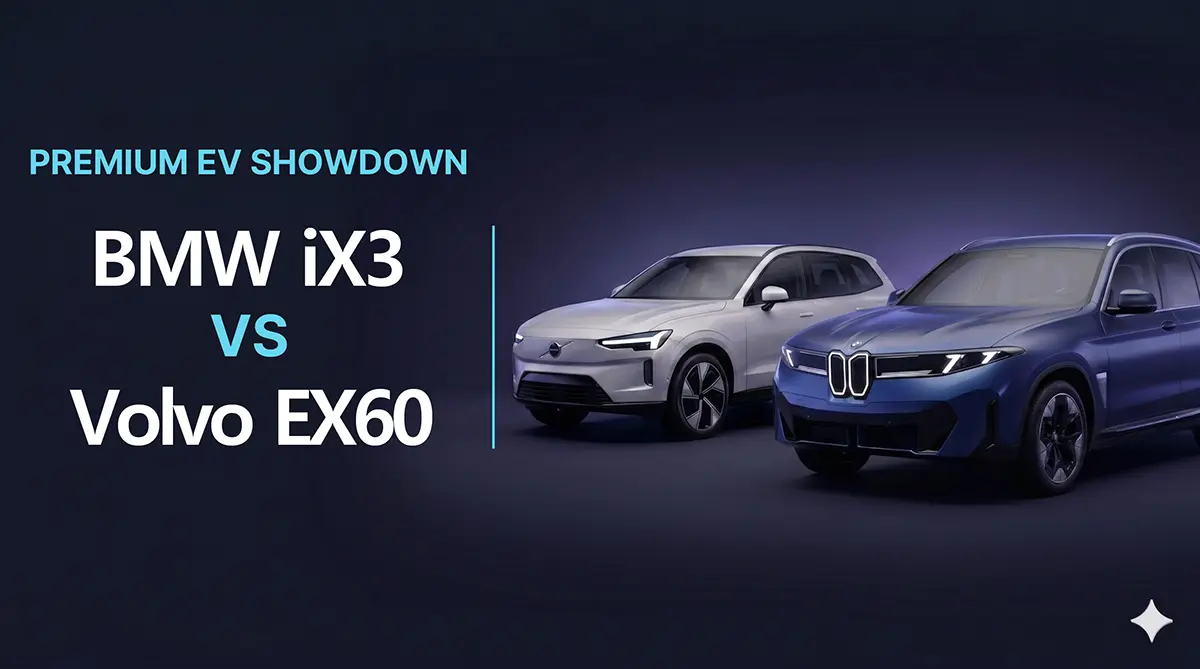
The premium electric SUV space just got a lot more interesting.
The BMW iX3 and Volvo EX60 are both rolling onto the field with 800V architecture, 400-mile range targets, and EV-only platforms built from a clean sheet — making them two of the most-watched electric SUVs hitting U.S. driveways this year.
Throw in the fact that the BMW iX3 just locked in the 2026 World Car of the Year title, while Volvo is calling the EX60’s safety package “the biggest safety leap since the 3-point seatbelt in 1959,” and you’ve got two heavyweights coming for the same buyer.
So which one actually deserves your money? Which one fits your driveway, your road trips, and your tolerance for first-year EV growing pains?
In this BMW iX3 Volvo EX60 EV comparison, we’re breaking down pricing, range, charging, ADAS, and the latest tech — no fluff, no fanboy takes.
ℹ️ This post contains spec-based informational images and AI-generated concept images. Concept images may differ from the actual product.
📌 Quick Take — The Bottom Line
What’s Locked In
- BMW iX3 50 xDrive: starting around $60,000 (BMW USA), reservations open May 6, 2026
- iX3: EPA-est. 400 miles, 463 hp, 0-60 mph in 4.7 seconds, first deliveries late September / early October 2026
- iX3 40 RWD (lower-priced entry trim) arriving early 2027 at under $55,000
- Volvo EX60: P6 and P10 delivering summer 2026, P12 fall 2026, starting around $60,000 (Volvo Cars), full trim pricing TBA
- Both ship with native NACS ports — Tesla Supercharger access from day one, no adapter needed
The Real Differences
- EX60 charges 2-3 minutes faster on the 10-80% sprint (P6/P10: 18 min, P12: 19 min vs iX3: 21 min)
- iX3 has certified hands-off ADAS up to 85 mph (130 km/h) on approved highways
- EX60 ships with adaptive dampers standard on P10 and P12; iX3 launches with passive dampers only (adaptive option arriving March 2027)
- EX60 wins on rear-seat room, base cargo volume, NVH, safety tech, AC home charging speed (19.2 kW vs 15.4 kW), and battery warranty (10 years vs 8)
- iX3 wins on driving feel, peak DC charging output, EPA range, and a fully validated production-car review record
- 📌 Quick Take — The Bottom Line
- 1. Two Cars, Same Segment, Different Platform Bets
- 2. Launch & Pricing — What U.S. Buyers Need to Know
- 3. Spec-by-Spec Showdown — Matched on Price, Not on Pitch
- 4. Platform Philosophy — Neue Klasse vs SPA3
- 5. Charging & Efficiency — Same 800V, Different Execution
- 6. Driving Feel & Reviews — One Validated, One Still Loading
- 7. Software & UI — Same Goal, Different Strategy
- 8. Safety & Autonomy — Two Different Philosophies
- 9. Risks Right Now — What Time Will Solve
- 10. Who Should Buy What?
- 💡 FAQ
- ✨ The Verdict
1. Two Cars, Same Segment, Different Platform Bets
The iX3 and EX60 sit in the exact same premium midsize electric SUV segment — but the engineers building them clearly disagree on what matters most.
☑️ BMW iX3 (Neue Klasse, NA5)
When BMW says this is “the first ground-up redesign in 60 years,” that’s not marketing fluff — it shows up in the actual engineering.
The iX3 isn’t just an electric X3 successor.
It’s the launch model for a platform that will spawn 40+ BMW EVs by the end of 2027.
BMW’s CEO has said the company has poured “well north of €10 billion” into Neue Klasse over the past five years — making it the single biggest platform investment in BMW Group history.
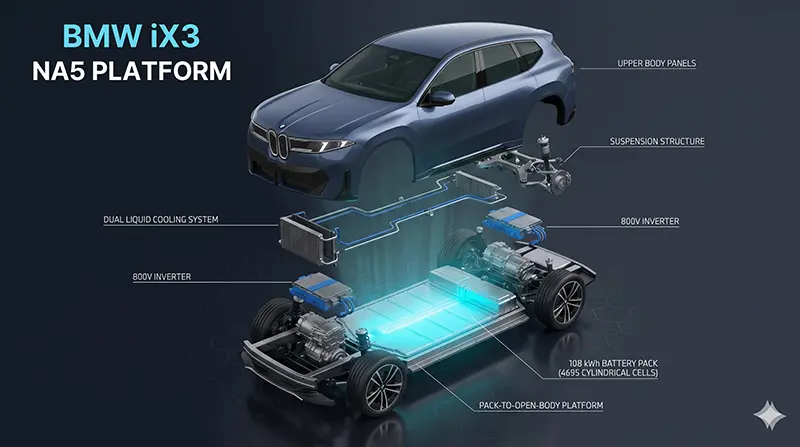
The headline tech is the 800V dedicated architecture and the Pack-to-Open-Body integration.
The battery pack itself completes the car’s lower body structure: the floorpan ships open, then the battery drops in to seal the structure shut.
That gets you body rigidity and packaging efficiency in one move — and because the cells stay separable, individual cell-level repair is on the table.
☑️ Volvo EX60 (SPA3)
The EX60 is the electric heir to the XC60 — and it’s the first production car off Volvo’s all-new SPA3 platform.
It introduces two pieces of new tech that have never been in a production Volvo before.
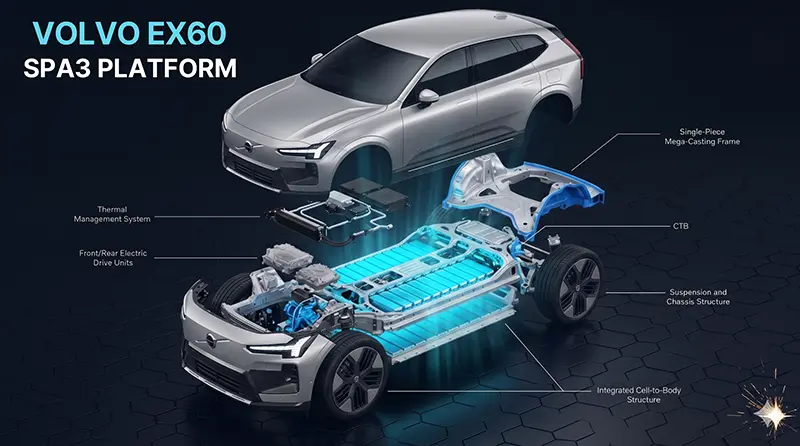
First is cell-to-body construction, where the battery cells become part of the body structure itself.
Old way: build a battery pack, then bolt it into the floor. EX60 way: the cells are the floor.
Second is an 8,400-ton megacasting press that replaces what used to be 60 to 100 stamped-and-welded steel parts in the rear body with a single massive aluminum casting.
The combined effect is a serious bump in body rigidity.
Volvo’s CTO has compared the EX60’s torsional stiffness to “approaching Koenigsegg hypercar levels” — Koenigsegg being the Swedish hypercar brand whose chassis stiffness sets the industry benchmark.
The trade-off with cell-to-body is that swapping out a single damaged cell becomes a much bigger job.
To offset that, Volvo backs every EX60 with a 10-year battery warranty — versus 8 years / 100,000 miles on the iX3, which already meets the U.S. federal EV minimum.
Both companies bet on dedicated EV platforms. They just chose very different priorities.
2. Launch & Pricing — What U.S. Buyers Need to Know
Before the spec sheet, the question is: when can you actually get one, and what does it cost?
☑️ BMW iX3 — Locked, Loaded, and Taking Reservations
- iX3 50 xDrive: starting around $60,000 (BMW USA)
- Reservations: open May 6, 2026
- Configurator: live in June 2026
- First U.S. deliveries: late September / early October 2026
- EPA-estimated range: 400 miles (preliminary, subject to final EPA certification)
- Production: U.S.-spec cars roll off the line in Debrecen, Hungary starting September 2026
Here’s the value play: in Germany, the iX3 50 xDrive starts at €73,925 (~$85,200).
In the U.S., BMW is opening the lineup at around $60,000 — roughly 30% less than European pricing once you account for currency.
That’s BMW USA going hard at market share for the Neue Klasse launch.
There’s also a lower-priced variant on the way.
The iX3 40 RWD is officially confirmed for early 2027 at under $55,000 — which would slot it head-on against rear-drive Tesla Model Y trims and the Mercedes GLC base model.
Global pre-orders crossed 50,000 units in just six months, with the Debrecen plant already running double shifts to keep up with European demand.
☑️ Volvo EX60 — On Sale, Multiple Trims Rolling Out
- EX60 P6 (RWD) and P10 AWD: deliveries starting summer 2026
- EX60 P12 AWD: arriving fall 2026
- EX60 Cross Country: 2028 model, raised ride height with air suspension
- Pricing: Volvo Cars officially pegs the core AWD model at “around $60,000” — full trim-by-trim MSRPs to be confirmed before on-sale
- All EX60s ship with native NACS, four years of complimentary Google services, and a 10-year battery warranty
Volvo CEO Håkan Samuelsson framed the launch this way: “With this car, we remove all remaining obstacles for going electric.”
The EX60 also enters the U.S. market at a moment when EV sales have cooled — Volvo is betting that range, charging speed, and safety tech can pull buyers off the fence.
Final pricing and trim-level MSRPs will be locked in when the configurators go live; out-the-door totals vary by state taxes, dealer fees, and any federal incentives you may qualify for.
☑️ Where the Competition Sits
Here’s how the rest of the premium midsize EV segment stacks up at U.S. MSRPs:
- Tesla Model Y: $39,990 (Standard RWD) climbing to $59,990 (Long Range Launch Series); the volume-seller Premium RWD and Premium AWD land at $46,380 and $50,380
- Mercedes-Benz GLC 400 4Matic (EV): mid-$60,000s expected (H2 2026 launch; official U.S. pricing TBA)
- Audi Q6 e-tron: $65,095–$71,895 across the e-tron quattro / Progressiv / Technik trims (currently on sale)
The iX3 and EX60 are pricing themselves right next to each other, which makes this comparison less about budget and more about what you actually want from the car.
3. Spec-by-Spec Showdown — Matched on Price, Not on Pitch
Quick note before the table: the EX60 P12 and the iX3 50 xDrive aren’t really direct rivals on price.
The P12 is a 670-hp halo trim that’s likely to land closer to $80,000, and ultimately faces off against the future iX3 M.
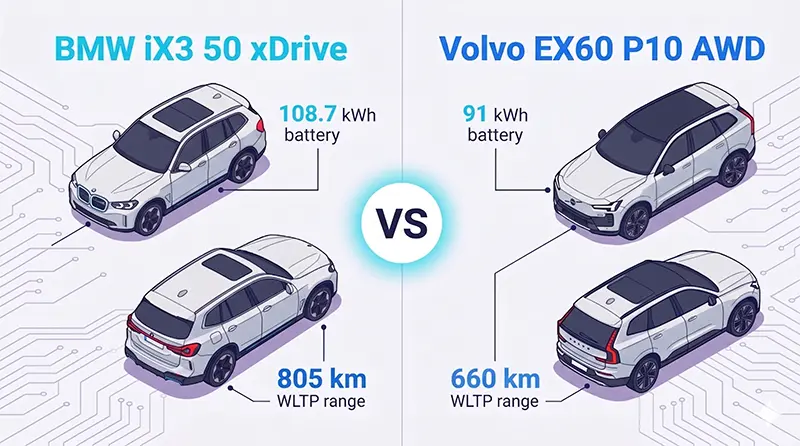
The right head-to-head for the iX3 50 xDrive is the EX60 P10 AWD.
| Spec | BMW iX3 50 xDrive | Volvo EX60 P10 (direct match) | Volvo EX60 P12 (reference) |
|---|---|---|---|
| Usable battery | 108.7 kWh | 91 kWh | 117 kWh |
| Power | 463 hp | 503 hp | 670 hp |
| Torque | 645 Nm (476 lb-ft) | 711 Nm (524 lb-ft) | 791 Nm (583 lb-ft) |
| 0-60 mph | 4.7 sec | 4.4 sec | 3.8 sec |
| EPA-est. range | 400 mi (preliminary) | 320 mi | 400 mi (preliminary) |
| WLTP range | 805 km | 660 km | 810 km |
| Peak DC charging | 400 kW | 370 kW | 370 kW |
| 10-80% charge time | 21 min | 18 min | 19 min |
| AC charging (standard) | 15.4 kW | 19.2 kW | 19.2 kW |
| Charging port | NACS (native) | NACS (native) | NACS (native) |
| Cargo (seats up) | 520 L | 634 L | 634 L |
| Cargo (seats folded) | 1,750 L | 1,647 L | 1,647 L |
| Wheelbase | 2,897 mm (114.1 in) | 2,970 mm (116.9 in) | 2,970 mm (116.9 in) |
| Drag coefficient | 0.24 | 0.26 | 0.26 |
| Top speed | 130 mph (limited) | 112 mph (limited) | 112 mph (limited) |
| Battery warranty | 8 yr / 100,000 mi | 10 years | 10 years |
Going trim-for-trim against the EX60 P10:
- iX3 wins: WLTP range (805 km vs 660 km), battery capacity, peak DC charging output, aerodynamics, and max cargo with seats folded (1,750 L vs 1,647 L). On EPA-estimated range, the iX3’s preliminary 400 mi outpaces the EX60 P10’s 320 mi by a clear margin.
- EX60 P10 wins: 0-60 mph (4.4 vs 4.7), base cargo volume (+114 L), rear legroom (73 mm longer wheelbase), AC home charging speed (19.2 kW vs 15.4 kW — roughly 25% faster overnight on a 240V Level 2), and battery warranty (10 years vs 8).
On paper, this comes down to a coin flip — your priorities decide it.
4. Platform Philosophy — Neue Klasse vs SPA3
Both the iX3 and EX60 use clean-sheet EV-only architectures, but they’re solving different problems.
☑️ BMW Neue Klasse — Modularity at Scale
The Neue Klasse is built to scale horizontally to 40+ models by the end of 2027. The iX3 is just the opening act — the i3 sedan (late 2026), iX5, and iX7 will all share this hardware.
The battery uses 4695 cylindrical cells (NMC chemistry), integrated into the body via the Pack-to-Open-Body method.
BMW added cooling channels not just on the side of the cells but between each cell — a dual liquid cooling architecture that keeps cell temperatures even under sustained 400 kW DC fast charging, while preserving the option for cell-level service.
☑️ Volvo SPA3 — Stiffness and Space, Maxed Out
Volvo’s most aggressive bets are the cell-to-body construction and the megacasting we already covered.
CTO Anders Bell has called SPA3 a platform that “can underpin everything from a B-segment to an F-segment vehicle” — and noted that if Volvo had built the ES90 sedan on SPA3 instead of SPA2, the car could have been roughly 8 inches lower.
The output of all that engineering: the EX60 measures 4,803 mm (189.1 in) end-to-end, basically identical to the iX3 at 4,782 mm (188.3 in).
But the EX60’s wheelbase is 2,970 mm — 73 mm (2.9 in) longer than the iX3’s 2,897 mm.
In real terms: rear-seat knee room in the EX60 punches above its segment, feeling closer to a class-up SUV.
☑️ The Trade-Offs
The BMW iX3 optimized for charging performance and modularity at scale.
The Volvo EX60 optimized for body rigidity and interior space, accepting that cell-level repair gets harder.
Volvo offsets that with a 10-year battery warranty — 2 years longer than the iX3’s coverage, and longer than the U.S. federal EV minimum.
5. Charging & Efficiency — Same 800V, Different Execution
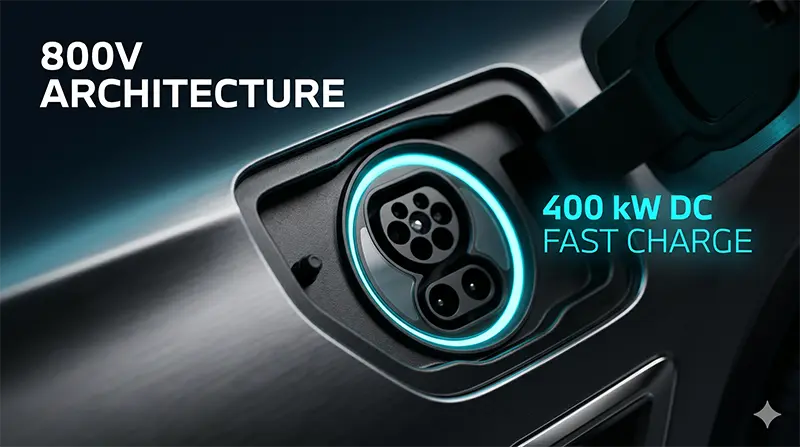
Both the BMW iX3 and Volvo EX60 run 800V architecture and support 400 kW–class DC fast charging.
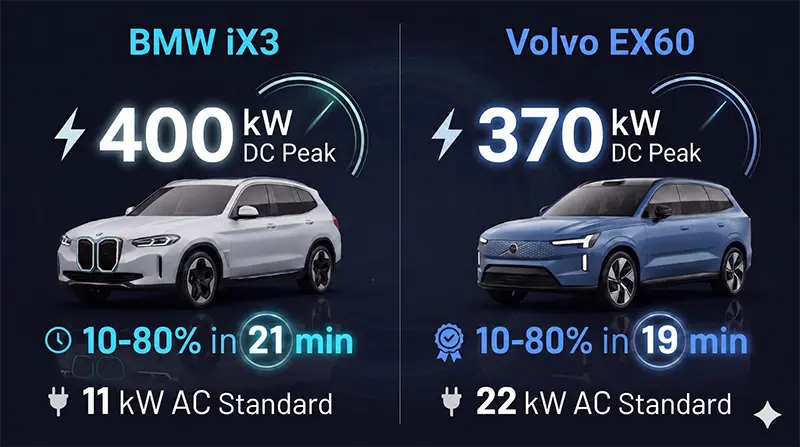
The interesting part: the iX3 has the higher peak (400 kW vs 370 kW), but the EX60 finishes the 10-80% sprint faster (18-19 min vs 21 min).
☑️ Charging Curves Tell Different Stories
The iX3 hits 400 kW for about 3 minutes when battery state of charge is above 10%, then settles into the 230-250 kW range.
The EX60 holds its 370 kW peak longer and flatter, averaging 4.1 kWh added per minute — among the best in the segment.
That puts the iX3 and EX60 ahead of direct rivals: the Mercedes GLC 400 4MATIC EV (330 kW peak, ~22 min, mid-$60,000s expected) and the Audi Q6 e-tron (270 kW peak, ~22 min, $65,095 starting MSRP).
☑️ NACS Native — A Real Game-Changer
Here’s the move that matters most for U.S. buyers: both the iX3 and the EX60 ship with native NACS ports from day one.
That means no adapter, no fumbling at a Tesla Supercharger, no software-update wait.
You pull up, plug in, you’re charging — at any of Tesla’s 25,000+ Supercharger stalls in North America, plus IONNA, Electrify America, ChargePoint, and EVgo through each automaker’s app integration.
For BMW, the iX3 is the first Neue Klasse model to launch with native NACS in the U.S.
For Volvo, the EX60 is the first Volvo period to do it.
The infrastructure question that used to dominate EV buying decisions? It’s basically off the table for these two.
☑️ AC Home Charging — Where the EX60 Pulls Ahead
This one’s quiet but matters more than people realize.
- EX60: 19.2 kW AC standard
- iX3: 15.4 kW AC standard (U.S. spec)
If you’ve got a 240V Level 2 setup at home — and most U.S. EV owners eventually do — the EX60 will fill an empty battery noticeably faster.
On a beefy circuit, you’re looking at full charge in roughly 6 hours on the EX60 vs roughly 7-8 hours on the iX3. Not a deal-breaker, but if you do a lot of overnight charging, it adds up over a year.
☑️ Cold Weather — Breathe Charge Wins on Paper
The Volvo EX60 ships with Breathe Charge, an adaptive charging algorithm developed by U.K. battery tech firm Breathe (Volvo is an investor) that monitors cell temperature and condition in real time and dynamically adjusts charging speed.
Volvo’s published numbers claim 30-48% faster charging at 32°F (0°C) versus a static algorithm.
Traditional preconditioning systems just warm the battery before you arrive at a charger.
Breathe Charge keeps adapting throughout the entire charging session.
The BMW iX3 offers navigation-based automatic battery preconditioning — set a charger as your destination and the system handles it.
It’s the industry-standard approach, but it has the industry-standard limitation: if you don’t route through the nav, it doesn’t precondition.
BMW hasn’t announced an equivalent algorithmic real-time adaptation.
For drivers in the Northeast, Midwest, or Mountain West dealing with real winters, that’s a meaningful EX60 edge.
6. Driving Feel & Reviews — One Validated, One Still Loading
This is where the information gap is widest.
The BMW iX3 has been in the hands of global media in production-car form since December 2025. By April 2026, the praise and criticism are well documented.
The Volvo EX60 has only been driven by media in prototype form so far — and even those drives had a Volvo engineer at the wheel with the journalist riding shotgun.
☑️ BMW iX3 — The Receipts Are In
The iX3 took home 2026 World Car of the Year and World Electric Vehicle, plus a stack of European and U.K. car-of-the-year wins.
In the World COTY finals, it beat out the Hyundai Palisade for the top spot.
The most consistent praise lands on the Heart of Joy integrated control unit — specifically its regenerative braking calibration and the new Soft Stop feature.
Soft Stop kills the head-bob that EVs typically get right before a full stop.
Top Gear called it “the joy of stopping.” InsideEVs compared the smoothness to “Rolls-Royce or Bentley territory.”
About 95% of everyday driving stops are handled with regen alone — no friction brakes needed.
The consistent critique: at launch, the iX3 doesn’t offer adaptive dampers. On rough pavement, the ride is on the firm side.
BMW has confirmed an adaptive damper option is coming as a March 2027 retrofit — but if you order at launch, passive is what you get.
☑️ Volvo EX60 — Prototype Impressions Only, So Far
A March 2026 prototype ride at Volvo’s Hällered proving grounds in Sweden generated a clear consensus on one thing: NVH.
Jalopnik described it as “feeling like you’re inside a church.” Carbuzz called it “the most solid Volvo I’ve driven in 12 years.”
But because journalists could only ride along, the actual driving feel — steering response, throttle calibration, brake feel — is still a question mark until production-car drives open up later in 2026.
☑️ Adaptive Dampers — A Real Asymmetry
The EX60 P10 and P12 ship with adaptive dampers as standard from launch.
The iX3 launches with passive dampers across the board, with adaptive coming as an option in March 2027.
The iX3’s review scores are locked in at high marks. The EX60’s verdict still requires production-car drives to settle.
Worth flagging: the iX3’s praise traces a lot of the way back to “Heart of Joy” — a genuinely new piece of integration, not just “BMW being BMW.”
That suggests the win isn’t a brand reflex; it’s actual engineering.
The EX60 should benefit from SPA3’s body rigidity and standard adaptive dampers when production drives start landing — but until they do, it’s projected upside, not validated reality.
7. Software & UI — Same Goal, Different Strategy
Both the BMW iX3 and Volvo EX60 chase the same target: keep the driver’s eyes on the road.
The execution couldn’t be more different.
☑️ BMW Panoramic iDrive — Information at Windshield Level
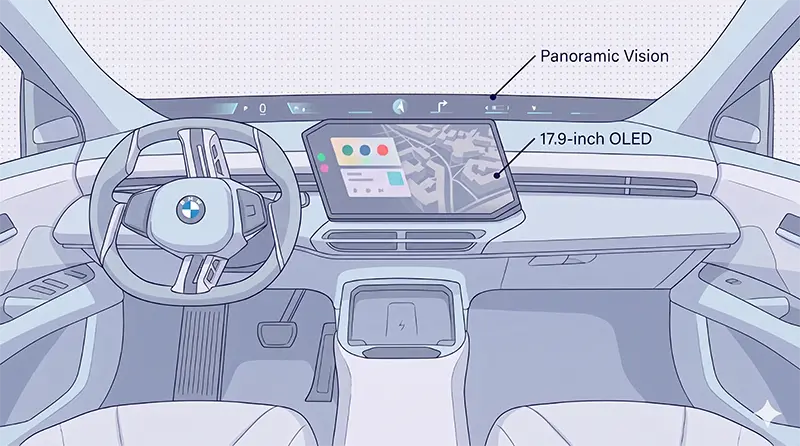
Panoramic iDrive is BMW’s first full iDrive redesign in 25 years, and the iX3 is its debut.
- 3D HUD optional: AR-style overlays projected onto the road
- Panoramic Vision: a 43.3-inch projected display running across the lower windshield, visible to driver and front passenger
- 17.9-inch parallelogram OLED center display: 3340×1440 resolution, asymmetrically angled toward the driver
- Dual voice assistants: BMW’s own assistant handles vehicle controls; Alexa+ handles general queries — the first time an LLM-based voice assistant has been integrated into a production car
The bottom line: information lives down at the lower windshield, so the driver’s eyes barely have to leave the road.
☑️ Volvo EX60 — Digital Cluster Returns, Gemini Standard
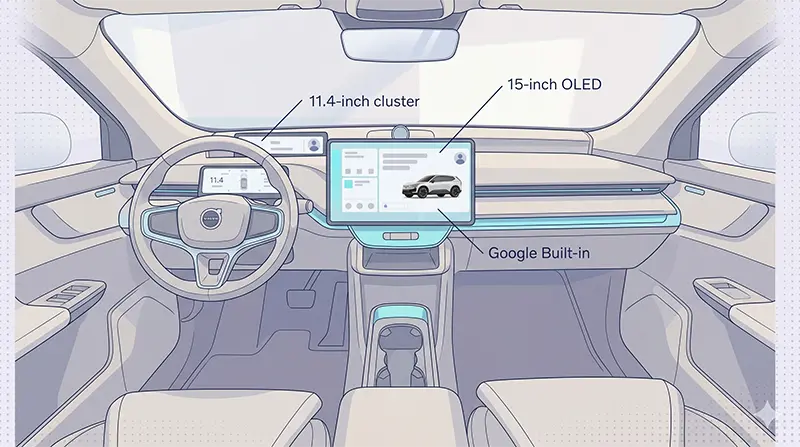
The EX60 walks back the EX30’s extreme minimalism — bringing back a real digital instrument cluster — and bets on AI integration as the differentiator.
- No HUD: unlike the EX90, the EX60 doesn’t offer a head-up display
- 11.4-inch digital cluster restored: a course correction from the cluster-free, HUD-free EX30
- 15-inch curved OLED center display: powered by Qualcomm Snapdragon 8255
- Voice assistant: Google Gemini integrated natively — pulls from your vehicle data, Gmail, calendar, and Maps in one conversation
The EX60’s strength is the integration between the car and Google’s ecosystem.
Say “find a well-rated charger near my meeting next Tuesday” and Gemini will:
① pull the meeting time and location from Google Calendar automatically, then
② query Google Maps for top-rated chargers near that address — all in one voice command.
You don’t have to dictate the address. You don’t have to switch apps. It just works.
☑️ The Trade-Offs
| Aspect | BMW iX3 | Volvo EX60 |
|---|---|---|
| Eye movement | Minimized (windshield-level info) | Cluster + center display switching |
| AI architecture | Split (Alexa+ + BMW assistant) | Unified (Gemini only) |
| Connectivity drops | Core vehicle functions guaranteed | Cloud-dependent features may degrade |
| OS | BMW Operating System X | Google Android Automotive |
Light on physical buttons: both the iX3 and EX60 take heat for this.
The iX3 dropped the iDrive rotary controller, and reviewers noticed. The EX60 buries climate controls in the touchscreen, which media have flagged as a usability step backward.
8. Safety & Autonomy — Two Different Philosophies
Both the BMW iX3 and Volvo EX60 market hard on safety — they just have very different definitions of it.
☑️ Volvo EX60 — Passive Safety, Reinvented
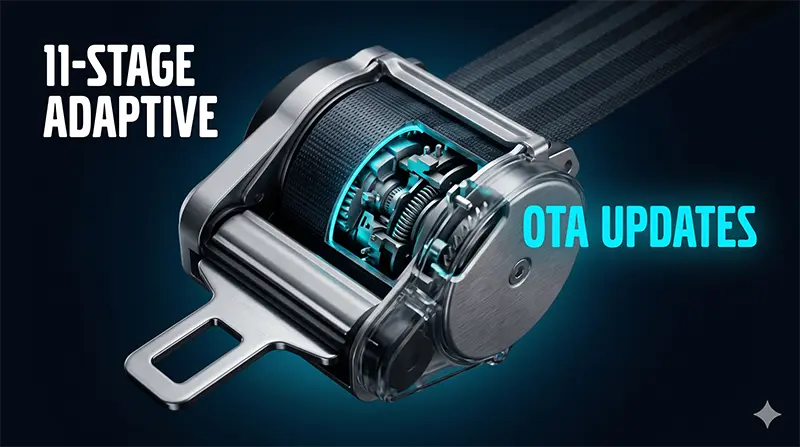
The headline is the Multi-Adaptive Safety Belt — the world’s first production 11-stage variable load-limiting belt.
It reads occupant height, weight, body shape, and seating posture, then cross-references collision direction, speed, and severity to dial in protection in real time.
The training data is 80,000+ real-world crash events, and the system updates over the air — meaning the protection logic gets smarter every time Volvo collects new crash data.
Volvo’s safety chief calls it “the biggest seatbelt upgrade since the 3-point belt in 1959.” It made TIME’s Best Inventions of 2025.
☑️ BMW iX3 — Active Safety and ADAS Leadership
The iX3’s headliner is Highway Assistant:
- Hands-off driving up to 85 mph (130 km/h) on approved controlled-access highways
- Eye-tracking lane changes: glance at the side mirror, glance at the lane, micro-tilt the wheel — system reads all three
- Symbiotic Drive: even with hands-off active, your micro inputs (small steering or brake adjustments) don’t kill the system. It blends your input with computer control instead of bouncing you out (24+ patents protect this)
The EX60 is currently a Level 2 hands-on system (Pilot Assist) — no hands-off mode at launch. Volvo has signaled hands-free Level 2+ via OTA update down the road, but no firm date.
9. Risks Right Now — What Time Will Solve
☑️ BMW iX3 Risk
- No adaptive dampers at launch: stiff ride on rough pavement. Adaptive option arrives March 2027 — until then, passive is your only choice.
☑️ Volvo EX60 Risks
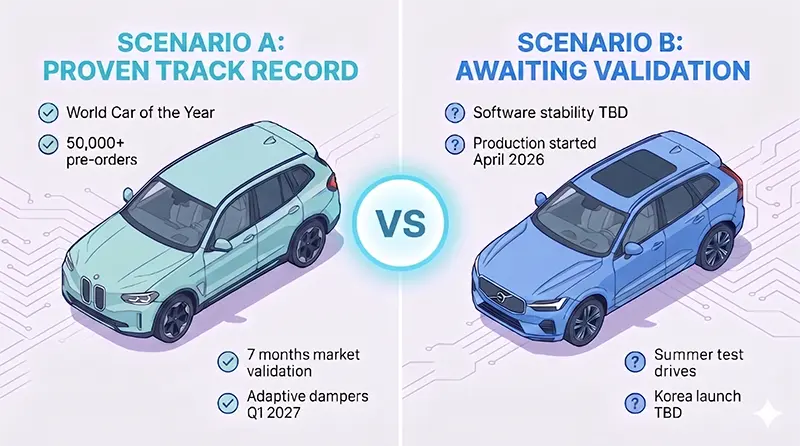
- Software validation pending: the EX90’s launch software was rough — failed key recognition, display blackouts, mid-drive power loss.
CTO Anders Bell publicly apologized in September 2025. Volvo says the EX60 inherits the now-stabilized EX90 software stack, but production-car validation is still an open question until cars land in customer hands this summer. - EX30 battery fire recall casts a shadow: Volvo recalled 40,323 EX30s globally in February 2026 over battery cell overheating and fire risk.
EX30 sales were halted in the U.S. as part of the response. The EX60 uses different cell chemistry, but media coverage has noted that some Sunwoda cells implicated in the EX30 issue also appear in the EX60 P6 and P10 — worth tracking through the validation period.
These risks are all snapshots from April 2026.
Most will resolve as time passes. iX3 adaptive dampers arrive in March 2027. EX60 production-car validation data starts stacking up from late summer 2026 onward.
If you’re shopping right now, though, “later” doesn’t help — the timing of your purchase decides which risks are yours.
10. Who Should Buy What?
This isn’t an iX3-vs-EX60 winner-loser question. It’s a fit question.
☑️ Buy the BMW iX3 if you…
- Need delivery in 2026: U.S. launch is locked, reservations open May 6, EPA cert is preliminary but firm
- Care about driving feel: Heart of Joy regen, Soft Stop, BMW’s century of chassis tuning
- Want the validated, awarded option: production-car reviews are in, World COTY hardware is on the mantle
- Use ADAS heavily: 85 mph hands-off, eye-tracking lane changes
- Drive long distances often: 400 miles EPA-est., 805 km WLTP
- Want native NACS without waiting for an OTA: it’s standard on the iX3 from launch
☑️ Buy the Volvo EX60 if you…
- Have time to wait for production-drive reviews and aren’t in a delivery rush
- Put safety at the top of the spec sheet: cell-to-body rigidity, megacasting, OTA-evolving safety belt, 10-year battery warranty
- Use the car for family road trips: NVH, standard adaptive dampers, +73 mm rear legroom, +114 L base cargo (520 L → 634 L)
- Want unified AI: Gemini native, Gmail/Calendar/Maps tied in
- Want the fastest home AC charging in the segment: 19.2 kW standard
- Are an XC60 owner: the EX60 is the natural upgrade path
☑️ U.S. Market Outlook — Which Is Really the Best Electric SUV?
For U.S. buyers, the iX3 vs EX60 fight is closer than the headlines suggest. Both cars have a legitimate claim to being the best electric SUV in this segment for 2026.
Both hit your driveway in 2026. Both start around $60,000.
Both ship with native NACS. Both pull EPA-est. 400 miles in their longest-range trims.
What separates them is character:
- iX3: validated production car, World COTY, ADAS leadership, faster peak charging, better drag coefficient. The known quantity.
- EX60: NACS native + 19.2 kW AC + 10-year battery warranty + Multi-Adaptive Safety Belt + Gemini integrated. The forward bet.
The iX3 40 RWD lower-priced trim arrives in early 2027 at under $55,000, and could end up the volume seller stateside given U.S. buyers’ appetite for entry trims — slotting head-on against rear-drive Tesla Model Y trims and the Mercedes GLC base model.
The EX60 lineup, P6 through P12, gives Volvo more powertrain spread than BMW’s launch lineup — and the P12’s 670 hp / 3.8-second 0-60 is squarely aimed at the inevitable iX3 M.
💡 FAQ
✨ The Verdict
After running this BMW iX3 Volvo EX60 EV comparison head-to-head across pricing, range, charging, safety, software, and ADAS, here’s the honest take: there is no clean winner.
These are evenly matched rivals.
On paper specs at the P10 trim, safety innovation, body rigidity, and interior space — EX60 takes it.
On ADAS, EV-development polish, market validation, and EPA-est. range tied at the top — iX3 takes it.
For a U.S. buyer who has to decide today, the iX3 is the more de-risked option: locked pricing, locked timing (reservations May 6, deliveries late September / early October), validated reviews, EPA cert imminent.
But the EX60 brings four things the iX3 simply can’t match: the Multi-Adaptive Safety Belt with OTA-evolving protection, megacasting + cell-to-body chassis stiffness, native Google Gemini integration, and a 10-year battery warranty.
This BMW iX3 and Volvo EX60 comparison reflects publicly available info as of April 2026.
Once production-car drives, real-world EPA cert, U.S. owner data, and EX60 trim-by-trim MSRPs all land, we’ll publish a follow-up with the updated picture.
Which one’s pulling at you more? Drop your thoughts below — and bookmark this for launch day.
![Split-screen comparison banner featuring Tesla Model Y and Hyundai Ioniq 5 electric SUVs side by side [AI Concept]](https://smartleadertech.com/wp-content/uploads/2026/06/model-y-ioniq-5-comparison-banner-300x169.webp)
![Hyundai IONIQ 5 electric SUV with parametric pixel LED light bar and grille-less front design [AI Concept]](https://smartleadertech.com/wp-content/uploads/2026/06/hyundai-ioniq-5-electric-crossover-marketing-visual-300x169.webp)
![Side-by-side comparison marketing banner featuring Tesla Model Y and BYD Sealion 7 electric SUVs with central VS graphic highlighting their distinct design philosophies [AI Concept]](https://smartleadertech.com/wp-content/uploads/2026/06/tesla-model-y-vs-byd-sealion-7-comparison-300x168.webp)