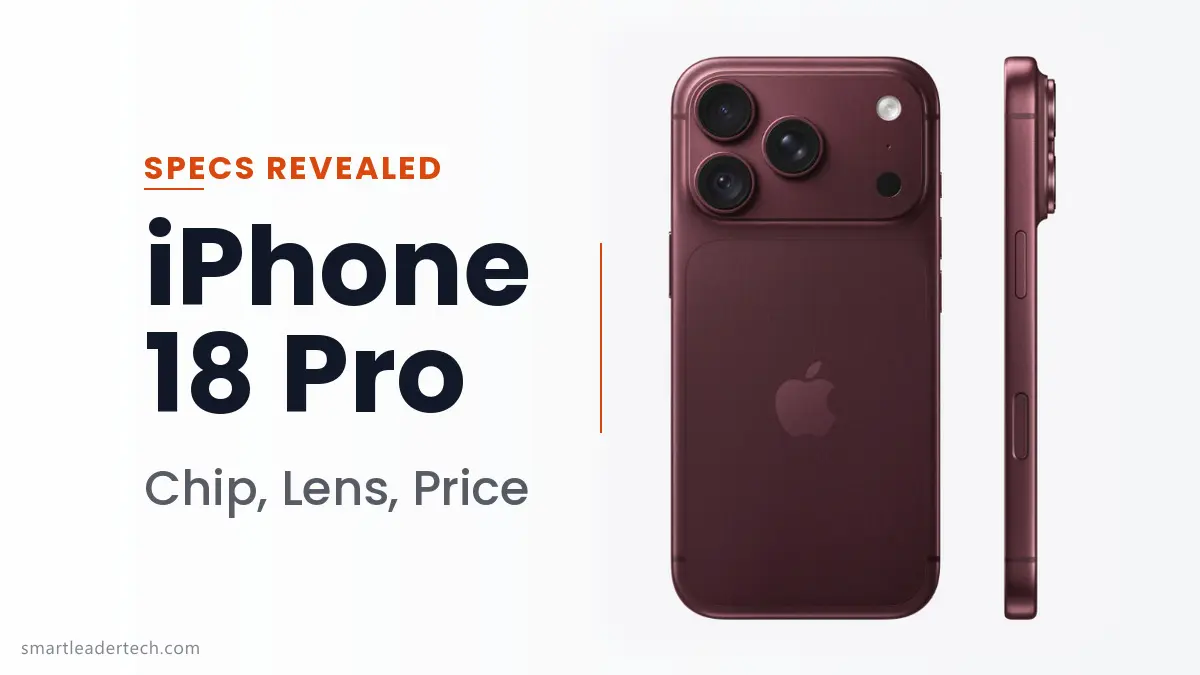
The iPhone 18 Pro is the first iPhone to ship with a 2nm chip and a variable aperture camera.
It looks almost the same as last year’s model, but according to the announcement in the Apple Newsroom, memory bandwidth is up 50 percent, sustained performance improves by up to 40 percent, and the price now starts at $1,199 for 256GB — $100 more than before.
In this article we start with the new features, then go point by point through what changed and what stayed the same compared to the iPhone 17 Pro.
After that we sort out where the announced figures don’t hold up as stated and what’s still unverified, then cover the colors, the price and the release schedule.
📌 Key takeaways
[Officially confirmed]
- A20 Pro chip on a 2nm process, GPU up from 6 to 7 cores
- Main camera aperture variable across four steps, ƒ/1.48 to ƒ/4.0
- Vapor chamber with triple the surface area, weight up 5g to 211g
[What’s new]
- Up to 20 percent faster CPU and up to 40 percent faster GPU, per Apple
- 36 hours of video playback, 3 hours more than the previous generation’s 33
- 50 percent charge in 15 minutes instead of 20, but it takes a 60W adapter
- New 2TB tier, Black returns and Burgundy joins the lineup
[Release date, price and storage]
- Pre-orders opened September 12 at 5 a.m. Pacific, on sale September 18
- $1,199 for 256GB, $100 above the previous generation’s launch price
- Four storage tiers: 256GB, 512GB, 1TB and 2TB
[Still unknown]
- Measured confirmation of the 40 percent sustained performance, still ahead of reviews
- Low-light performance and mechanical durability of the variable aperture
- Real-world battery life, heat and camera image quality
[Bottom line]
If you’re on last year’s model, waiting for the reviews costs you nothing; if you’re on an older generation, there’s enough here.
- 📌 Key takeaways
- 1. iPhone 18 Pro specs: what actually changed?
- 2. iPhone 18 Pro variable aperture: what does it actually do?
- 3. iPhone 17 Pro vs 18 Pro: what's different?
- 4. iPhone 18 Pro colors: what changed?
- 5. iPhone 18 Pro price: how much did it go up?
- 6. iPhone 18 Pro release date and pre-order schedule?
- 💡 FAQ
- ✨ Final thoughts
1. iPhone 18 Pro specs: what actually changed?
Three things changed significantly in the iPhone 18 Pro specs: the chip, the thermal design and the main camera.
The battery and the modem changed too, but by smaller margins.
The display, the telephoto and front cameras and the 12GB of RAM are the same as on last year’s iPhone 17 Pro.
Only storage and price change from one configuration to the next, and the comparisons in this article use 256GB as the baseline.
Here are the iPhone 18 Pro specs item by item, according to Apple.
| Spec | iPhone 18 Pro |
|---|---|
| Chip | A20 Pro, 2nm / 6-core CPU (2 super + 4 efficiency) / 7-core GPU / dual 16-core Neural Engine |
| Display | 6.3-inch, 2,622 × 1,206, 460ppi, 1–120Hz variable refresh rate, always-on |
| Brightness (official) | 1,000 nits typical / 1,600 nits peak HDR / 3,000 nits peak outdoor |
| Cameras | 48MP 24mm variable ƒ/1.48–ƒ/4.0 + 48MP 13mm ƒ/2.2 + 48MP 100mm ƒ/2.8 |
| Battery | 24 hours typical use, 36 hours video playback |
| Charging | Up to 50% in 15 minutes wired / MagSafe and Qi2 up to 25W |
| RAM and storage | 12GB / 256GB, 512GB, 1TB, 2TB |
| Weight and size | 211g / 150.0 × 71.9 × 8.75mm |
| Modem and wireless | Apple C2 / N1, Wi-Fi 7, Bluetooth 6 |
The always-on entry in the display row means the time and your notifications stay visible at low brightness even while the phone is locked and the screen is off.
That feature was already on the previous generation. One line in the iPhone 18 Pro specs table didn’t come from Apple directly.
The 12GB of RAM isn’t in the official specifications — it was read out through developer tools, and it matches the previous generation.
☑️ A20 Pro on 2nm: what’s different?
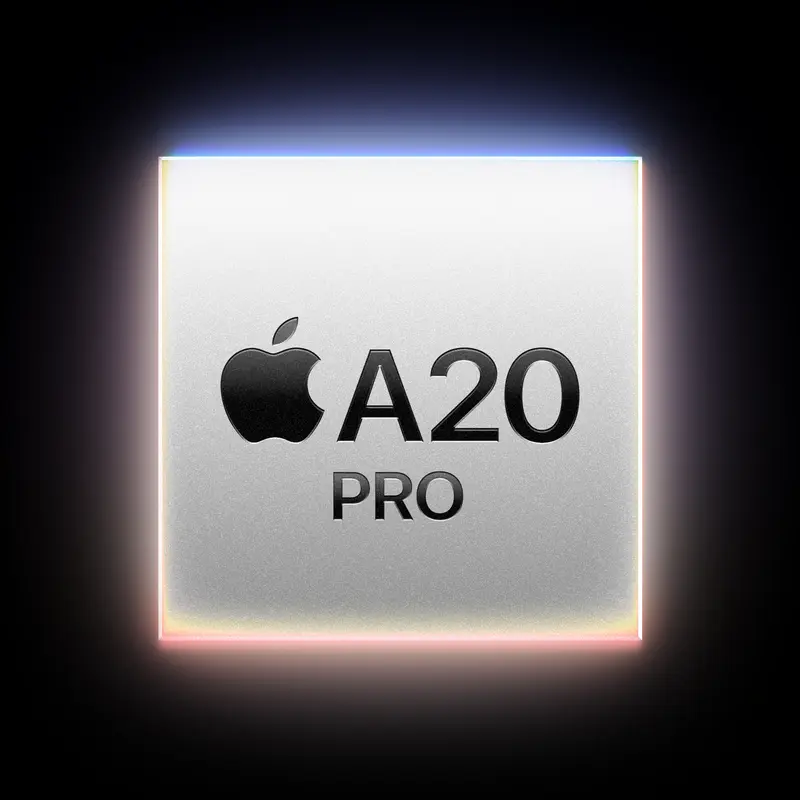
The A20 Pro is the first 2nm chip in an iPhone.
The nanometer figure describes how finely the circuits are etched into the chip: the smaller the number, the more circuits fit into the same area, and the less power they draw.
That headroom is also why the GPU goes from 6 cores to 7, and why the Neural Engine, which handles the AI math, jumps from 16 cores to 32.
The layout inside the chip changed as well. Until now, smartphone chips stacked the memory on top of the processor.
That saves space, but with the memory sitting directly over the processor, the heat coming off the processor has nowhere to go.
The A20 Pro moves the memory next to the processor instead.
That opens a direct path for the heat to escape, and it shortens the distance signals travel between processor and memory.
Memory bandwidth is also up 50 percent over the previous-generation A19 Pro. Where that extra bandwidth shows up most is AI work.
AI models running on the device spend most of their time reading values out of memory over and over, so how fast that read happens decides the speed.
RAM stays at 12GB, the same as the previous generation. What grew isn’t the capacity but the memory bandwidth and the Neural Engine core count.
It’s the same reason HBM, the memory used in AI servers, gets so much attention right now. HBM stacks memory in multiple layers and widens the data paths to push bandwidth up.
Whether it’s the phone in your hand or an AI accelerator in a server room, AI performance comes down to read speed more than capacity.
Here’s how Apple describes the CPU and GPU gains.
The CPU keeps its 6-core layout: 2 super cores for the heavy work and 4 efficiency cores for the light stuff.
The super cores are up to 20 percent faster than on the A19 Pro.
The GPU, along with the extra core noted above, is up to 40 percent faster.
So what about the actual scores?
No outlet has published its own measurements yet, and all that’s available right now are the entries posted to the public Geekbench 6.7.0 database.
| Test | iPhone 18 Pro | iPhone 17 Pro |
|---|---|---|
| Single-core | 4,719 | 3,523–3,895 |
| Multi-core | 12,677 | 8,810–9,746 |
MacRumors, which reported these entries, noted that the values are unverified.
The iPhone 17 Pro has several entries on file, so its score lands as a range, and the gain calculated against it comes out as a span too: 21 to 33 percent single-core, 30 to 44 percent multi-core
The GPU gain runs roughly 38 to 40 percent under Metal, the graphics benchmark, which broadly lines up with Apple’s claim.
Final performance, though, won’t be settled until the reviews land.
☑️ Is the 40 percent sustained performance a measured figure?
![Exploded view of iPhone 18 Pro specs showing the widened vapor chamber stacked above the processor and the memory beside it [AI Concept]](https://smartleadertech.com/wp-content/uploads/2026/09/iphone-18-pro-spec-vapor-chamber-02.webp)
No.
The up-to-40-percent gain in sustained performance is Apple’s own figure, and the benchmarks published so far only measure short bursts of load, so they can’t verify it.
It’s also worth separating the two places 40 percent shows up in the announcement.
One is the 40 percent GPU figure, which compares instantaneous performance between the A20 Pro and the A19 Pro.
The other is 40 percent sustained performance, which compares how long the iPhone 18 Pro and the iPhone 17 Pro hold their performance.
Same number, different thing being measured. What decides sustained performance is the thermal design.
When a chip gets hot it slows itself down, which is called throttling.
The faster the heat gets pulled out, the later that kicks in, and the longer high performance holds.
The improvement comes in two stages.
The memory relocation covered above puts the chip in direct contact with the vapor chamber, and the vapor chamber itself now has three times the surface area of the previous generation.
Apple says it applied a new material but hasn’t disclosed which one.
How effective that design actually is hasn’t been established yet.
The Geekbench run noted above wraps up in a few minutes and can’t capture performance under a long load, and stress test results with extended load aren’t out yet because the reviews haven’t landed.
The weight went up.
The dimensions match the previous generation and the thickness stays at 8.75mm, but the weight climbs from 206g to 211g, 5g heavier.
Whether those 5g come from the larger vapor chamber is unclear.
2. iPhone 18 Pro variable aperture: what does it actually do?
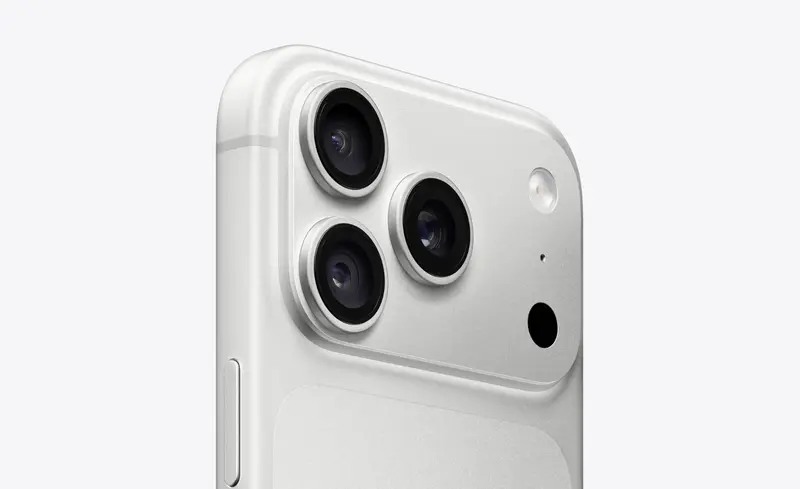
The iPhone 18 Pro variable aperture adjusts the main camera’s aperture to match the shooting situation.
Six blades thinner than a human hair overlap to widen or narrow the opening, moving across four steps from ƒ/1.48 at its widest to ƒ/4.0 at its narrowest.
The aperture is the opening that controls how much light comes through the lens. Open it wide and more light gets in, which helps in the dark and blurs the background.
Stop it down and less light gets through, but everything from the near subject to the distant background comes out evenly sharp.
That blurred background you get from opening the aperture wide is called bokeh. Until now, that opening was fixed on the iPhone.
The main camera on last year’s iPhone 17 Pro could only shoot at ƒ/1.78, so the amount of light had to be managed with shutter speed and ISO.
At the widest setting of ƒ/1.48, about 1.45 times more light comes in than at the previous generation’s ƒ/1.78.
Apple says low-light shots under those conditions come out about 50 percent better than on the previous generation.
That figure hasn’t been verified yet. For context, the variable aperture camera itself isn’t a new idea.
The Galaxy S9 and S10 switched between two steps, ƒ/1.5 and ƒ/2.4, before the S20 dropped it, and Xiaomi has shipped a model adjustable from ƒ/1.63 to ƒ/4.0.
It’s a first for the iPhone, not for the smartphone.
☑️ Four aperture steps: how good is the manual control?
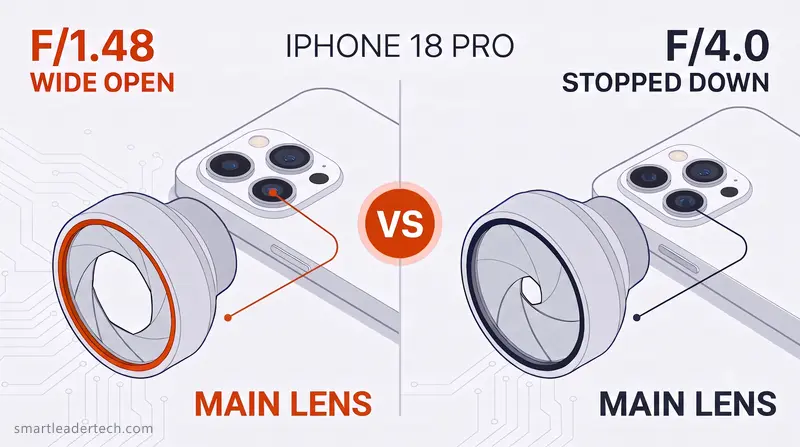
The aperture that was locked to a single value through the previous generation now has four steps.
It moves between ƒ/1.48, ƒ/1.8, ƒ/2.8 and ƒ/4.0.
By default the camera picks one to suit the scene, and you can set it yourself if you want.
It isn’t continuous, though.
Unlike shutter speed or ISO, it doesn’t adjust in fine increments — it only moves between those four fixed steps.
Only the main camera is affected.
The 13mm ultra wide stays fixed at ƒ/2.2 and the 100mm telephoto at ƒ/2.8, both unchanged.
Manual camera controls are new on the iPhone 18 Pro as well.
In the stock Camera app you can set aperture, shutter speed and white balance yourself, and there’s a histogram to check your exposure by eye.
The aperture is one piece of that. It isn’t that the aperture arrived on its own — a whole set of manual shooting tools showed up at once.
Through the previous generation you needed a separate app for this kind of control. The manual controls apply to the front camera too.
☑️ Variable aperture: the hands-on verdicts split
Opinions on the effect of the iPhone 18 Pro variable aperture split on the floor at the announcement event.
The sticking point was the difference in background blur.
Tom’s Guide shot a drinking glass at two apertures and reported a clearly different background blur.
Engadget, shooting a light fixture in the same space, saw only the shape of the light flare change and found the difference in background blur hard to make out, holding off on a verdict until it could use an actual device.
Both assessments came out of a demo lasting a few dozen minutes.
On top of that, the demo ran indoors only, so low-light shooting — the whole point of this feature — couldn’t even be attempted.
Sensor size is a variable too.
The smaller the sensor, the less the aperture affects background blur, and Apple didn’t disclose the sensor size this time around.
There are durability concerns as well.
With blades thinner than a hair and moving parts inside a device you carry every day, the worry that this adds one more point of failure surfaced right after the announcement.
Apple says it chose a blade material with durability in mind, but no endurance test results have been released.
Personally, I see manual control landing in the stock Camera app as a bigger change than the four aperture steps.
The aperture effect still has to be verified, while shutter speed and a histogram are things you previously needed a separate app to get.
3. iPhone 17 Pro vs 18 Pro: what’s different?
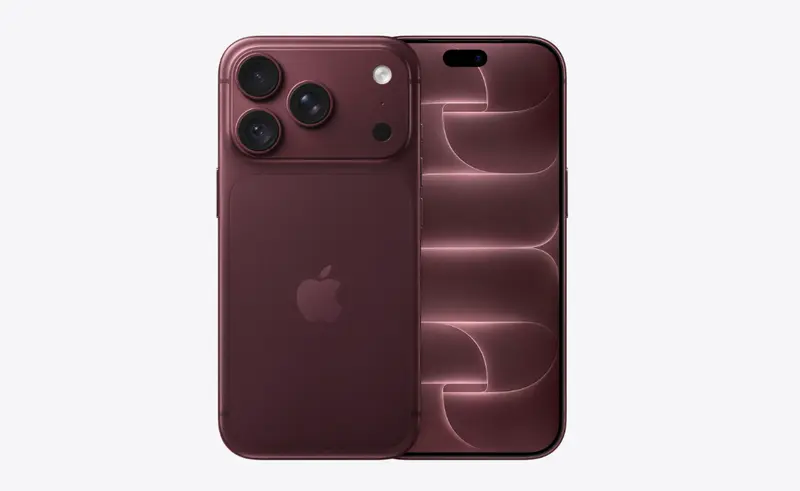
Narrow the iPhone 17 Pro vs 18 Pro comparison down to what ties directly to performance and five things changed: the chip, the thermals, the main camera, the battery and the modem.
On top of that there are the visible changes — a smaller Dynamic Island and a reworked color lineup — plus a storage ceiling that rises to 2TB.
The Dynamic Island is the black area at the top of the screen where ongoing tasks like music playback or a timer sit.
It got smaller this year, and the number of items it can show at once went from two to three.
Here’s the iPhone 17 Pro vs 18 Pro comparison item by item.
| Spec | iPhone 17 Pro | iPhone 18 Pro |
|---|---|---|
| Chip | A19 Pro, 3nm / 6-core GPU | A20 Pro, 2nm / 7-core GPU |
| Main camera | 48MP, fixed ƒ/1.78 | 48MP, variable ƒ/1.48–ƒ/4.0 |
| Dynamic Island | 2 Live Activities | Smaller, 3 Live Activities |
| Video playback | 33 hours | 36 hours |
| Wired charging | 40W and up, 50% in 20 minutes | 60W class, 50% in 15 minutes |
| Modem | Qualcomm | Apple C2 |
| Weight | 206g | 211g |
| Storage | 256GB–1TB | 256GB–2TB |
| Colors | 3 | 4 |
| Official price (256GB) | $1,099 | $1,199 |
The previous-generation price in the table above is the September 2025 launch price.
The iPhone 17 Pro was discontinued when the iPhone 18 Pro was announced and is no longer sold at the Apple Store.
The modem switches from Qualcomm to Apple’s own C2.
Apple says it uses 15 percent less energy, but the comparison there is against the C1X, Apple’s earlier modem that debuted in the iPhone Air.
That isn’t a comparison against the Qualcomm modem in the previous-generation iPhone 17 Pro, and the improvement over that model hasn’t been disclosed.
☑️ What stayed the same?
The display, two of the three camera lenses and the RAM capacity carry over from the previous generation. More stayed the same than changed.
Here’s what didn’t change.
- Display — 6.3-inch, 460ppi, 1–120Hz, up to 3,000 nits peak outdoor
- Ultra wide, telephoto and front cameras — no spec changes. The front camera only gains manual control
- RAM — 12GB (bandwidth up 50 percent)
- Wireless charging — MagSafe and Qi2 up to 25W
- Size and thickness — 150.0 × 71.9 × 8.75mm
- Durable materials — aluminum unibody, Ceramic Shield 2 up front
Personally, I’d say that if you’re on an iPhone 17 Pro, the only reason to switch is the main camera.
The chip gets faster every generation, and setting aside the move to 2nm it lands inside the expected range; the thermal improvement is the kind of thing you can’t feel until the numbers are in.
The display hasn’t changed at all beyond the smaller Dynamic Island.
☑️ Battery and charging: what improved?
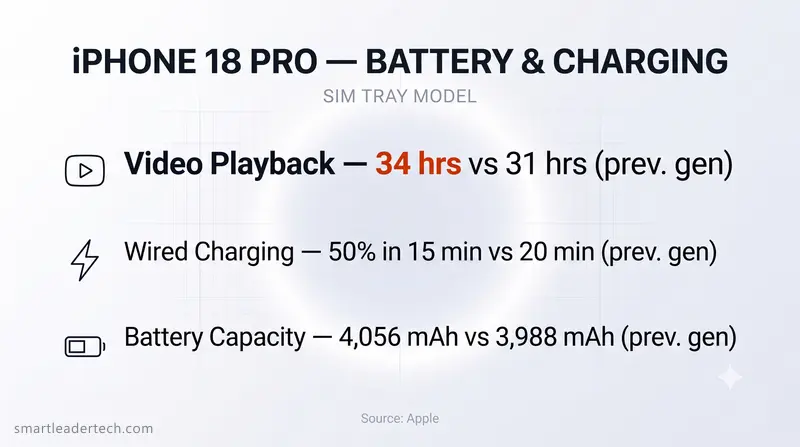
Video playback goes from 33 hours to 36, a 3-hour gain.
That’s a figure Apple measured under its own conditions.
Apple doesn’t put battery capacity in the spec sheet, though, so there’s no way to check how much of that gain comes from a bigger cell.
Where the extra hours come from, Apple doesn’t say.
Apple publishes three battery figures.
| Metric | iPhone 18 Pro | iPhone 17 Pro |
|---|---|---|
| Typical use | 24 hours | — |
| Video playback | 36 hours | 33 hours |
| Video playback (streamed) | 33 hours | — |
The footnotes on Apple’s site show that video playback and streaming are measured by looping a movie, while typical use mixes calls and app usage.
Line the three numbers up against each other and the baselines don’t match.
Only one figure, video playback, is comparable to the previous generation, so how much the battery actually improves in daily use will take independent measurements to establish.
Battery specs split by region.
The eSIM-only model, sold in 12 regions, uses the space the SIM tray would take for the battery instead, which buys 2 extra hours of video playback.
Size and weight are listed identically for both versions. There’s nothing to tell them apart from the outside; only the internal layout differs.
The model on sale here is the eSIM-only one, not the version with a SIM tray. So the 36 hours is the figure that applies to the phone you’d actually buy.
The 34 hours that turns up in coverage from other markets is the SIM-tray model’s number.
Charging hits 50 percent in 15 minutes, 5 minutes faster than the previous generation.
In exchange, the adapter requirement went up.
The previous generation reached 50 percent in 20 minutes with 40W or more; this is the first time an iPhone has called for a 60W adapter spec.
The power adapter isn’t included with the phone, and Apple hasn’t announced a price for it yet.
4. iPhone 18 Pro colors: what changed?
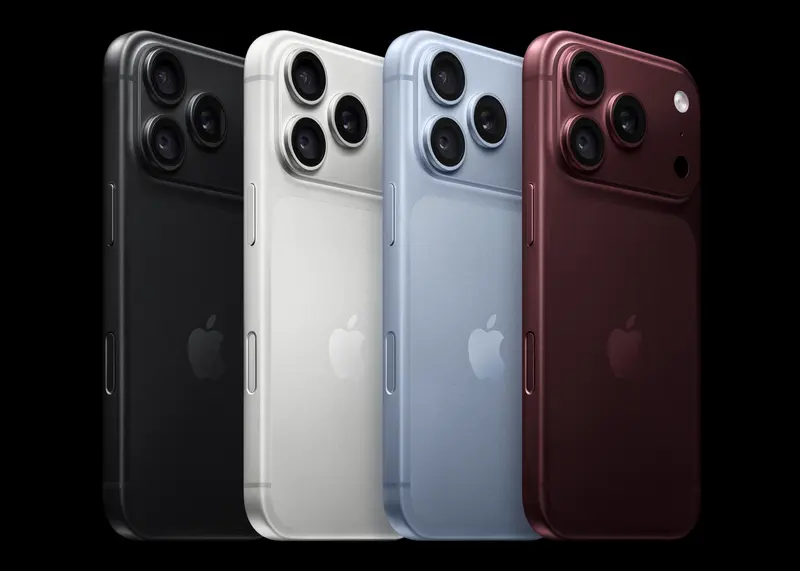
The iPhone 18 Pro colors are Black, Silver, Glacier and Burgundy — one more than the previous generation.
Silver is the only one carried over from the iPhone 17 Pro, and Black is back after a year away.
- Black — back in the Pro line after a year
- Silver — the only color name carried straight over from the previous generation
- Glacier — a pale blue, new
- Burgundy — a dark cherry red, new
More noticeable than the color names is the finish on the back.
The aluminum frame and the rear glass are matched in color, so the seam where the two materials meet stands out less.
MacRumors described that as a departure from the previous generation, where the rear glass alone looked lighter than the frame.
All four iPhone 18 Pro colors are sold in every storage tier from 256GB up to 2TB.
5. iPhone 18 Pro price: how much did it go up?
The iPhone 18 Pro price is $1,199 for 256GB.
That’s $100 more than the $1,099 the previous-generation iPhone 17 Pro launched at in September 2025.
As a percentage, that works out to a 9.1 percent increase.
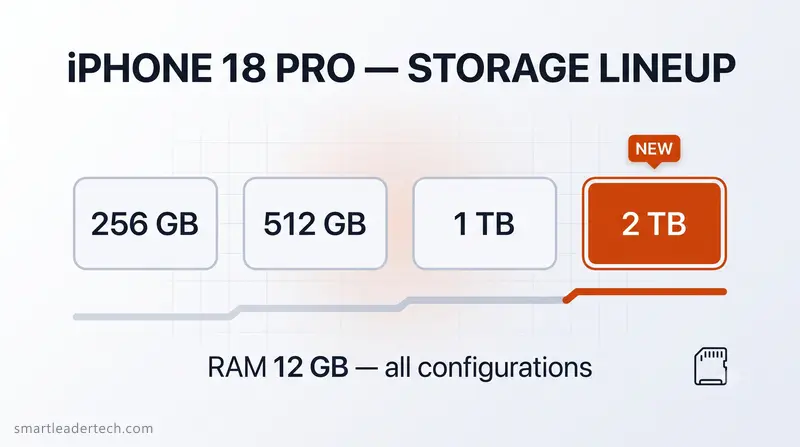
| Storage | Official price |
|---|---|
| 256GB | $1,199 |
| 512GB | $1,399 |
| 1TB | $1,799 |
| 2TB | $2,399 |
What stands out about this price list is that the increase isn’t the same across configurations.
The 256GB tier went up $100, while the 1TB tier jumped $300, from $1,499 to $1,799.
The 512GB tier went up $100 like the entry configuration, so the bigger jump lands on the 1TB step alone.
The 2TB tier is new this year.
On the previous generation the 6.3-inch Pro stopped at 1TB and 2TB was exclusive to the Pro Max.
The top configuration goes from $1,499 to $2,399.
Apple hasn’t given a reason for the increase. Some analyses point to rising memory costs, but that stays a guess.
Personally, I’d point out that the iPhone 18 Pro price widens by $200, then $400, then $600 with each step up in storage, so the burden ramps up fast at the top end.
Since you can’t add storage to an iPhone later, a higher configuration only makes sense if you genuinely need the space — video work, for instance.
Final pricing may vary by retailer and available promotions. If the iPhone 18 Pro price feels like a stretch, the standard iPhone 17 is worth a look too.
☑️ The price gap with the Galaxy S26 Ultra
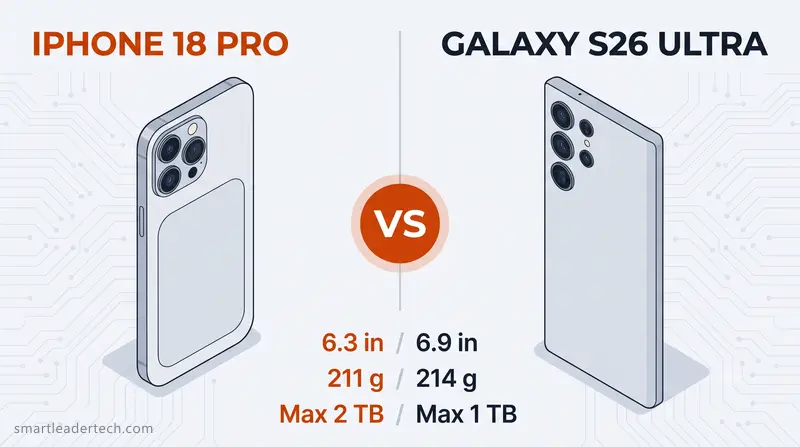
The Galaxy S26 Ultra in 256GB sells for $1,299.
The iPhone 18 Pro in the same configuration is $1,199, which puts it $100 below the Galaxy.
On price alone, then, the iPhone 18 Pro is the cheaper of the two at the baseline configuration.
The two do have different screen sizes, though: 6.3 inches against 6.9.
The Galaxy S26 Ultra sits closer to the iPhone 18 Pro Max, which is in the same 6.9-inch class.
Even so, the weights are nearly identical at 211g and 214g, and the storage ceiling is 2TB on the iPhone against 1TB on the Galaxy.
Performance and camera image quality can’t be compared yet, since no independent measurements for the iPhone 18 Pro have been published.
6. iPhone 18 Pro release date and pre-order schedule?
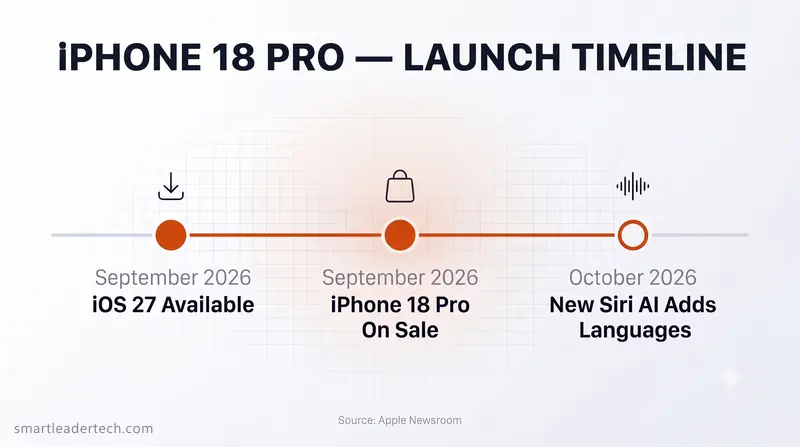
The iPhone 18 Pro release date is September 18, and pre-orders opened on September 12.
You’re in the first launch wave, along with more than 65 other countries. Per the announcement in the Apple Newsroom, pre-orders opened at 5 a.m. Pacific on September 12.
A second wave follows on September 25 across 20 countries. That list hasn’t been published.
iOS 27 ships September 14 as a free update.
That’s four days ahead of the iPhone 18 Pro release date, and the phone comes with that version already installed.
☑️ When can you start using the new Siri AI?
The iPhone 18 Pro supports the new Siri AI, and the English version is there from launch day — there’s no waiting.
Apple had been running Siri AI in English only, and plans to widen it to French, Japanese, Portuguese and Spanish sometime in October.
What arrives alongside iOS 27 on September 14 is the English version. It’s worth separating this from Apple Intelligence.
Apple Intelligence is the umbrella name for the AI features as a whole, things like photo editing and image generation, while Siri AI is the rebuilt version of the Siri voice assistant inside it.
Apple Intelligence supports 16 languages from September 14, so it works in English from launch day as well.
To sum up, there’s nothing on the AI side you’ll be waiting on — both the new Siri AI and the wider Apple Intelligence features work in English from day one.
The new Siri AI does have a daily usage cap, and Apple has said it will charge for anything beyond that.
The amount hasn’t been announced.
💡 FAQ
Q1. I’m using an iPhone 17 Pro — is the iPhone 18 Pro worth switching to?
It comes down to whether you need the variable aperture. The display, the ultra wide, telephoto and front cameras, the RAM and the size all carry over, so outside the main camera there’s no visible difference.
The chip and the thermals changed a lot, but with no measurements out there’s no way to gauge how much you’d feel it. If photography isn’t a big part of what you do, skipping this generation costs you nothing.
Q2. Is the iPhone 18 Pro really rated for 36 hours of video playback?
It is. That rating covers the eSIM-only model, which is the version sold here, along with 24 hours of typical use and 33 hours of streamed video.
If you’ve seen 34 hours in coverage from abroad, or in a piece that picked it up from there, that’s the figure for the SIM-tray model, not the one sold here.
✨ Final thoughts
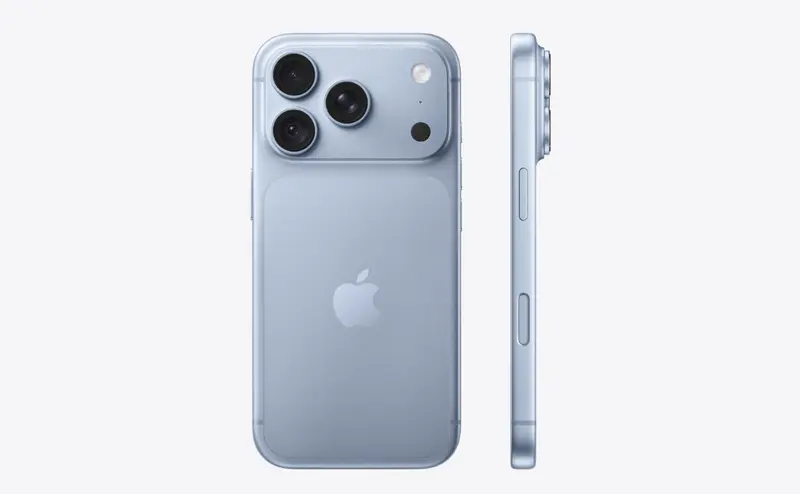
The iPhone 18 Pro changed more on the inside than the outside.
The 2nm A20 Pro, a vapor chamber with triple the surface area and a variable aperture main camera are all new.
On the other side, the display, the other two cameras and the RAM carry over from the previous generation, and the exterior is hard to tell apart unless you set the two side by side.
What’s settled so far stops at the official specs.
Both the 40 percent sustained performance and the low-light performance of the variable aperture will take reviews to judge.
If you’re on last year’s model, there’s not much reason to rush and pay $100 more; if you’re moving up from an iPhone 15 Pro or earlier, the jump is big enough.
Are you planning to jump to this generation?
Drop your thoughts below 🚀