
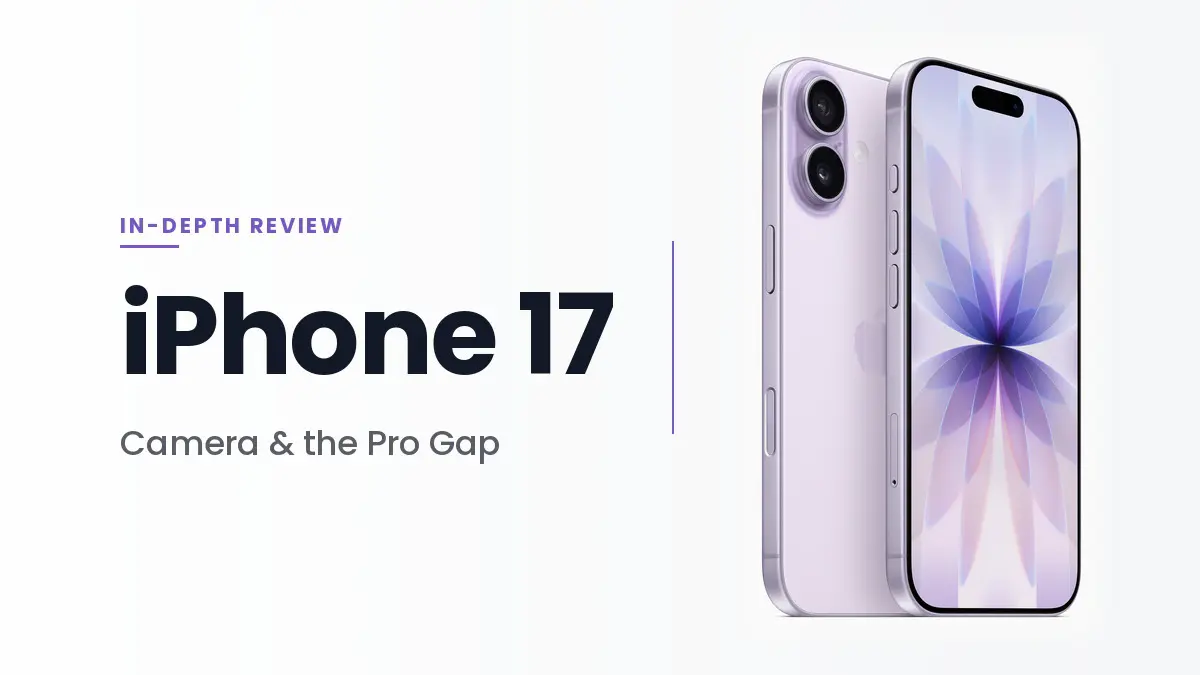
The iPhone 17 was the best-selling smartphone in the world in Q1 2026.
In Counterpoint Research‘s tally it took the top spot with a 6% share of sales, and the iPhone 17 series swept all three leading positions.
A non-Pro model taking first place is unusual.
It happened because most of the display and camera gap with the Pro has disappeared — though not all of it.
In this article we check the iPhone 17’s specs and camera against measured data, sorting what has closed on the Pro from what still hasn’t.
From there we walk through the generational changes, battery and charging, official pricing, and the other items you need to make the call.
ℹ️ This post contains informational images based on official specs as well as concept images created with AI. Concept images may differ from the actual product.
📌 Key Takeaways
[Price] 256GB $799 / 512GB $999
[Key Specs] 6.3-inch 120Hz, 3,692mAh, dual 48MP rear, 256GB base
[Pros]
- First base model with the same 120Hz display as the Pro
- Time and notifications stay visible with the screen off
- Ultra Wide camera bumped to 48MP, matching the Pro
- Base storage doubled to 256GB
[Cons]
- No physical telephoto lens — 2x is a sensor crop
- No vapor chamber, so it throttles under long loads
- USB transfer stuck at 480Mb/s for a third generation
[Verdict] Unless you genuinely need telephoto, the base model is enough.
- 📌 Key Takeaways
- 1. iPhone 17 Specs: The Short Version First
- 2. iPhone 17 Camera: What Actually Changed?
- 3. iPhone 17 Pro Difference: How Far Has the Gap Closed?
- 4. iPhone 16 vs 17: The Generational Changes
- 5. iPhone 17 Battery and Charging: Any Better?
- 6. iPhone 17 Colors: Five Choices
- 7. iPhone 17 Price: Where $799 Sits
- 💡 FAQ
- ✨ Wrapping Up
1. iPhone 17 Specs: The Short Version First
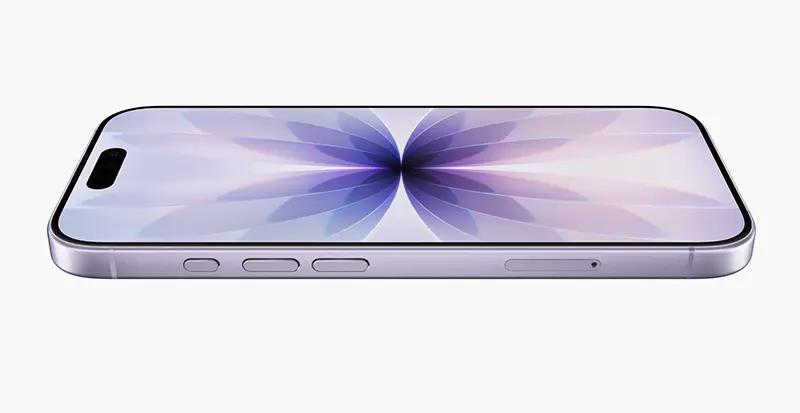
The thing to get straight about the iPhone 17 specs is which items are a first for any iPhone and which are a first for the base model.
First for any iPhone
- Square front sensor — you can switch between vertical and horizontal shots without rotating the phone.
- Ceramic Shield 2 — a front glass coating Apple designed in-house, improving scratch resistance and anti-reflection together. Unlike the Pro, it isn’t applied to the back
- N1 wireless chip — Apple replaced a sourced wireless chip with its own design. Bluetooth moves from 5.3 to 6, and Apple says AirDrop and hotspot stability improved
First for the base model
- ProMotion 120Hz — the refresh rate shifts between 1 and 120Hz depending on what’s on screen. Fast-moving content like scrolling gets a higher rate to look smooth, and when it isn’t needed the rate drops to save power
- Always-On display — with the screen off and locked, time and notifications stay readable at low brightness. Until now this was a Pro-only feature
- 48MP Ultra Wide — the Ultra Wide goes from 12MP to 48MP, so both rear cameras are now 48MP
The first three are new technology Apple added this year; the last three are Pro specs handed down.
On that square front sensor, a bit more detail: front camera sensors used to be rectangular.
Because the two sides differed in length, holding the phone vertically gave you a vertical photo, and getting a horizontal one meant turning the phone sideways.
The sensor’s aspect ratio decided the shooting orientation.
A square sensor is equal on both sides. So all that’s left to decide is which region inside the sensor to crop.
A horizontal shot keeps the width and trims the top and bottom; a vertical shot keeps the height and trims the sides.
The result is that you can capture both orientations with a setting on screen instead of turning the phone.
The field of view also widens on its own depending on how many people are in frame. With a group, everyone fits without a selfie stick or a switch to Ultra Wide.
Here are the main iPhone 17 specs at a glance.
| Item | iPhone 17 |
|---|---|
| Chipset | A19, 6-core CPU / 5-core GPU, TSMC 3rd-gen 3nm |
| Display | 6.3-inch 2,622×1,206, LTPO OLED, 1–120Hz, Always-On |
| Brightness (official) | 1,000 nits typical / 1,600 nits HDR / up to 3,000 nits outdoor peak |
| Cameras | 48MP F1.6 main + 48MP F2.2 Ultra Wide / 18MP F1.9 front |
| Battery & charging | 3,692mAh (unofficial reading) / MagSafe·Qi2 wireless 25W |
| Storage | 256GB / 512GB |
| Materials | Ceramic Shield 2 / aluminum frame / color-infused glass |
| Modem | Qualcomm Snapdragon X80, mmWave supported |
| Wireless | N1 in-house chip, Wi-Fi 7 · Bluetooth 6 |
One note on that battery figure: Apple didn’t publish it.
The official spec sheet lists no mAh at all, only up to 30 hours of video playback, and 3,692mAh is a reading pulled from the EU energy label.
☑️ How Bright Is the iPhone 17 Display?
Apple lists three figures, but the one that actually holds for any length of time is the 1,000-nit typical auto brightness.
The 3,000-nit number applies to part of the screen outdoors, and only for a moment.
| Measure | Official (iPhone 17) | iPhone 17 measured | iPhone 17 Pro | Galaxy S26 |
|---|---|---|---|---|
| Manual max | — | 824 nits | 818 nits | 751 nits |
| Auto sustained | 1,000 nits | 1,012 nits | 1,012 nits | 1,383 nits |
| Momentary peak | HDR 1,600 nits / outdoor partial 3,000 nits | Over 1,700 nits (about 2 sec) | — | 2,552 nits (10% patch) |
All three devices were measured by GSMArena using the same method.
The Pro is effectively identical, and Samsung’s Galaxy S26 leads on auto sustained brightness.
On paper it’s 50% brighter than last year’s model, but the brightness you actually live with sits around 1,000 nits.
GSMArena flagged that this measured lower than the previous generation, while noting that the anti-reflective coating applied as standard made outdoor use perfectly workable.
☑️ How Much Faster Is the A19?
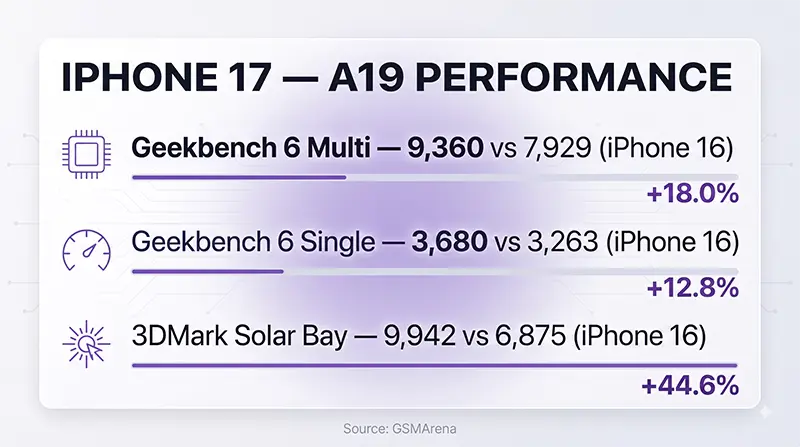
On Geekbench 6 it’s up 12.8% single-core and 18.0% multi-core over the previous generation.
Same outlet, same version, so the gain reads straight across.
| Geekbench 6 | iPhone 17 | iPhone 16 | iPhone 17 Pro | Galaxy S26 |
|---|---|---|---|---|
| Single-core | 3,680 | 3,263 | 3,846 | 2,995 |
| Multi-core | 9,360 | 7,929 | 9,923 | 10,824 |
The interesting part is the gap to the Pro.
The Pro runs an A19 Pro with one extra GPU core, yet the CPU scores differ by just 4.3% single and 5.7% multi.
On CPU alone, that’s not enough of a gap to separate tiers within the same generation.
Against the Galaxy S26, the results split.
It’s 22.9% ahead on single-core but 13.5% behind on multi-core.
For context, single-core drives snappiness — web loading, app launches — while multi-core matters when you’re running several things at once.
The GPU gap is wider.
| 3DMark | iPhone 17 | iPhone 16 | iPhone 17 Pro |
|---|---|---|---|
| Wild Life Extreme | 4,803 | 4,295 | 5,868 |
| Solar Bay (ray tracing) | 9,942 | 6,875 | 11,877 |
Ray tracing performance jumped the most.
It calculates light bounces and shadows close to how they behave in reality, and it’s where the realism of a game’s visuals is decided.
That’s a 44.6% gain over the previous generation — enough to pass A18 Pro, last year’s Pro chip, despite having one fewer GPU core.
The GPU difference against the iPhone 17 Pro comes down to core count.
Five cores versus six shows up as 18.1% in Wild Life Extreme, which measures general graphics performance.
☑️ What About Heat and Sustained Performance?
![Exploded isometric view of the iPhone 17 with arrows tracing heat moving from the A19 chip out to the aluminium frame [AI Concept]](https://smartleadertech.com/wp-content/uploads/2026/08/iphone-17-thermal-exploded-view-03.webp)
The iPhone 17 doesn’t have the vapor chamber the Pro got.
The prevailing criticism is that it therefore loses more performance under sustained load — though that isn’t always true depending on the test.
On the Pro, the vapor chamber sits over the A19 Pro and passes heat out to the whole aluminum frame.
With heat spread rather than pooled in one spot, performance holds longer.
The base model, by contrast, carries over the previous generation’s thermal design.
GSMArena judged that the A19 runs hot enough under GPU load in particular to give up a large chunk of its performance, adding that the back gets uncomfortably hot to hold.
No specific figures were published, though.
PhoneArena‘s testing had the Pro holding 65–70% stability in the 3DMark stress test, with the base model throttling sooner.
There’s a measurement pointing the other way, too.
In the 20-minute Solar Bay Extreme run compiled by Notebookcheck, the iPhone 17 held 66.2% against the Pro’s 61.4% — the base model came out higher.
The consensus favors the Pro on GPU performance, but the complaint about surface heat shows up across multiple outlets.
Personally, if you’re not gaming for long stretches, I’d call this difference safe to ignore.
2. iPhone 17 Camera: What Actually Changed?
![Partial reveal close-up of the iPhone 17 camera housing with the lower 48MP ultra wide lens lit in lavender [AI Concept]](https://smartleadertech.com/wp-content/uploads/2026/08/iphone-17-camera-ultrawide-48mp-04.webp)
What changed on the iPhone 17 camera is the rear Ultra Wide and the front selfie camera.
The Ultra Wide went from 12MP to 48MP, putting both rear cameras at 48MP, and the front swapped in an 18MP square sensor.
The main camera hardware is unchanged.
| Module | iPhone 17 | iPhone 16 |
|---|---|---|
| Main | 48MP F1.6, 26mm | 48MP F1.6, 26mm |
| Ultra Wide | 48MP F2.2, 13mm | 12MP F2.2, 13mm |
| Telephoto | None (2x main sensor crop) | None (2x crop) |
| Front | 18MP square sensor | 12MP |
GSMArena noted that the main camera is built on the same Sony IMX904 used in the iPhone 16 and 15 with an identical lens setup, meaning improvements have landed on the Ultra Wide alone for two years running.
☑️ What the 48MP Ultra Wide Really Delivers
The pixel count quadrupled, but the dominant view is that the results didn’t improve nearly as much.
Fine detail and dynamic range are both still called weak.
In low light especially, missing detail and noise show up together, making this the weakest of the three lenses.
The area that drew the best reviews is macro.
The Ultra Wide module handles close-range shooting, and both detail and color are called impressive there.
Put simply, the Ultra Wide’s pixel bump means more for macro than it does for the quality of wide shots.
☑️ The 2x Telephoto Isn’t Optical
Apple calls it 2x telephoto with optical quality, but what actually happens is a 12MP crop from the center of the 48MP main sensor to look like 2x.
There is no physical telephoto lens. Opinions split on that wording.
DPReview criticized “optical quality” as evoking a real zoom lens when it amounts to a crop using only the sensor’s central pixels.
On the other hand, DXOMARK‘s measurements of the Pro model rated crop quality well through the 2x range, with detail falling off past 2x.
So the crop approach works up to around 2x and breaks down beyond it.
The problem is that the base model has no lens to take over above that, so anything past 2x is straight into digital zoom territory.
☑️ How Is Video Recording?
Video is where the iPhone 17 draws the most consistently strong reviews.
Main-camera 4K footage is rated top-tier on detail, dynamic range, and color accuracy alike.
Dual Capture also arrived in the stock Camera app.
It records the front and rear cameras at the same time, saving one video with the front feed laid over the rear footage in a small window.
There are limits.
Only Apple’s single layout is available, so you can’t enlarge the front window or switch to a split screen, and while the Pro can swap between three rear lenses mid-recording, the base model has no telephoto and gets two.
Shooting 4K 60fps comes with a condition.
You have to set the capture format to High Efficiency (HEVC); it isn’t supported under Most Compatible (H.264).
The trade-off is that HEVC footage needs the matching codec on whatever plays it.
Most recent phones handle it, but an older PC or certain editing software may lack the codec, leaving the file unplayable or uneditable.
3. iPhone 17 Pro Difference: How Far Has the Gap Closed?
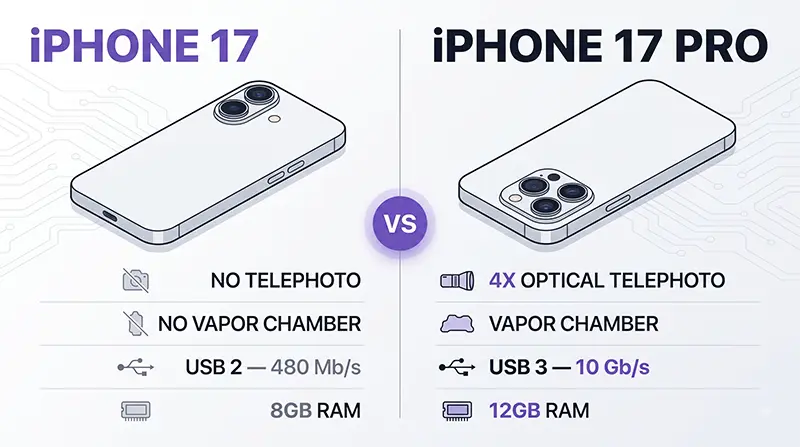
With this generation, the iPhone 17 matches the Pro on display, Ultra Wide, front camera, and base storage.
What’s left is four items: the telephoto lens, thermals, wired transfer speed, and editing formats like ProRes.
The two phones are closer this generation than they’ve ever been, and the real differentiators have narrowed to telephoto and price.
Thermals, transfer speed, and editing formats only become a problem for specific usage patterns.
☑️ Where the iPhone 17 Matches the Pro
Gather up the items that are identical or negligibly different and you get this.
- Display — 6.3-inch, 120Hz ProMotion, Always-On, and identical brightness claims, with measurements effectively the same
- Ultra Wide and front cameras — understood to be the same modules, with the improved 48MP Portrait processing applied to both
- CPU — 4.3% single and 5.7% multi on Geekbench 6
- Base storage — both start at 256GB
☑️ The Gaps That Remain — iPhone 17 Pro Difference
What’s left are hardware gaps that no software update will close.
| Gap | iPhone 17 | iPhone 17 Pro |
|---|---|---|
| Telephoto | None (2x sensor crop) | 48MP 4x optical, 8x extended |
| Thermals | No vapor chamber | Vapor chamber |
| Wired transfer | USB 2, up to 480Mb/s | USB 3, up to 10Gb/s |
| RAM | 8GB | 12GB |
| Editing formats | Not supported | ProRAW·ProRes·Log |
| Back glass | Strengthened glass | Ceramic Shield 2 |
Moving files to a PC over USB-C is roughly a 20x difference in speed.
In practical terms that’s about 60MB/s on USB 2 versus about 1,250MB/s on USB 3 — a gap you feel immediately if you shuttle 4K footage often.
☑️ Is $300 More Worth It?
The gap between the base model and the Pro is $300.
What that buys you is five things: the telephoto lens, editing formats, the thermal design, faster wired transfer, and 12GB of RAM.
Personally, I’d say the Pro only makes sense when at least two of those five genuinely apply to you.
Unless you shoot distant subjects often, game for long sessions, and move large video files to a PC regularly, it’s hard to build a case for spending the extra $300.
The base model outselling the Pro line in Q1 2026 looks like that same calculation playing out.
4. iPhone 16 vs 17: The Generational Changes
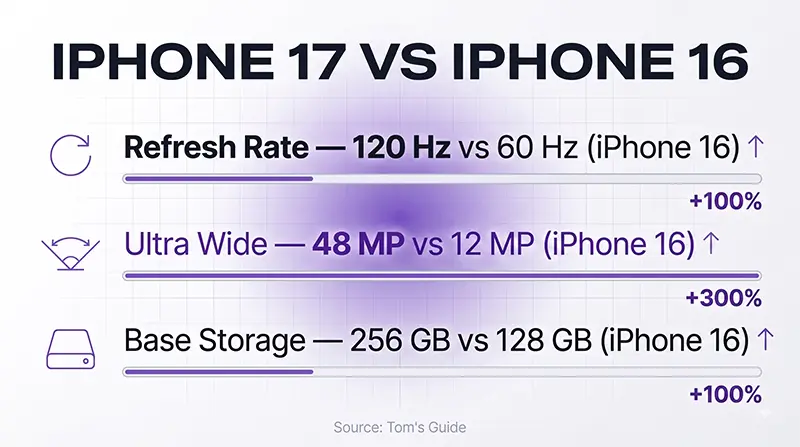
The iPhone 17 is a generation with a lot of change in it.
The refresh rate doubled, Ultra Wide resolution quadrupled, and base storage doubled.
Here are the nine items that changed.
| Item | iPhone 16 | iPhone 17 | Change |
|---|---|---|---|
| Display | 6.1-inch, fixed 60Hz | 6.3-inch, 1–120Hz | Up to 2x refresh rate |
| Outdoor peak brightness | 2,000 nits | 3,000 nits | +50% |
| Ultra Wide | 12MP | 48MP | 4x resolution |
| Front | 12MP | 18MP square | +50% pixels |
| Official playback time | Up to 22 hours | Up to 30 hours | +8 hours |
| Battery capacity (unofficial) | 3,561mAh | 3,692mAh | +3.7% |
| Wired charging (official) | 50% in 30 min with 20W+ adapter | 50% in 20 min with 40W+ adapter | One-third less time |
| Front glass | Ceramic Shield | Ceramic Shield 2 | 3x scratch resistance (official) |
| Base storage | 128GB | 256GB | 2x |
The generational comparison follows the breakdown compiled by Tom’s Guide.
Personally, four of these strike me as the meaningful ones: the 120Hz display, double the base storage, the Ultra Wide improvement, and faster charging.
Look at the generational change through price and it’s cleaner still: the iPhone 17 launched at the same $799 as the iPhone 16 while doubling base storage, which makes it a price cut in practice.
Those are launch prices, and the iPhone 16 was reduced when the iPhone 17 arrived.
5. iPhone 17 Battery and Charging: Any Better?
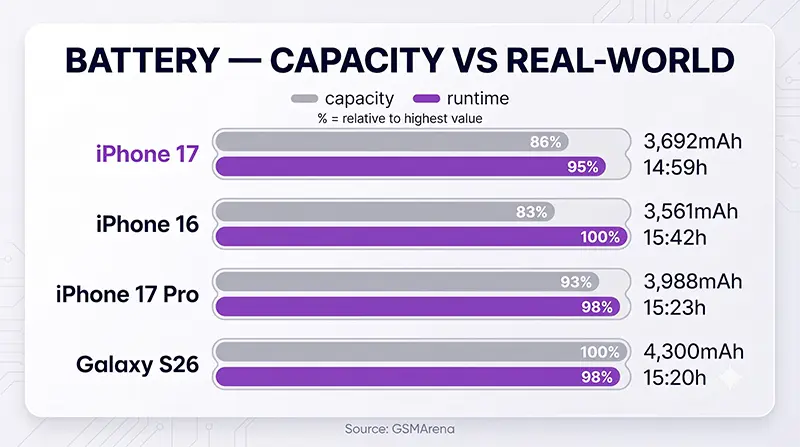
The iPhone 17 battery is 3,692mAh, up 3.7% over the previous generation.
Apple doesn’t publish battery capacity, so that figure comes from EU certification filings.
Measured mixed-use time, though, came in 43 minutes shorter than the previous generation, while a full charge got 17 minutes faster.
| Metric | iPhone 17 | iPhone 16 | iPhone 17 Pro | Galaxy S26 |
|---|---|---|---|---|
| Mixed-use measured | 14:59h | 15:42h | 15:23h | 15:20h |
| Battery capacity | 3,692mAh | 3,561mAh | 3,988mAh | 4,300mAh |
These are GSMArena‘s results from a mix of calls, web browsing, video playback, and gaming.
All four devices were measured the same way and set side by side. The reason capacity went up while runtime went down is the display.
The new high refresh rate shortened web browsing endurance, while the gaming and video segments are measured at 60Hz and so aren’t much affected.
Against the iPhone 17 Pro and the Galaxy S26, the differences sit inside 2–3%.
Of the three, it has the smallest battery and still comes out effectively even on measured runtime.
Apple’s official 30 hours of video playback is measured on a different basis and can’t be read alongside those numbers.
6. iPhone 17 Colors: Five Choices
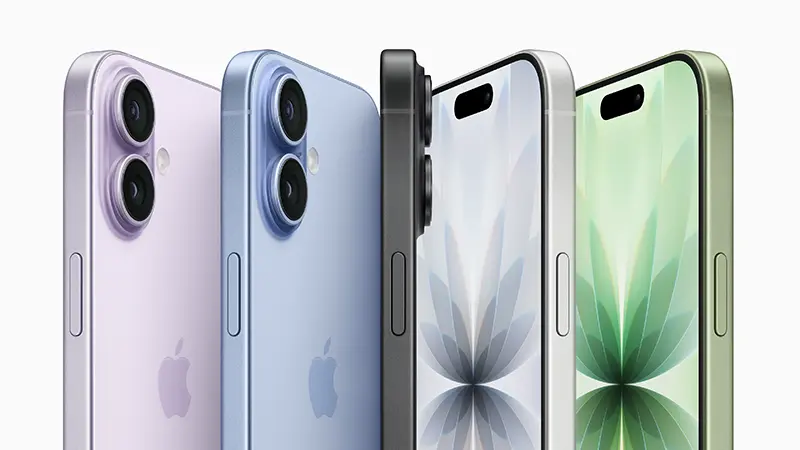
The iPhone 17 colors are Black, White, Lavender, Mist Blue, and Sage — five in total.
- Black — neutral
- White — neutral
- Lavender — soft purple
- Mist Blue — soft blue
- Sage — soft green
Apart from the two neutrals, they’re all low-saturation pastels — nothing as vivid as the Pro line’s Cosmic Orange or Deep Blue.
The materials are the same regardless of color.
All five use color-infused glass on the back and Ceramic Shield 2 on the front, with an aluminum frame finished to match the back.
Color-infused glass doesn’t mean paint applied to the surface — the coloring material goes in as the glass is made, so the glass itself carries the color.
7. iPhone 17 Price: Where $799 Sits
Per the Apple official store, the iPhone 17 runs $799 for 256GB and $999 for 512GB.
The only difference between the two is storage; everything else is identical.
| Configuration | Official price | Difference vs. tier below |
|---|---|---|
| 256GB | $799 | — |
| 512GB | $999 | +$200 |
Since 512GB changes nothing but capacity, that $200 is the price of storage alone.
For reference, the iPhone 17 Pro starts at $1,099, and pricing is as of August 2026.
Personally, if you’re weighing the 512GB, I’d look at the Pro in the same breath.
Add $100 to that $999 and you’re at the Pro 256GB, which trades storage for the telephoto lens, the thermal design, 12GB of RAM, and the rest of the Pro-only hardware.
Final pricing may vary by retailer and available promotions.
☑️ How It Compares to the Galaxy S26
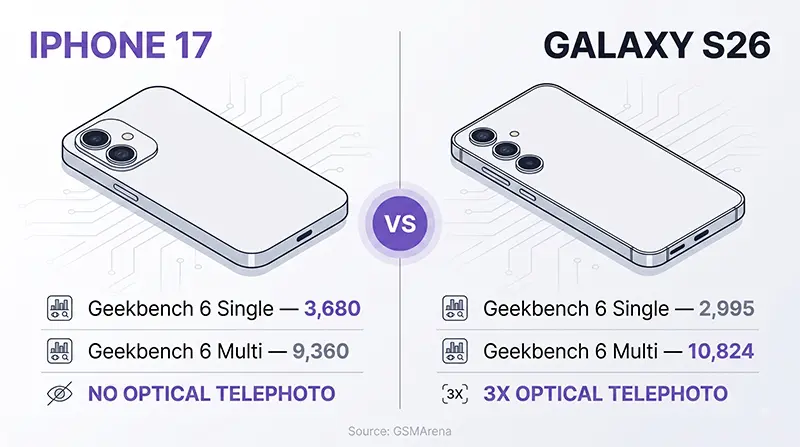
Per Samsung’s official store, the Galaxy S26 lists at $899.99 for 256GB — $100 more than the iPhone 17. On price, the iPhone 17 has the edge.
That said, $100 isn’t the whole story. The two split on performance characteristics.
The iPhone 17 leads on single-core, while the Samsung Galaxy S26 brings multi-core and a 3x optical telephoto.
💡 FAQ
Q1. I’m on an iPhone 16 — is the iPhone 17 worth switching to?
It depends on how you use your phone, but this generation gives you enough reason to switch. The display goes from 60Hz to 1–120Hz, the Ultra Wide from 12MP to 48MP, and the front camera swaps to a new module.
Base storage also goes from 128GB to 256GB, and performance is up 12.8% single and 18.0% multi on Geekbench 6.
Wired transfer speed and measured battery life, though, see no improvement. Personally, the refresh rate is the item you run into most while using the phone, so I’d call it reason enough to upgrade.
Q2. Does a screen protector cancel out the anti-reflective effect?
The iPhone 17’s anti-reflective Ceramic Shield 2 coating cuts reflections roughly 50% compared with the iPhone 16, which had no anti-reflective treatment.
Put a standard tempered-glass protector on it, though, and that effect is canceled out. The coating is designed to work in direct contact with air.
Cover it with a protector and the conditions change. If you plan to use one, go with a product that has its own anti-reflective treatment.
Q3. How many years of software support does the iPhone 17 get?
Apple doesn’t state a support duration for individual models. Only a regulatory minimum of five years exists on paper, and no confirmed end date has been published.
In practice, iPhones have generally received five to seven years of OS updates plus longer security patching — the iPhone 11, for instance, got eight major versions.
But that’s a track record after the fact, which is a different thing from the Galaxy S26’s approach of promising seven years up front.
✨ Wrapping Up
![Isometric vector illustration pairing the lavender iPhone 17 two-lens back with its even-bezel front view [AI Concept]](https://smartleadertech.com/wp-content/uploads/2026/08/iphone-17-isometric-final-verdict-10.webp)
The iPhone 17 is the first generation where the base model is genuinely enough.
It brings a 120Hz display, a 48MP Ultra Wide, an 18MP front camera, and 256GB of base storage — and on a like-for-like capacity basis, the price actually went down.
Telephoto, thermals, and wired transfer are the three that still sting, but all three are limited to specific usage patterns.
Unless you shoot distant subjects often, game for long sessions, and move large video files regularly, the $300 gap to the Pro is just money out the door.
This iPhone 17 generation makes the base model the most balanced choice on the board.
Drop your thoughts below — and bookmark this one if you’re still deciding. 🚀