
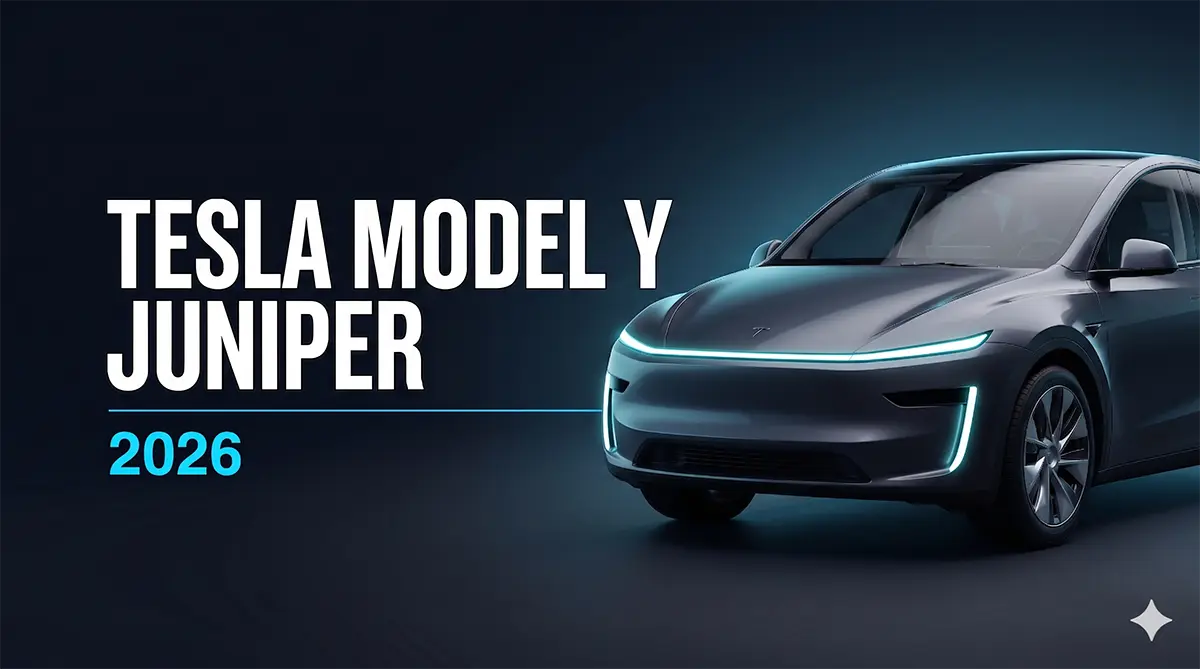
Eyeing an electric SUV in the $40K range?
The Tesla Model Y Juniper was already America’s top-selling EV before the refresh, and 2025 only cemented its lead.
According to Teslarati’s recap of Cox Automotive’s Q4 2025 US EV Sales Report, the Model Y moved 357,528 units in 2025 — a commanding 39.5% share of the entire US EV market, far ahead of any single competitor.
No other EV in America came close.
Even with Tesla bumping Premium and Performance trim prices in May 2026, the Standard RWD still starts at $39,990.
In this post, we’ll dig into where the Tesla Model Y RWD and Long Range trims actually diverge, what the Juniper refresh changed under the skin, and the trade-offs hiding in the spec sheet — the missing CarPlay, the 400V charging architecture, and more.
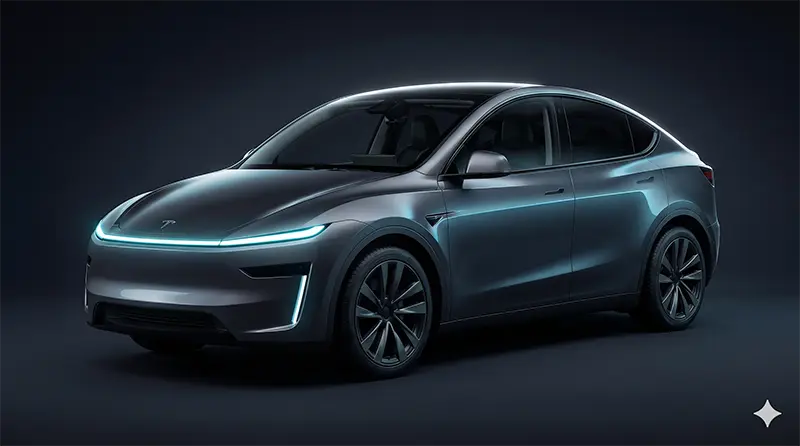
ℹ️ This post contains spec-based informational images and AI-generated concept images. Concept images may differ from the actual product.
📌 Key Summary
[Pricing] Standard RWD $39,990 / Standard AWD $41,990 / Premium RWD $45,990 / Premium AWD $49,990 / Performance $57,990 (May 2026 pricing, excludes $1,640 destination + order fees).
[Range & Charging] EPA-rated: Standard RWD 321 mi (LFP), Premium RWD 357 mi (longest in lineup, NCM), Premium AWD 327 mi (NCM), Performance 306 mi. Supercharger peaks at 250 kW (V3) with V4 hardware deploying for up to 350 kW.
[Strengths]
- NVH: 22% reduction in road noise, 51% reduction in rough-road vibration
- Euro NCAP 5-star (91% adult, 93% child)
- Largest fast-charging network in the US — roughly 3,095 Supercharger stations and 37,000+ ports
- 8-inch rear screen, with ventilated front seats standard on Premium trims
- JD Power 2026 ALG Residual Value triple-crown winner
[Weaknesses]
- 400V / 250 kW peak charging — slower than 800V rivals like the IONIQ 5 and EV6
- No Apple CarPlay or Android Auto — Tesla’s native ecosystem only
- Premium and Performance trims got a $500–$1,000 price hike in May 2026
[Bottom Line] For city and weekend driving, the Standard RWD makes the most sense. For long highway runs and cold-weather range stability, the Premium AWD is worth the $10,000 jump.
- 📌 Key Summary
- 1. 2026 Tesla Model Y Juniper: What's New?
- 2. Tesla Model Y Range: How Big Is the Gap Between Trims?
- 3. Charging and Supercharger: How It Works in the US
- 4. Interior and Infotainment — The Decisive Changes
- 5. ADAS and FSD: What's Available in the US?
- 6. Price — What Does $39,990 Mean?
- 7. Tesla Model Y Juniper and the Meaning of 357,528 US Sales
- 💡 FAQ
- ✨ The Bottom Line
1. 2026 Tesla Model Y Juniper: What’s New?
The 2026 Tesla Model Y’s biggest change is NVH (noise, vibration, harshness) and efficiency.
According to EVXL, Tesla’s official test cycles show rough-road vibration down 51%, road noise down 22%, and the drag coefficient improved from 0.23 to 0.22 — a 4% gain.
The old Model Y had class-leading acceleration and range, but ride quality and noise were always the weak spots.
Road impacts came straight through to the cabin, and interior noise drew constant criticism.
The Juniper refresh zeroes in on those two flaws. The body measures 4,797 × 1,920 × 1,624 mm — about 40 mm longer overall.
But the biggest change is hidden underneath, in the rear floor pan. The previous Model Y used roughly 70 stamped panels welded together at the back.
The Juniper replaces them with a single mega-cast unit.
With the welds gone, the body gets stiffer and absorbs road vibration better. That’s the structural foundation for the entire NVH improvement.
☑️ Full-Width Light Bar and What 0.22 Cd Really Means
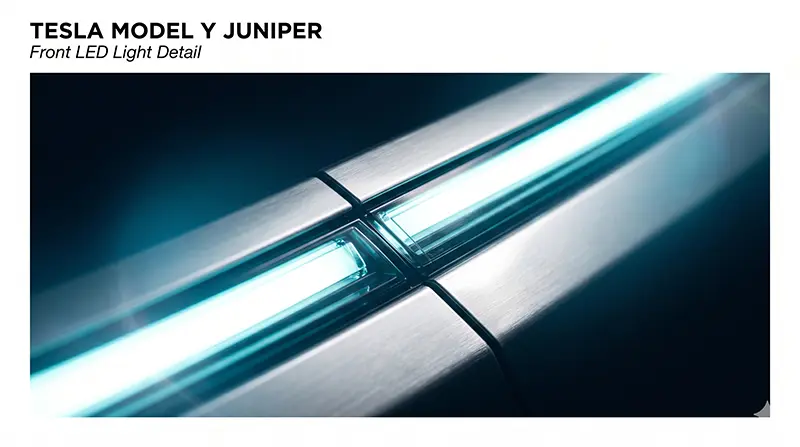
The front and rear both got full-width LED light bars.
Most cars have separate left and right headlights. A full-width light bar runs as a single ribbon from the very edge of the left fender to the right.
The rear is even more interesting.
InsideEVs called the Model Y Juniper’s rear lights the auto industry’s first “indirect reflection panel” taillights.
Here’s how it works. Normally, LEDs or light guides are visible from outside the bodywork.
The Model Y Juniper hides the LEDs deep inside the body and reflects their glow off the inside of the panel, so the panel itself glows softly.
Think of it like indirect ceiling lighting in a living room — but on a car.
The 0.22 Cd drag coefficient isn’t just a styling stat. Most SUVs sit at 0.30–0.35.
The Hyundai IONIQ 5, known for being efficient, is at 0.288. The BMW iX comes in at 0.25.
That puts the Model Y Juniper near the top of any production SUV — down from the previous 0.23, a 4% reduction.
And that 4% translates directly into efficiency. Same battery capacity, more range.
Tesla VP Lars Moravy said the refresh delivered a 5–10% improvement in official certified range and a 10% gain in real-world range without growing the battery.
☑️ How Tesla Finally Tamed the Harsh Ride
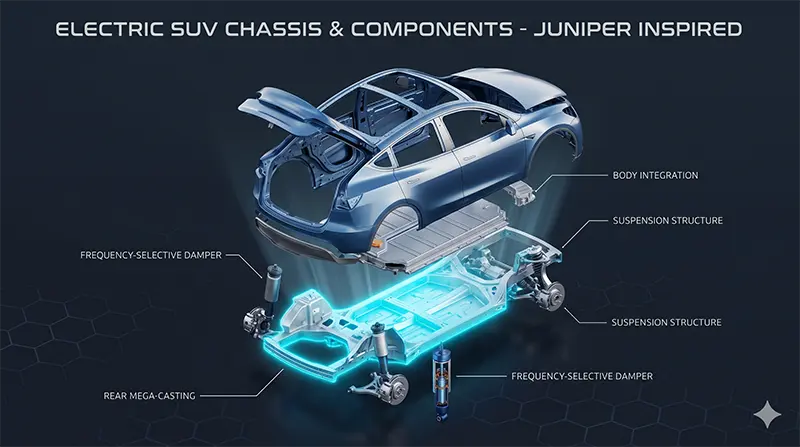
The biggest behind-the-wheel change is the suspension.
The frequency-selective dampers proven on the Model 3 Highland are now retuned for the Model Y.
A standard damper responds to every impact with the same stiffness setting.
Soft tuning means the body wallows in corners. Stiff tuning means every small bump from a city street comes straight through.
You can’t have plush and planted at the same time.
Frequency-selective dampers split incoming impacts into fast vibrations and slow vibrations.
Quick, sharp inputs like rough pavement get a soft response. Slow body movements like cornering lean get a firm response.
The result: plush on city streets but no roll in the corners.
2. Tesla Model Y Range: How Big Is the Gap Between Trims?
The 2026 Tesla Model Y range varies across five EPA-rated trims.
| Spec | Standard RWD | Premium RWD | Premium AWD | Performance |
|---|---|---|---|---|
| EPA Range | 321 mi | 357 mi | 327 mi | 306 mi |
| 0–60 mph | 6.8 sec | 5.4 sec | 4.6 sec | 3.3 sec |
| Drivetrain | RWD | RWD | AWD | AWD |
| Battery | LFP | NCM | NCM | NCM |
| Starting MSRP | $39,990 | $45,990 | $49,990 | $57,990 |
(Source: Tesla US, EPA)
The Standard RWD runs an LFP battery, while the Premium and Performance trims use NCM chemistry.
The Standard AWD ($41,990) sits between Standard RWD and Premium with a 294-mile EPA rating.
LFP chemistry slows down more than NCM in cold weather — both charging speed and usable range drop.
For winter driving, that’s worth keeping in mind.
☑️ Tesla Model Y RWD — Who Is LFP and 321 Miles For?
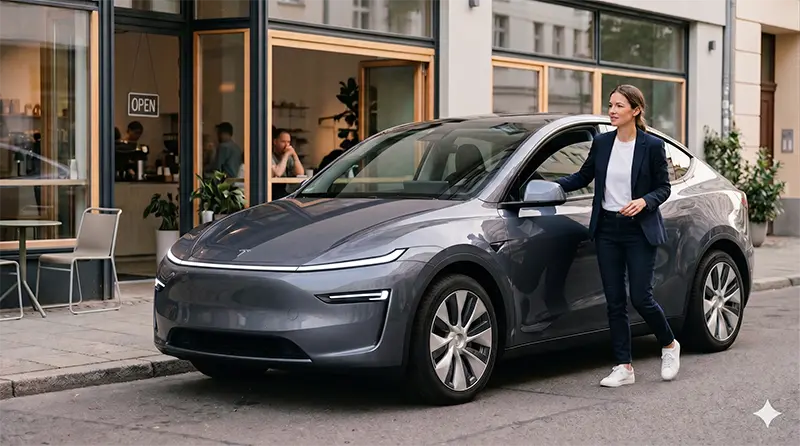
The Tesla Model Y RWD packs an LFP battery of roughly 60 kWh usable.
LFP has lower energy density than NCM, but better thermal stability and lower cost. The safety and price advantages are LFP’s calling cards.
The drawbacks are also clear: shorter absolute range (321 miles) and slower cold-weather charging.
User reports consistently point to LFP charging slowing down in winter.
That said, for city commuters or families running 150–200 miles on weekend trips, 321 miles is more than enough.
☑️ Tesla Model Y Long Range — What NCM and 327 Miles Mean
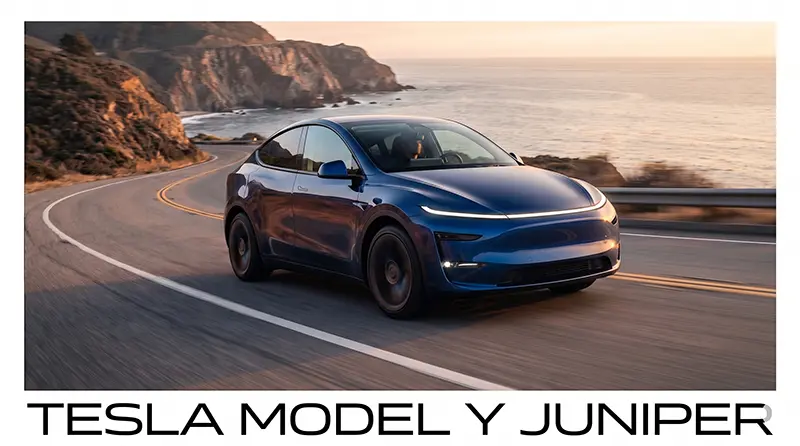
The Tesla Model Y Long Range models — the Premium RWD and Premium AWD — use NCM batteries.
The decisive difference between the LFP Standard RWD and the NCM Premium trims is battery chemistry.
LFP slows down in cold weather because the chemistry itself reacts more sluggishly at low temperatures — both charging speed and usable capacity take a bigger hit.
NCM holds up much better in the cold, so in winter the Standard RWD pays a heavier penalty than the Long Range trims.
For long-distance commuters or anyone with significant highway miles, the $10,000 jump to Premium AWD is worth it.
Beyond range, you’re getting NCM cold-weather consistency, AWD traction, and dual motors with a 4.6-second 0–60.
Compared to similar-priced competitors like the IONIQ 5 and EV6 AWD variants in this segment, Premium AWD’s 327 miles is class-leading.
3. Charging and Supercharger: How It Works in the US
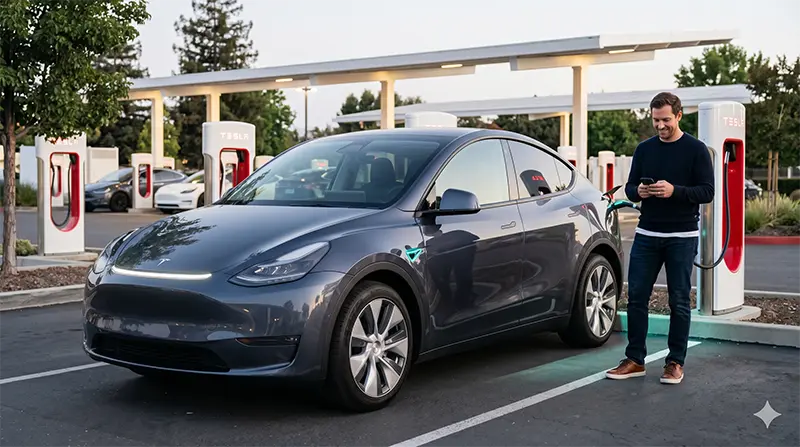
There are two pieces to the Tesla Model Y Juniper charging story.
The car itself and the Supercharger network. The car’s onboard charging speed is a known weak spot.
Electrifying.com and other global outlets have called it out consistently.
The Model Y still runs a 400V architecture, so it can’t move as many electrons per minute as the 800V Hyundai IONIQ 5 or Kia EV6 at the same fast charger.
The 250 kW peak only holds for a short window.
The 800V cars’ 350 kW peak holds across a wider charging curve. End result: 10–80% charging takes longer on the Model Y.
But the US is where the Supercharger network rebalances the equation.
According to US EV Charging Stations, Tesla operates roughly 3,095 Supercharger stations and 37,000+ ports across the country — the largest DC fast-charging network in the US, accounting for more than half of all DC fast charging nationwide.
The transition to V4 hardware is well underway.
V4 stalls support up to 350 kW for compatible future vehicles, and crucially, the longer cables reach any EV in any stall.
The network is also broadly open to non-Tesla EVs now through NACS.
So while non-Tesla EVs may charge faster on the same Supercharger, Tesla owners still get the smoothest experience — Plug & Charge authentication, in-car routing, and station status all baked in.
The car charges slower than the headline competition, but charging is also less hassle.
4. Interior and Infotainment — The Decisive Changes
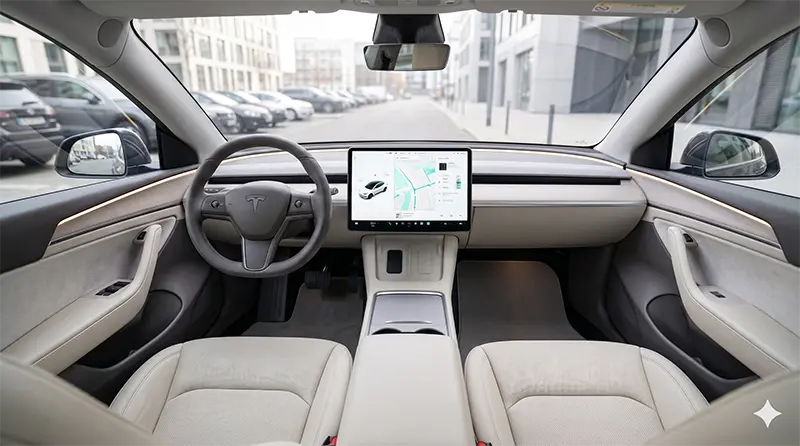
The four biggest interior changes in the Model Y Juniper:
- 15.4-inch center display (up from 15.0)
- 8-inch rear touchscreen (new)
- Ventilated front seats (on Premium trims)
- Turn signal stalk retained (Tesla didn’t replace it with haptic buttons like the Model 3 Highland)
Beyond those four, there’s plenty more in comfort, audio, and packaging.
According to Tparts, the standard config includes 2 wireless charging pads and 3 USB-C ports rated at 65W (2 front, 1 rear) — enough to charge a laptop on the go.
Speaker count is up to 16, and 360-degree acoustic glass uses double panes on the front, rear, and sides.
Second-row power folding and reclining are now one-touch.
Cargo volume jumps to 2,130L with the second row down — about 100L more than before.
☑️ Why Keeping the Turn Signal Stalk Sends a Message
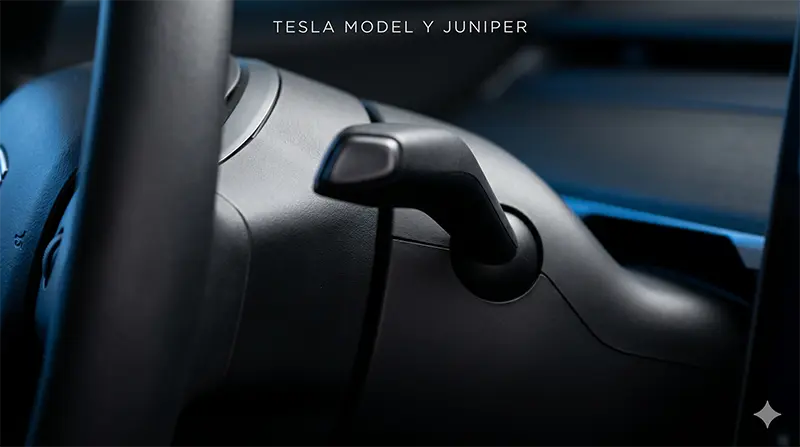
When Tesla refreshed the Model 3 Highland, they killed the left turn signal stalk and replaced it with haptic buttons.
It triggered the loudest backlash from global media and owners in years. The Model Y Juniper walks that back.
The left turn signal stalk is retained — and it’s a global standard, not a regional choice.
Edmunds called this the Model Y’s single most important point of differentiation.
The screen-based gear shift and haptic wiper button stayed, but for the one control you use constantly — the turn signal — Tesla kept the physical stalk.
That’s the design choice owners keep praising.
☑️ No Apple CarPlay, No Android Auto — A Gap vs IONIQ 5 and EV6
Tesla doesn’t support Apple CarPlay or Android Auto on any of its vehicles.
The brand sticks with its own infotainment system, period.
For US buyers, that means Google Maps and Waze don’t pipe to the car screen, and your Spotify and Apple Music workflows live on the phone (or through the car’s own streaming integrations).
Tesla’s built-in navigation is a global system, so for US drivers it doesn’t quite match Google Maps or Waze for live traffic and routing logic in dense urban areas.
This is where the comparison gets sharp.
The Hyundai IONIQ 5 and Kia EV6 both support wireless Apple CarPlay and Android Auto out of the box, starting at $35,000 and $37,900 respectively.
If phone integration is non-negotiable, that’s a meaningful gap.
5. ADAS and FSD: What’s Available in the US?
US-spec Tesla Model Y Juniper comes with Autopilot standard, with Full Self-Driving (Supervised) available exclusively as a $99/month subscription — Tesla discontinued the $8,000 one-time purchase option on February 14, 2026, following Musk’s announcement.
According to NotaTeslaApp, FSD is currently available in the US and parts of Europe.
The hardware is fully there.
The latest HW4 (AI4) computer is standard, and there’s a new front bumper camera.
Tesla Vision — cameras only, no radar — pulls a 92% safety assist score on Euro NCAP.
The system is proven.
In the US, FSD-Supervised handles automatic lane changes, city-street driving, and highway merges with driver supervision — full use of the hardware Tesla has built into the car.
☑️ What the HW3 Owner Backlash Means
According to Tesla Oracle, Elon Musk directly admitted on the Q1 2026 earnings call that HW3’s memory bandwidth is 1/8 of HW4’s — meaning unsupervised FSD is not technically possible on HW3 cars.
That admission landed hard with HW3 owners who paid for FSD and now can’t run the full v14 release.
A HW3-specific FSD v14 Lite is due at the end of June 2026, but it won’t be the full version.
For new buyers, this is mostly academic — HW4 is standard on every 2026 Model Y.
But it’s a reminder that OTA updates aren’t infinite. HW4 will hit a wall eventually too.
The question is just when.
6. Price — What Does $39,990 Mean?
The 2026 Tesla Model Y pricing as of May 2026:
- Standard RWD: $39,990
- Standard AWD: $41,990
- Premium RWD: $45,990
- Premium AWD: $49,990
- Performance: $57,990
All trims add $1,640 in destination and order fees.
The Standard trim keeps the new Juniper styling, the HW4 computer, and full Supercharger network access.
For commuters who don’t need maximum range or AWD, it’s the most accessible Model Y in years.
Tesla raised Premium RWD and Premium AWD by $1,000 each, and Performance by $500, in May 2026.
The two Standard trims held steady.
This was Tesla’s first US Model Y price hike in nearly two years — a reversal from the multi-year stretch of cuts.
The Standard RWD at $39,990 is the headline number. With destination and order fees, the out-the-door starting point is around $41,630.
The price gap between Standard RWD and Premium AWD is $10,000.
Final pricing may vary based on options, destination fees, and state-specific taxes.
7. Tesla Model Y Juniper and the Meaning of 357,528 US Sales
The Tesla Model Y Juniper’s 357,528 US sales in 2025 are more than a bestseller statistic.
According to Teslarati’s recap of Kelley Blue Book’s Q4 2025 US EV Sales Report, the Model Y captured an overwhelming 39.5% share of the US EV market — far ahead of any single competitor.
For comparison, the second-best-selling EV in 2025 was Tesla’s own Model 3 at 192,440 units.
☑️ How Is Resale Value Rated?
According to Autoblog, Tesla pulled a triple crown at the JD Power 2026 ALG residual value awards.
TopSpeed estimates the Model Y holds about 45.5% of its value after 3 years, and 40–45% after 5 years — among the best in the EV segment.
In the US, the May 2026 price hike was modest — Premium trims went up $1,000, Performance $500, and the Standard trims stayed put.
Buyers who got in before the change saw a slight relative benefit on paper.
☑️ What Should You Watch For?
One key thing to flag before you order.
According to Cars.com, the US NHTSA registered a battery pack contactor failure recall on December 9, 2025, which includes 2026 Model Y units.
Tesla typically addresses these issues via OTA updates when possible, but it’s worth checking your VIN on the NHTSA portal before delivery and after taking ownership.
💡 FAQ
Q1. Should I get the Tesla Model Y RWD or Long Range?
If your driving is mostly city and weekend trips and you want the lowest entry point, the Standard RWD makes sense.
If you log significant highway miles, drive in cold weather, or want maximum range, the NCM-equipped Premium RWD (357 mi, longest in the lineup) or Premium AWD (327 mi with AWD traction) is the better call.
Q2. The May 2026 price hike — should I have bought sooner?
The hike was modest ($500–$1,000 on Premium and Performance trims; Standard RWD untouched), and it’s the first Model Y price increase in nearly two years.
Given Tesla’s JD Power 2026 ALG triple-crown residual value rating and roughly 45.5% value retention at 3 years, the Model Y still holds value better than most EVs in its class.
Q3. Is the Model Y Juniper’s charging speed actually a problem?
The 250 kW peak is slower than 800V rivals like the IONIQ 5 and EV6.
But with around 3,095 Supercharger stations and 37,000+ ports across the US — plus V4 hardware deploying for faster speeds on compatible vehicles — the network coverage and reliability make up a lot of ground. For city and mid-range driving, the speed gap doesn’t really bite.
Q4. What’s Tesla’s service network like?
Tesla operates around 250+ service centers across the US, plus a dedicated Mobile Service fleet that handles many repairs at your home or office.
That’s a smaller fixed footprint than legacy dealer networks like Toyota or Honda. Rural buyers should verify their nearest service center on Tesla’s locator before ordering.
✨ The Bottom Line

The 2026 Tesla Model Y Juniper, with its NVH overhaul and a Standard RWD at $39,990, locked down a 39.5% share of the US EV market in 2025.
No single rival came close.
Personally, here’s how I’d shop it:
If you’re focused on city and weekend driving and want the lowest entry point with Tesla’s Supercharger ecosystem, the Standard RWD is the move.
If you log serious highway miles or live where winter actually bites, paying up to the Premium AWD for $10,000 more gets you NCM chemistry, AWD traction, and a 4.6-second 0–60.
On the flip side, if 800V ultra-fast charging is non-negotiable, or you really want Apple CarPlay and Android Auto, the IONIQ 5 and EV6 make a strong case at their post-cut starting prices.
With GM’s EV sales surging year-over-year and Hyundai-Kia slashing prices to compete, 2026 will be a fascinating year for the US EV market.
Whether the Tesla Model Y can hold onto that 39.5% crown is the storyline worth watching.
Drop your thoughts below — what would you go with?
![Split-screen comparison banner featuring Tesla Model Y and Hyundai Ioniq 5 electric SUVs side by side [AI Concept]](https://smartleadertech.com/wp-content/uploads/2026/06/model-y-ioniq-5-comparison-banner-300x169.webp)
![Hyundai IONIQ 5 electric SUV with parametric pixel LED light bar and grille-less front design [AI Concept]](https://smartleadertech.com/wp-content/uploads/2026/06/hyundai-ioniq-5-electric-crossover-marketing-visual-300x169.webp)
![Side-by-side comparison marketing banner featuring Tesla Model Y and BYD Sealion 7 electric SUVs with central VS graphic highlighting their distinct design philosophies [AI Concept]](https://smartleadertech.com/wp-content/uploads/2026/06/tesla-model-y-vs-byd-sealion-7-comparison-300x168.webp)