
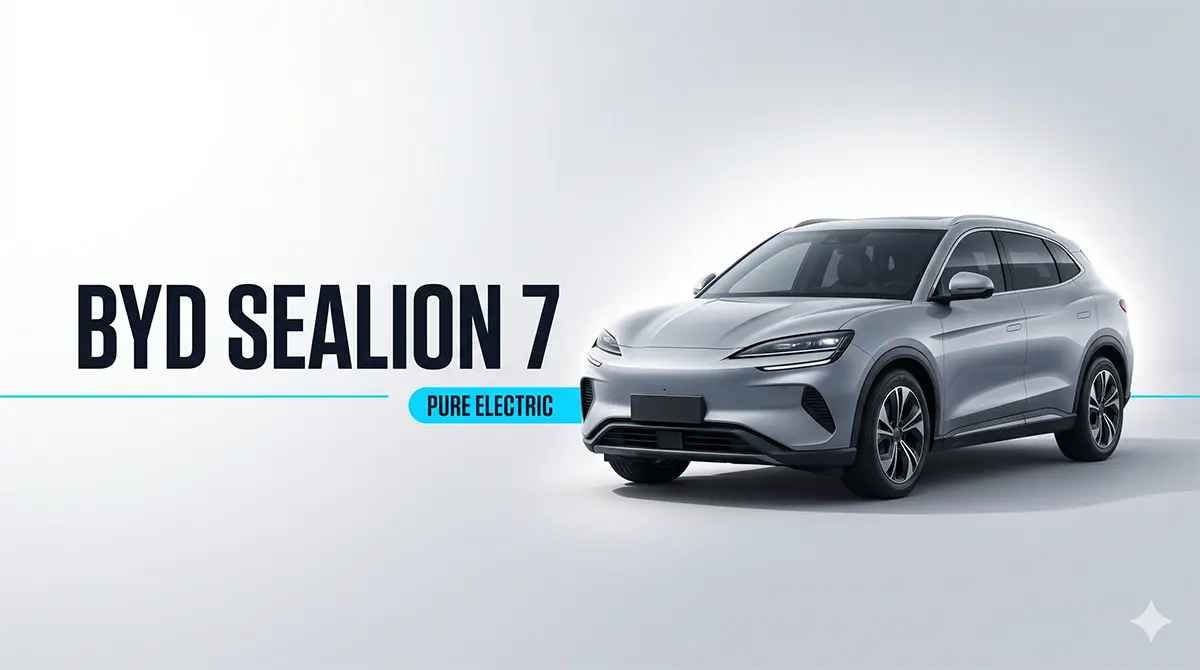
Looking for an electric SUV under £50,000 that doesn’t skimp on kit?
If the Tesla Model Y has been the only name on your shortlist, the BYD Sealion 7 deserves a serious look.
BYD is no longer an unfamiliar name in the UK.
The brand sold over 51,000 cars in 2025 — making it the sixth best-selling manufacturer in the country, ahead of Citroën and Dacia combined — and by April 2026, BYD had overtaken Tesla to become the UK’s top-selling EV brand with over 12,700 pure-electric registrations year-to-date.
The Sealion 7 sits at the top of the BYD electric lineup as the flagship model, and it’s the one carrying the heaviest expectations.
The BYD Sealion 7 price starts at £46,990 — roughly £5,000 more than the entry-level Model Y Standard. On paper, that looks like a disadvantage.
In practice, the gap closes fast once you compare what’s actually included: heated and ventilated front seats, a panoramic glass roof, a 12-speaker Dynaudio sound system, wireless Apple CarPlay, and a 360-degree camera are all standard on every single BYD Sealion 7.
You’d struggle to match that list on a Model Y at any price.
The BYD Sealion 7 range spans from 283 to 312 miles on the WLTP cycle depending on trim, and the top-spec Excellence brings 800V architecture and 230 kW rapid charging — something the entry-level Model Y cannot match.
In this BYD Sealion 7 review, we’ll work through everything that matters: how the specs translate to real-world UK driving, where the BYD Sealion 7 genuinely outperforms the Model Y, where it falls short, and whether the asking price is justified once you factor in the trade-offs.
ℹ️ This post contains spec-based informational images and AI-generated concept images. Concept images may differ from the actual product.
📌 Key Takeaways
UK Specifications at a Glance:
- BYD Sealion 7 price: Comfort £46,990 / Design AWD £51,990 / Excellence AWD £58,990
- BYD Sealion 7 range (WLTP): Comfort 300 miles / Design 283 miles / Excellence 312 miles
- 82.5 kWh or 91.3 kWh LFP Blade Battery
- DC rapid charging: 150 kW (Comfort/Design) or 230 kW (Excellence, 10–80% in 24 minutes); AC 11 kW; V2L standard
Verified Strengths:
- Standard equipment puts most rivals to shame: panoramic roof, 360° camera, 11 airbags, heated and ventilated front seats, heated rear seats, 12-speaker Dynaudio — all from £46,990
- Wireless Apple CarPlay and Android Auto: a decisive gap versus the Model Y, which supports neither
- Five-star Euro NCAP rating (adult occupant 87%, child 93%, vulnerable road users 76%, safety assist 79%)
Worth Noting:
- DC charging at 150 kW (Comfort and Design) trails the Model Y (175–250 kW) and is well behind the Ioniq 5 and EV6 (350 kW). The Excellence’s 230 kW narrows the gap considerably.
- Real-world efficiency has drawn criticism from UK reviewers — motorway range in cold weather can dip to 200–220 miles
- BYD placed 30th out of 31 manufacturers in the 2025 Driver Power customer satisfaction survey. The six-year, 93,750-mile vehicle warranty and eight-year, 155,000-mile battery warranty offer some reassurance.
- 📌 Key Takeaways
- 1. What the UK Gets: Three Trims, Two Platforms
- 2. Blade Battery and BYD Sealion 7 Range: What the Numbers Really Mean
- 3. Charging: How 150 kW and 230 kW Perform on UK Roads
- 4. Interior and Infotainment: Where the BYD Sealion 7 Pulls Ahead of the Model Y
- 5. ADAS and Safety: BYD Sealion 7 DiPilot vs Model Y Autopilot
- 6. BYD Sealion 7 Review Roundup: What the Press Say
- 7. Strengths vs Concerns
- 8. BYD Sealion 7 Price and Positioning: How It Stacks Up Against the Model Y
- 💡 FAQ
- ✨ Final Verdict
1. What the UK Gets: Three Trims, Two Platforms
The BYD electric vehicle lineup in the UK spans both of BYD’s current platform generations — and unlike some markets that only receive one, British buyers get the full range. The step from Comfort to Excellence isn’t just incremental; it’s a platform change.
| Spec | Comfort (RWD) | Design (AWD) | Excellence (AWD) | China |
|---|---|---|---|---|
| Platform | e-Platform 3.0 (400V) | e-Platform 3.0 (400V) | e-Platform 3.0 Evo (800V) | e-Platform 3.0 Evo |
| Battery | 82.5 kWh | 82.5 kWh | 91.3 kWh | 71.8 / 80.64 / 91.3 kWh |
| DC Peak Charging | 150 kW | 150 kW | 230 kW | 230–240 kW |
| Power | 230 kW (309 hp) | 390 kW (523 hp) | 390 kW (523 hp) | — |
| 0–62 mph | 6.7 s | 4.5 s | 4.5 s | — |
| WLTP Range | 300 miles | 283 miles | 312 miles | — |
| UK Price | £46,990 | £51,990 | £58,990 | — |
The Comfort and Design share the same 82.5 kWh Blade Battery on the 400V e-Platform 3.0, with a DC charging ceiling of 150 kW.
Moving from Comfort to Design is primarily about drivetrain — you gain a second motor on the front axle, all-wheel drive, and a considerable leap in outright performance.
The trade-off is a shorter WLTP range (283 miles versus 300) from the same battery working harder to feed two motors.
The Excellence steps up to BYD’s newer e-Platform 3.0 Evo with 800V architecture, a larger 91.3 kWh battery, and DC charging at up to 230 kW — cutting the 10–80% time from 32 minutes to around 24.
You also get Nappa leather upholstery and a head-up display.
If charging speed matters to you, the Excellence makes a materially different case from the lower two trims.
If it doesn’t — and for many commuter-focused drivers it won’t — the Comfort is arguably the sweet spot: 300 miles of WLTP range, 309 hp, and BYD’s full equipment list for under £47,000.
☑️ e-Platform 3.0 and Cell-to-Body (CTB) Construction
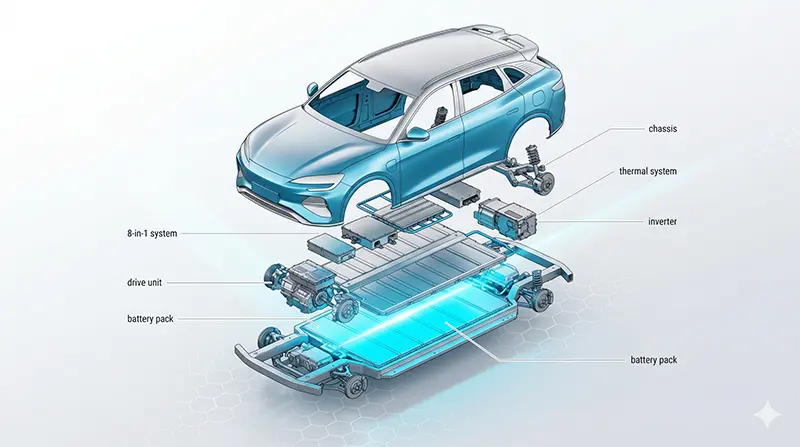
The e-Platform 3.0 integrates eight core components — vehicle control, battery management, motor control, and more — into a single 8-in-1 drive unit.
Consolidating these parts reduces the physical footprint of the drivetrain and shortens wiring paths, which cuts energy losses.
Paired with this is BYD’s Cell-to-Body (CTB) construction. In a conventional EV, the battery pack sits inside its own sealed casing, and the car’s body is built on top of it.
That means two separate layers: the battery enclosure lid and the floor panel.
CTB eliminates one of those layers by making the battery pack’s upper cover double as the structural floor of the cabin. The practical effects are threefold.
First, the battery sits lower, dropping the centre of gravity and reducing body roll through corners.
Second, the freed-up height can be redistributed as cabin headroom or used to lower the overall roofline.
Third, in a collision, the battery functions as a load-bearing structural element rather than passive cargo — distributing impact forces across a wider area and protecting the passenger cell.
Think of it less as cargo sitting in the basement and more as a structural pillar supporting the building.
This low centre of gravity comes up repeatedly in UK road tests: multiple reviewers have noted that the BYD Sealion 7 feels composed and planted, more like a saloon than a tall SUV.
☑️ Wolfgang Egger and the Ocean Aesthetics Design Language
The BYD Sealion 7 was designed under the direction of BYD’s Global Design Director, Wolfgang Egger.
Egger began his career in 1989 at Alfa Romeo.
He moved on to SEAT, then returned to Alfa Romeo before joining Audi in 2007 as Head of Group Design — a role that put him in charge of design across Audi, Lamborghini, and SEAT simultaneously, overseeing a 220-person team.
The Alfa Romeo 8C, Audi Q7, R8, and e-tron concept all passed through his hands. He joined BYD in 2016 and has since shaped the brand’s current design direction.
The BYD Sealion 7 applies his ‘Ocean Aesthetics’ design language — the same philosophy that underpins the Dolphin and Seal.
The overall impression is of a vehicle designed with purpose rather than derivative ambition.
Dimensions are 4,830 × 1,925 × 1,620 mm, with a wheelbase of 2,930 mm — making the BYD Sealion 7 79 mm longer, 53 mm wider, and 40 mm longer in the wheelbase than the Tesla Model Y.
The wider body and flat CTB floor translate into noticeably more generous second-row legroom.
2. Blade Battery and BYD Sealion 7 Range: What the Numbers Really Mean
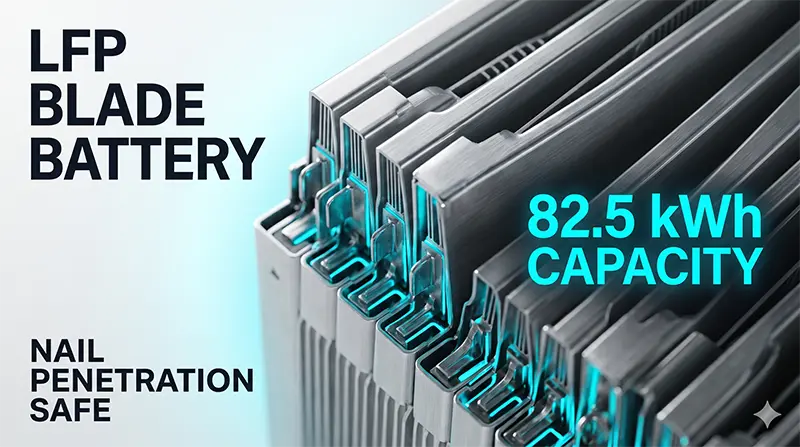
The BYD Sealion 7 uses an LFP (lithium iron phosphate) Blade Battery, designed and manufactured in-house by BYD’s subsidiary FinDreams.
LFP chemistry trades a degree of energy density compared with NMC (nickel-manganese-cobalt) cells for substantially better thermal stability — and it avoids cobalt and nickel entirely, which brings both cost and ethical advantages.
In BYD’s official battery stress tests, the Blade cell passed nail penetration, crush, bend, oven heating at 300°C, and 260% overcharge tests without catching fire.
☑️ What the Nail Penetration Test Actually Means
When a nail punctures a battery cell, it creates an internal short circuit that can trigger thermal runaway — essentially, the cell catches fire.
Standard NMC cells almost universally fail this test.
The fact that the Blade cell passes it is down to a combination of LFP’s inherent chemical stability and the structural rigidity of the blade-shaped cell format — a chemistry advantage and a form-factor advantage working in tandem.
☑️ BYD Sealion 7 Range: WLTP Figures and Real-World UK Experience
The WLTP figures across the BYD Sealion 7 range position it competitively, if not class-leadingly, against its main rivals.
| Model | WLTP Combined Range | Battery |
|---|---|---|
| BYD Sealion 7 Comfort (RWD) | 300 miles | 82.5 kWh |
| BYD Sealion 7 Excellence (AWD) | 312 miles | 91.3 kWh |
| Tesla Model Y Standard (RWD) | 314 miles | — |
| Tesla Model Y Long Range RWD | 387 miles | — |
| Hyundai IONIQ 5 LR RWD (84 kWh) | ~329 miles | 84 kWh |
On paper, the BYD Sealion 7 Comfort and the Tesla Model Y Standard are neck and neck.
Where the BYD falls behind is at the top of the range — the Tesla Model Y Long Range stretches to 387 miles, a significant advantage for anyone routinely covering longer distances.
In real-world UK driving, the picture becomes more nuanced — and not entirely in BYD’s favour. UK media long-term tests have returned mixed results.
One six-month test of the Comfort found motorway-dominated range in cold conditions sitting at roughly 200–220 miles — a significant drop from the claimed 300.
A separate six-month test of the Excellence reported that real-world range in mixed driving averaged around 290 miles, with the reviewer noting that commuter use was more than adequately served.
At just over 2,300 kg, the Sealion 7 is a heavy car, and multiple reviewers have noted that weight takes a toll at sustained motorway speeds.
The takeaway: the BYD Sealion 7 range holds up well for daily commutes and mixed driving, but drops off more sharply at sustained motorway speeds and in cold weather than the WLTP figures suggest.
That’s not unique to BYD — most EVs see a similar gap — but it’s worth factoring in if your driving profile is motorway-heavy.
BYD equips every Sealion 7 with a heat pump as standard, which helps manage efficiency in cooler weather by recapturing waste heat from the drivetrain.
LFP chemistry also handles temperature extremes more gracefully than NMC alternatives, contributing to more consistent performance through the seasons.
The warranty picture is reassuring.
You get six years or 93,750 miles on the vehicle, and the Blade Battery is covered for eight years or 155,000 miles with a guaranteed minimum state of health of 70% — comfortably surpassing Tesla’s eight years or 120,000 miles.
3. Charging: How 150 kW and 230 kW Perform on UK Roads
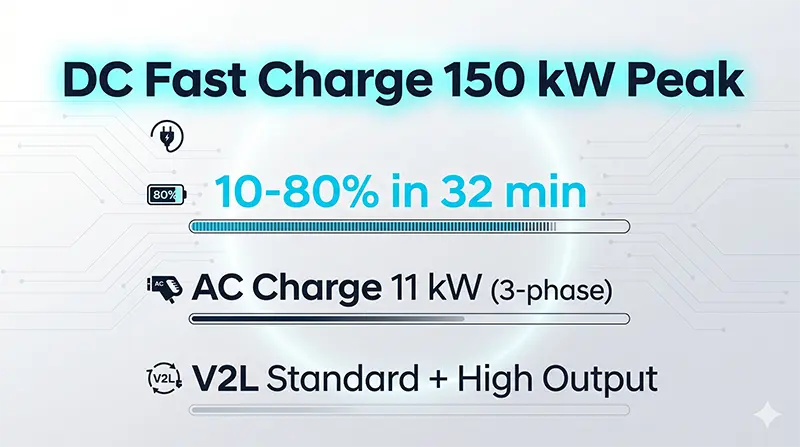
The Comfort and Design trims support DC rapid charging at up to 150 kW, giving a 10–80% charge in approximately 32 minutes.
The Excellence, with its 800V architecture, pushes that to 230 kW and cuts the same charge to around 24 minutes. All trims get 11 kW AC three-phase charging and standard V2L capability.
A common criticism is that the Comfort’s 150 kW ceiling looks sluggish next to the Tesla Model Y’s 175 kW (Standard) or 250 kW (Long Range).
The numbers bear that out. But context matters.
The UK’s public rapid-charging network — BP Pulse, Gridserve, Osprey, Pod Point, Ionity, and others — sits predominantly in the 50–150 kW range, with 300 kW+ ultra-rapid chargers still concentrated at motorway service areas and select hubs.
For the majority of public charging stops, the BYD Sealion 7 Comfort’s 150 kW ceiling aligns with what the infrastructure actually delivers.
For those who opt for the Excellence, 230 kW brings genuinely competitive charging speeds that match or exceed most rivals outside of the Ioniq 5 and EV6’s 350 kW peak.
One long-term UK reviewer noted consistently seeing speeds above 150 kW in real-world conditions with the Excellence — a meaningful step up.
A 24-minute 10–80% fill is faster than the Model Y Long Range and keeps pace with most competitors in the segment.
It’s also worth noting that Tesla’s Supercharger network in the UK has partially opened to non-Tesla CCS vehicles.
Around 42 sites with 477 individual chargers currently accept CCS vehicles via the Tesla app, though non-Tesla users pay a premium.
This means a BYD Sealion 7 can, in principle, use some Superchargers — but it’s far from the seamless plug-and-go experience Tesla owners enjoy, and coverage is limited.
Tesla’s charging ecosystem remains a genuine advantage for Model Y buyers: broader access, faster speeds, and lower per-kWh pricing.
For BYD Sealion 7 owners, charging relies primarily on the public network.
For daily commuters with a home wallbox — where the 11 kW AC rate is a useful step above the 7 kW most wallboxes deliver — that’s a minor inconvenience.
For frequent long-distance drivers, it’s a more significant consideration.
4. Interior and Infotainment: Where the BYD Sealion 7 Pulls Ahead of the Model Y
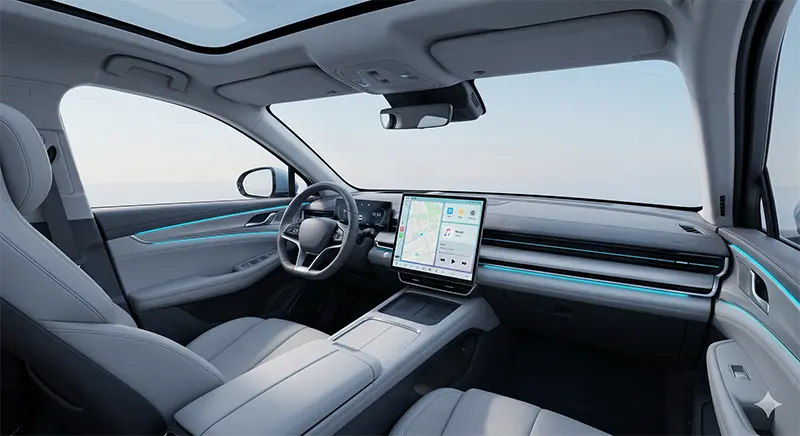
This is where the BYD Sealion 7 price starts to make a genuinely compelling case. The standard-fit equipment list across all trims is remarkably generous:
- 15.6-inch rotating touchscreen, 10.25-inch digital instrument cluster
- Qualcomm Snapdragon 8155 SoC, DiLink 5.0 operating system
- Wireless Apple CarPlay and Android Auto
- 50W wireless charging pad with cooling airflow
- 2.1 m² panoramic glass roof with electric sunshade
- Eight-way power-adjustable driver’s seat, heated and ventilated front seats, heated rear seats
- 12-speaker Dynaudio sound system
- Quad-zone voice control, OTA software updates, driver monitoring system
The Design adds 20-inch alloy wheels (up from 19-inch on Comfort).
The Excellence brings Nappa leather upholstery and a head-up display. Beyond paint colour, there is nothing on the options list — what you see is what you get.
Boot space is 520 litres, expanding to 1,789 litres with the 60:40 rear seats folded. There’s also a 58-litre frunk.
The Tesla Model Y quotes 854 litres of boot space, but that figure is measured to the roof rather than the parcel shelf — a different methodology from BYD’s measurement.
In terms of usable, day-to-day luggage space, the gap is less dramatic than the headline numbers suggest. The Model Y does, however, offer a larger frunk at 117 litres.
☑️ Apple CarPlay and Android Auto: The Decisive Gap with the Model Y
The Tesla Model Y does not support Apple CarPlay or Android Auto. Full stop. It relies entirely on Tesla’s own infotainment ecosystem.
The BYD Sealion 7 offers both wirelessly, allowing you to use Apple Maps, Google Maps, Waze, Spotify, podcasts, and the rest of your phone’s app library directly on the main display.
For anyone whose digital life revolves around their smartphone — which is most people — this alone can tip the balance.
More broadly, the combination of familiar app access and a conventional instrument cluster behind the steering wheel makes the BYD Sealion 7 feel immediately approachable in a way that Tesla’s screen-only interface sometimes doesn’t.
For drivers who’ve come from conventional cars, the transition is markedly smoother.
This is arguably the single clearest differentiator between the BYD Sealion 7 and the Model Y in daily use — and it’s one that UK reviewers consistently highlight as a point in BYD’s favour.
☑️ Snapdragon 8155 and UI Assessment
The 15.6-inch display runs on a Qualcomm Snapdragon 8155 chipset.
UK reviewers have described the screen responsiveness as tablet-like — fast, fluid, and free of the lag that affects some competitors.
Criticisms do exist. Climate controls are almost entirely touch-based, with very few physical buttons.
When Apple CarPlay or Android Auto is active, it occupies the full screen, meaning you need to exit it to access vehicle-specific controls like air conditioning or seat settings.
Some reviewers have also noted that the car’s own UI can feel marginally less snappy than the chipset’s potential would suggest.
The rotating display — which switches between portrait and landscape orientation — is initially eye-catching.
Carwow and Top Gear have both described it as a feature you show friends once or twice before never bothering with it again. It’s more talking point than practical benefit.
5. ADAS and Safety: BYD Sealion 7 DiPilot vs Model Y Autopilot
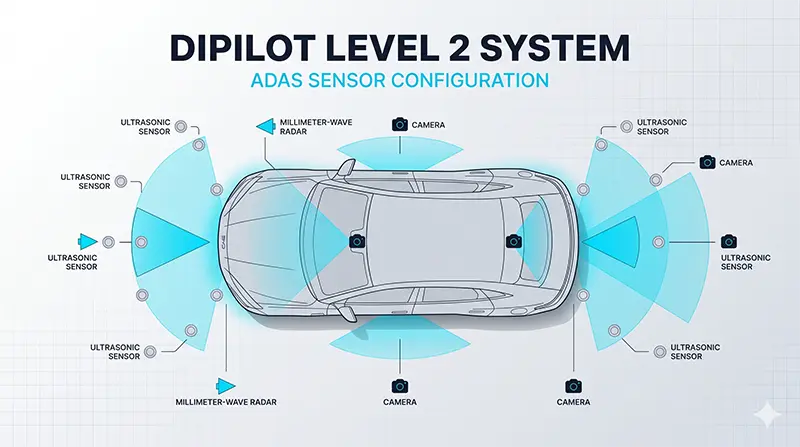
The BYD Sealion 7 comes with the following standard safety and assistance features:
- 11 airbags, 360° camera (3D surround view)
- Adaptive cruise control (ACC), automatic emergency braking (AEB)
- Lane departure steering assist, blind spot detection (BSD)
- Rear and front cross-traffic collision braking, traffic sign recognition, intelligent speed limit
- Driver attention warning, driver monitoring system (A-pillar sensor)
The UK-spec BYD Sealion 7 runs BYD’s DiPilot 10, based on 12 ultrasonic sensors, 5 millimetre-wave radars, and 11 cameras. It’s classified as Level 2.
The more advanced DiPilot 100 (God’s Eye) system is available only in China and has not been introduced to any global market, including the UK.
The BYD Sealion 7 has been awarded a full five-star Euro NCAP rating, scoring 87% for adult occupant protection, 93% for child occupant protection, 76% for vulnerable road users, and 79% for safety assist features.
☑️ Tesla Autopilot and FSD: The Real-World Difference in the UK
The BYD Sealion 7 is a straightforward Level 2 system: no hands-free driving, no automatic lane changes.
Tesla offers Enhanced Autopilot and Full Self-Driving Capability as paid extras on the Model Y — FSD is available for purchase in the UK at £6,800 — but FSD cannot legally be used on UK public roads as of May 2026.
Tesla’s own UK configurator notes that it depends on further development and regulatory approval.
In practical terms, both the BYD Sealion 7 and the Tesla Model Y operate at the same Level 2 autonomy in the UK today.
Tesla’s hardware may offer more potential down the line, but that potential hasn’t yet translated into a real-world advantage on British roads.
6. BYD Sealion 7 Review Roundup: What the Press Say
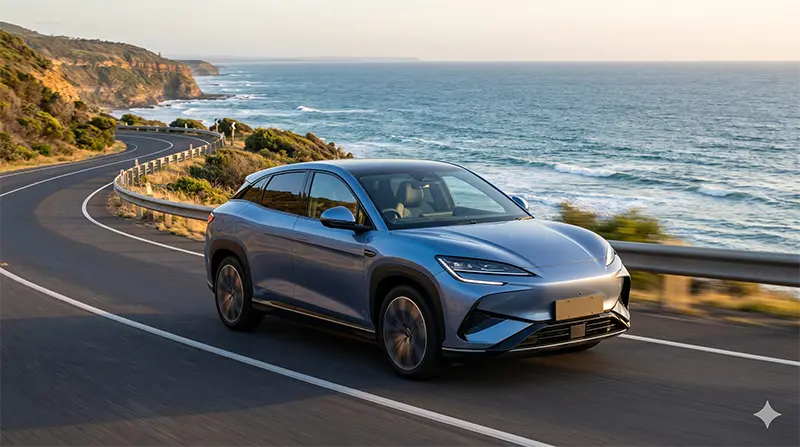
A survey of UK and global media reveals a consistent pattern: strong praise for value and equipment, qualified criticism of driving dynamics and efficiency.
☑️ Australia: Where the BYD Sealion 7 Has Outsold the Model Y
Australia is the market where the BYD Sealion 7 has most meaningfully challenged the Tesla Model Y.
Following its February 2025 launch, the BYD Sealion 7 outsold the Tesla Model Y on three separate occasions: in April 2025 (743 to 280), July 2025 (1,427 to 555), and April 2026 (1,780 to 822).
As of April 2026, the BYD Sealion 7 holds the top spot in Australian EV sales.
Australian media have praised the standard equipment, noting that the entry-level model is so well-specced that there’s little incentive to pay more for the higher trims.
Reviewers have also highlighted more natural steering feel than the Model Y and better cornering composure.
☑️ UK Media: A Thorough but Mixed Verdict
UK reviews land on a consistent split.
Build quality, equipment levels, and cabin refinement draw widespread praise — multiple outlets have highlighted the solid construction, generous use of soft-touch materials, and the fact that double-glazed windows make the Sealion 7 noticeably quieter than the Model Y.
The criticisms are equally consistent.
Real-world efficiency falls short of official claims, particularly on motorway-heavy routes in cold weather, where one long-term tester saw range drop to around 200–220 miles.
The ride, while composed at lower speeds, has been described as unsettled over rougher UK surfaces — a tuning issue rather than a fundamental flaw.
At over 2,300 kg, the car’s weight is felt at sustained motorway speeds.
The Excellence fares better in long-term tests: 230 kW charging consistently delivered over 150 kW in practice, the 312-mile range held up well for commuter use, and V2L proved genuinely useful.
If the budget stretches, the Excellence addresses several of the Comfort’s weak points.
The consensus: well-built, well-equipped, and strong on value — but not yet polished to the level of the best European and Korean rivals for ride comfort and driving engagement.
7. Strengths vs Concerns
A summary of the themes that emerge most consistently across BYD Sealion 7 review coverage and early owner feedback.
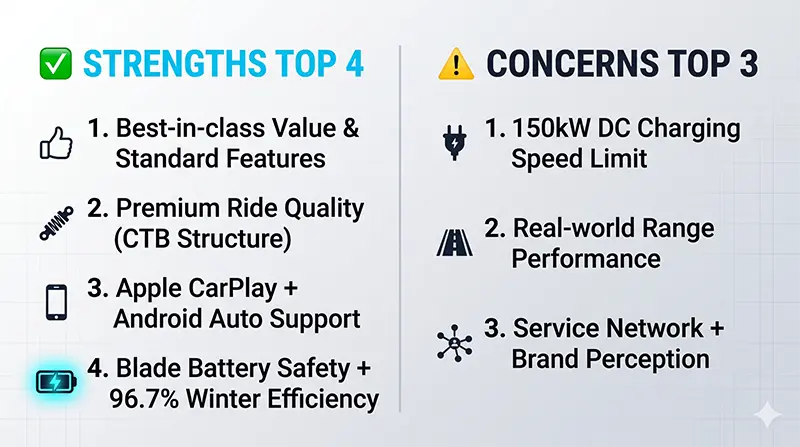
☑️ Top Strengths
- Unbeatable value and class-leading standard equipment
- Saloon-like ride comfort and composure
- Wireless Apple CarPlay, Android Auto & rotating 15.6″ display
- Blade Battery safety & strong cold-weather efficiency
☑️ Key Concerns
- 150 kW DC rapid charging speed limit
- Real-world motorway efficiency and range
- Brand maturity and UK customer service network
8. BYD Sealion 7 Price and Positioning: How It Stacks Up Against the Model Y
A direct comparison between the BYD Sealion 7 and the Tesla Model Y at the closest UK price points:
| Spec | BYD Sealion 7 Comfort RWD | BYD Sealion 7 Excellence AWD | Tesla Model Y Standard | Tesla Model Y LR RWD |
|---|---|---|---|---|
| UK Price | £46,990 | £58,990 | £41,990 | £48,990 |
| WLTP Range | 300 miles | 312 miles | 314 miles | 387 miles |
| DC Peak Charging | 150 kW | 230 kW | 175 kW | 250 kW |
| 0–62 mph | 6.7 s | 4.5 s | ~7 s | ~5.4 s |
| Wheelbase | 2,930 mm | 2,930 mm | 2,890 mm | 2,890 mm |
| Boot (+ frunk) | 520 L (+ 58 L) | 520 L (+ 58 L) | 854 L (+ 117 L) | 854 L (+ 117 L) |
| Apple CarPlay | Wireless ✅ | Wireless ✅ | Not supported ❌ | Not supported ❌ |
| Warranty | 6 yr / 93,750 mi | 6 yr / 93,750 mi | 4 yr / 60,000 mi | 4 yr / 60,000 mi |
Sources: BYD UK, Tesla UK
Final pricing may vary depending on specification and any applicable incentives.
It’s also worth noting that the Design (£51,990) and Excellence (£58,990) trims exceed the £50,000 VED luxury car supplement threshold — adding £425 per year in years two through six — while the Comfort sneaks under at £46,990.
☑️ Where the BYD Sealion 7 Leads
- Apple CarPlay and Android Auto — the ability to use your phone’s apps natively on the car’s screen remains the single most tangible everyday advantage over the Model Y
- Ride quality and second-row space — the CTB-derived low centre of gravity and 2,930 mm wheelbase deliver a more settled ride and more generous rear legroom
- Standard equipment and warranty — at £46,990, the BYD Sealion 7 Comfort comes with kit that would push a Model Y well past £50,000 if Tesla offered it as options (which, in many cases, it doesn’t). The six-year vehicle warranty is 50% longer than Tesla’s four-year coverage, and the battery warranty extends to 155,000 miles versus Tesla’s 120,000.
☑️ Where the Tesla Model Y Leads
- Charging speed and infrastructure — even the entry-level Model Y Standard charges faster (175 kW vs 150 kW), and the Supercharger network remains the most reliable rapid-charging experience in the UK
- Absolute range and efficiency — the Model Y Long Range RWD’s 387-mile WLTP figure gives it a comfortable margin over the BYD Sealion 7 Excellence’s 312 miles. Real-world efficiency testing consistently favours the lighter Tesla. For frequent long-distance drivers, this is a meaningful practical advantage.
💡 FAQ
Q1. How does the BYD Sealion 7 range hold up in real-world UK driving?
The WLTP figures — 300 miles (Comfort), 283 miles (Design), 312 miles (Excellence) — hold up well in mixed driving.
In cold-weather motorway use, UK reviewers have seen the Comfort drop to around 200–220 miles, with the Excellence faring better on its larger battery.
That’s not unusual for an EV of this weight, but it’s a wider gap than lighter rivals like the Model Y. Adequate for daily commutes and weekends; worth planning extra stops on longer motorway runs.
Q2. Is BYD’s UK dealer network large enough to support ownership?
BYD operates 132 UK sites (targeting 150 by mid-2026) with solid warranties (6-year vehicle / 8-year battery).
However, despite rapid sales growth, BYD ranked 30th out of 31 in the 2025 Driver Power customer satisfaction survey. Long-term reliability remains unproven, so verify your nearest service centre before committing.
Q3. What about residual values for a brand this new to the UK?
With under three years in the UK market, BYD lacks established residual value data.
If 3-to-5-year resale value is a priority, the Tesla Model Y or Hyundai IONIQ 5 are safer choices. The Sealion 7 is better suited for long-term owners prioritizing immediate spec-per-pound value over depreciation defense.
✨ Final Verdict
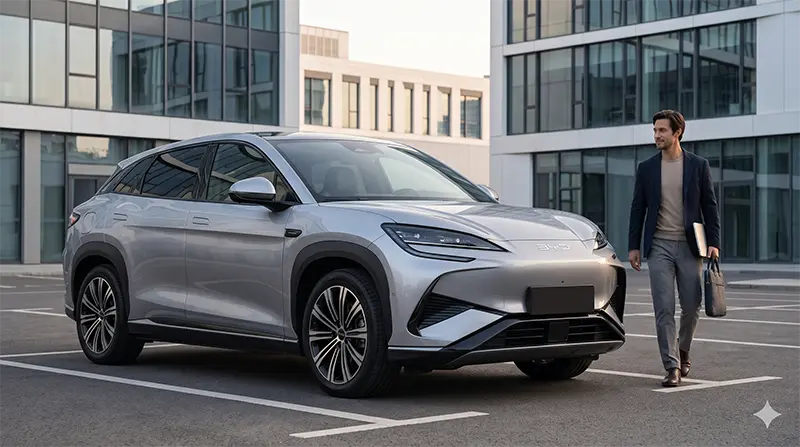
The Sealion 7 is not the cheapest BYD electric SUV on the UK market, nor is it the most affordable overall — the Tesla Model Y Standard undercuts it by £5,000.
But it may well be the most generously equipped.
At £46,990, the Comfort comes loaded with kit that most rivals either charge extra for or don’t offer at all.
Step up to the Excellence at £58,990, and you get 800V architecture, 230 kW charging, and 312 miles of range — a genuinely well-rounded package at the upper end of its class.
The caveats are real, though. Charging speed on the Comfort and Design trails the Model Y.
Real-world range at motorway speeds can disappoint.
And BYD is still building the long-term reliability and customer satisfaction track record that established brands take for granted.
The driving experience, while composed and refined, hasn’t quite been polished for UK road surfaces to the degree that the best rivals manage.
If your driving life centres on commuting and weekend family trips, and you value having comprehensive standard equipment without an agonising options list, the BYD Sealion 7 Comfort is a well-judged choice.
If you regularly cover long motorway distances and charging speed or outright range is your deciding factor, the Tesla Model Y Long Range — or a Kia EV6, for that matter — remains the stronger proposition today.
Either way, BYD has earned its place on the shortlist. This is no longer a brand you can afford to overlook.
Let us know in the comments — which spec appeals to you?
![Split-screen comparison banner featuring Tesla Model Y and Hyundai Ioniq 5 electric SUVs side by side [AI Concept]](https://smartleadertech.com/wp-content/uploads/2026/06/model-y-ioniq-5-comparison-banner-300x169.webp)
![Hyundai IONIQ 5 electric SUV with parametric pixel LED light bar and grille-less front design [AI Concept]](https://smartleadertech.com/wp-content/uploads/2026/06/hyundai-ioniq-5-electric-crossover-marketing-visual-300x169.webp)
![Side-by-side comparison marketing banner featuring Tesla Model Y and BYD Sealion 7 electric SUVs with central VS graphic highlighting their distinct design philosophies [AI Concept]](https://smartleadertech.com/wp-content/uploads/2026/06/tesla-model-y-vs-byd-sealion-7-comparison-300x168.webp)