![Hyundai IONIQ 5 electric SUV with parametric pixel LED light bar and grille-less front design [AI Concept]](https://smartleadertech.com/wp-content/uploads/2026/06/hyundai-ioniq-5-electric-crossover-marketing-visual.webp)
Welcome to Smartleader, where editor Sanghoon Jeon cuts straight to what matters in IT and EV trends.
Tesla’s Model Y still leads US EV sales, but the Hyundai Ioniq 5 — a global bestseller that swept three categories at the 2022 World Car Awards — has earned its place as one of America’s best-selling electric SUVs in its own right.
And here’s the kicker: for 2026, Hyundai slashed Ioniq 5 prices across the entire lineup — by as much as $9,800 per trim.
An EV that was already a top pick just turned into a flat-out value play.
In this guide, we’ll break down the Ioniq 5’s price, range, charging time, efficiency, pros and cons, and Android Auto support — everything you’d want to know if you’re weighing whether to buy one, all from a real-world ownership perspective.
ℹ️ This post contains spec-based informational images and AI-generated concept images. Concept images may differ from the actual product.
📌 Key Takeaways
[Price] From $35,000 for the SE Standard Range up to about $48,975 for a loaded Limited AWD (MSRP, before the destination charge).
[Range & Charging] EPA-estimated 318 miles on the extended-range battery, 245 miles on the Standard Range. Roughly 18–20 minutes for a 10–80% charge on a 350-kW fast charger.
[Pros]
- Class-leading 800V ultra-fast charging (peak around 263 kW)
- Standard wireless Apple CarPlay and Android Auto
- Spacious interior with 3.6-kW V2L power output
- Adjustable regen with one-pedal driving, and a three-time World Car Award winner
[Cons]
- Large turning circle from the long wheelbase (awkward in tight spots)
- ICCU reliability concerns and recall history
[Bottom Line] If you value a roomy cabin, 800V charging, strong build quality, and V2L, the Ioniq 5 earns a recommendation. Just weigh the ICCU track record before you buy.
- 📌 Key Takeaways
- 1. Why the Ioniq 5 Became a Global Bestseller
- 2. How Much Range Does the Ioniq 5 Have?
- 3. Ioniq 5 Charging Time: What 800V Fast Charging Delivers
- 4. Ioniq 5 Efficiency: How Frugal Is It in the Real World?
- 5. Ioniq 5 Android Auto and Infotainment
- 6. How Much Does the Ioniq 5 Cost?
- 7. Ioniq 5 Pros and Cons: The Quick Verdict
- 💡 FAQ
- ✨ Final Thoughts
1. Why the Ioniq 5 Became a Global Bestseller
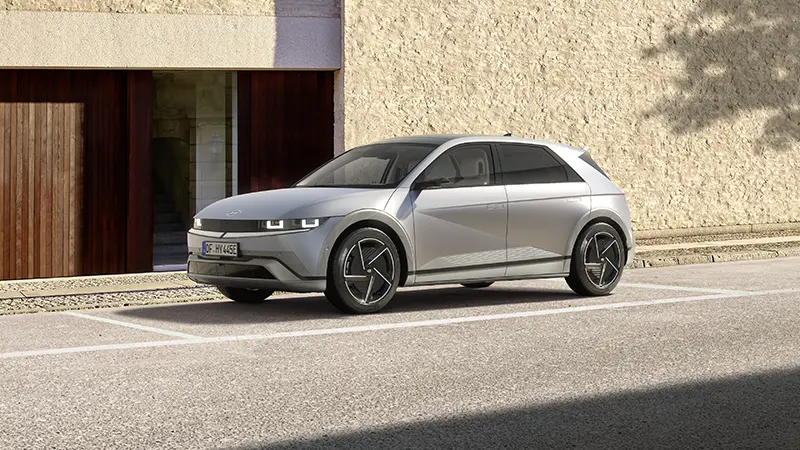
Built on a dedicated EV platform with a roomy cabin and fast charging, the Ioniq 5 set the benchmark for its class right out of the gate.
After sweeping three categories at the 2022 World Car Awards, it has gone on to become one of the best-selling electric SUVs in the US.
But this isn’t a car coasting on trophies.
In a recent evaluation, InsideEVs named the Ioniq 5 an Editor’s Choice, calling out its intuitive usability — there’s no learning curve like the one some drivers hit with a Tesla.
It keeps a dedicated instrument cluster, leaves frequently used functions as physical buttons, and supports familiar CarPlay and Android Auto — so anyone coming from a regular car can hop in and feel at home with nothing new to learn.
US News ranked it the #1 compact electric SUV for families, and Edmunds named it a Best Electric SUV.
The wording varies by outlet, but the core verdict is consistent: space, build quality, and charging.
☑️ The Strengths of the E-GMP 800V Platform
The first thing to understand is the E-GMP platform underneath it all, which runs an 800V system as standard.
Here’s why 800 volts matters.
Charging power comes down to voltage and current, and you can’t just crank up the current — heat gets in the way.
An 800V EV can pull more power at the same current.
That’s why the Ioniq 5 can go from 10–80% in roughly 18–20 minutes on a 350-kW fast charger, while a 400V car on the very same charger hits a current ceiling and can’t match that pace.
This matters more than ever in the US.
The Ioniq 5 comes with a native NACS port, so it plugs straight into Tesla Superchargers with no adapter — and a CCS adapter is included for the other networks.
Tesla Superchargers run at 400 volts, and the Ioniq 5’s 800V architecture steps the voltage up to keep charging strong even there, so it’s far less picky about where you plug in.
According to Hyundai‘s official specs, this compact-class body measures 4,655 mm long with a wheelbase that stretches to 3,000 mm.
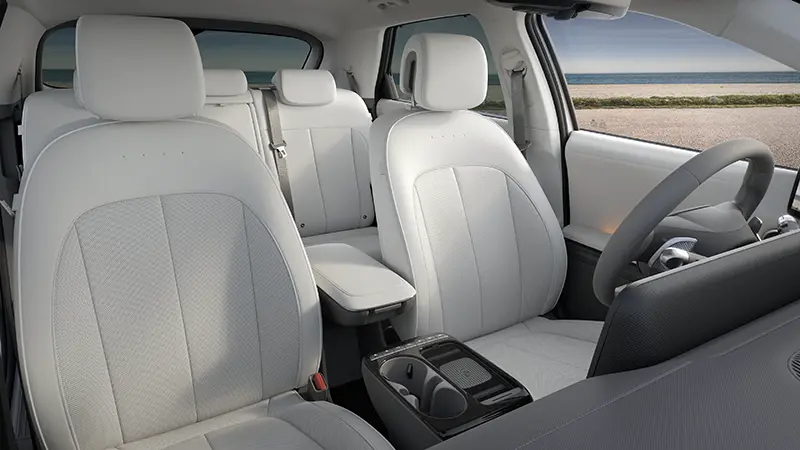
Because the dedicated E-GMP platform pushes the wheels out to the corners and trims the front and rear overhangs, the cabin feels bigger than the exterior suggests, and the floor is flat.
☑️ What’s New for the 2026 Ioniq 5
The 2026 Ioniq 5 is a model-year update, not a ground-up redesign.
It carries over the hardware from the 2024 refresh and focuses its changes on pricing and positioning.
The headline news is value: Hyundai cut prices across the entire lineup for 2026 — by as much as $9,800 per trim — repositioning an already strong EV as one of the best deals in the segment.
We’ll break down the full trim-by-trim pricing later in this guide.
2. How Much Range Does the Ioniq 5 Have?
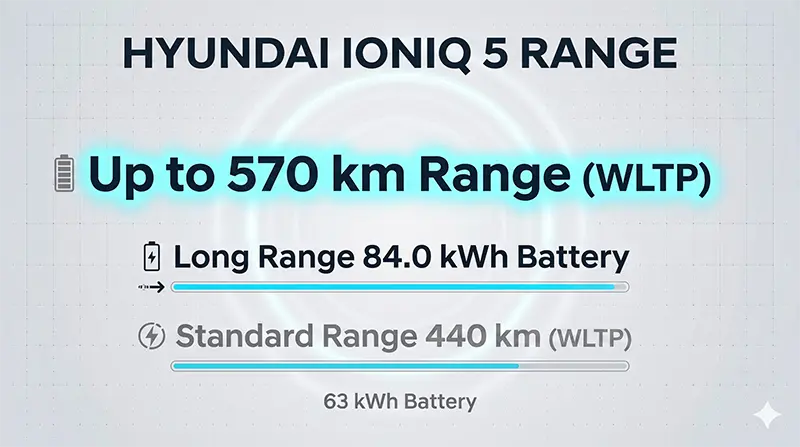
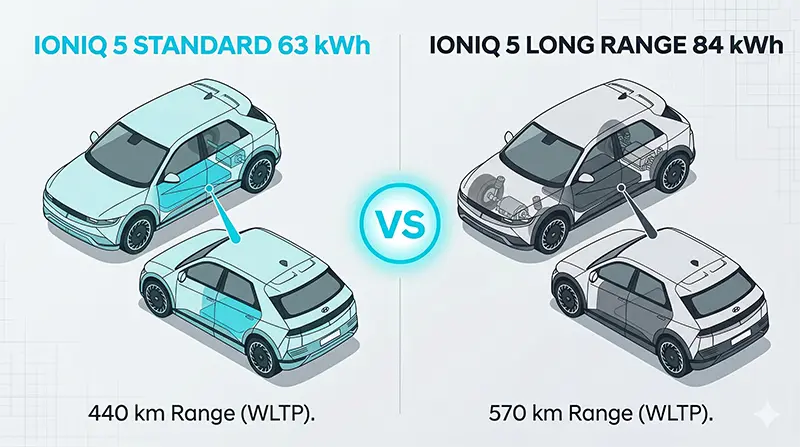
The Ioniq 5’s range lands at an EPA-estimated 318 miles for the extended-range RWD model (19-inch wheels) and 245 miles for the Standard Range.
Choose AWD or 20-inch wheels and those numbers dip — to 290 miles for the AWD SE/SEL, and 259–269 miles for the XRT and Limited AWD.
The extended-range model uses an 84.0-kWh (80.0 kWh usable) NCM battery, while the Standard Range carries a 63-kWh pack.
The Kia EV6 shares the same 84-kWh pack and is rated at up to 319 miles — essentially a tie.
Both the Ioniq 5 and EV6 deliver competitive range for a compact electric SUV.
☑️ Why Range Numbers Differ by Country (EPA vs WLTP)
An EV’s range figure can swing dramatically depending on which country’s test it’s measured under — and if you don’t know that, overseas reviews can leave you scratching your head.
| Trim (RWD, 19″) | EPA (US) | WLTP (Europe) |
|---|---|---|
| Extended Range 84 kWh | 318 mi | 354 mi (570 km) |
| Standard Range 63 kWh | 245 mi | 273 mi (440 km) |
Per US News, the EPA rates the extended-range model at 318 miles, while Europe’s WLTP cycle pushes that to 354 miles.
Of the two, the EPA is the more conservative; WLTP runs more generous.
So when a European review quotes 354 miles, it isn’t a different car — just a different test.
If anything, the EPA’s 318-mile figure is strict enough that in mild weather and everyday driving, many owners meet or even beat it.
☑️ How Much Range Do You Lose in Cold Weather?
Like any EV, the Ioniq 5 loses range in winter — but thanks to its heat pump, the drop is about average for the class.
In InsideEVs‘ real-world AWD test, range fell about 28.5% versus EPA at roughly 16°F (−9°C).
Pulling together various winter tests and owner data, a 20–30% loss is typical in everyday sub-freezing driving, climbing past 35% in extreme cold or at highway speeds.
That said, large-scale studies put the Ioniq 5’s cold-weather retention slightly above average, so it isn’t a car that suffers unusually big winter losses.
Still, the absolute loss isn’t trivial — if you do a lot of winter highway and long-distance driving, factor that into your trim choice.
3. Ioniq 5 Charging Time: What 800V Fast Charging Delivers
![Exploded isometric view of IONIQ 5 with 800V architecture, 84 kWh battery pack, and dual motor layout [AI Concept]](https://smartleadertech.com/wp-content/uploads/2026/06/ioniq-5-800v-fast-charging-platform-architecture-03.webp)
The Ioniq 5’s charging time clocks in at about 18–20 minutes to go from 10% to 80% on a 350-kW fast charger — among the quickest in its class.
That figure comes from Hyundai‘s official specs, and it’s a direct payoff of the 800V platform we covered earlier.
☑️ Can You Really Hit 10–80% That Fast?
The official number assumes ideal conditions, so real-world tests matter more.
The short answer: it mostly holds up.
In EV-Database‘s independent measurements (Fastned data), it peaked around 263 kW and averaged about 196 kW across a 10–80% session — top-tier figures that track closely with Hyundai’s claims.
To put it in everyday terms, about 15 minutes on a 350-kW charger adds enough range for a solid highway leg — roughly the time it takes to grab a coffee at a rest stop, and you’re set to keep going.
☑️ V2L and Charging Convenience
The Ioniq 5 supports V2L (using the car to power external devices) at up to 3.6 kW.
That’s enough to run an electric grill, an electric blanket, lights, and a laptop — your whole camping setup — at once.
Among rivals, the Tesla Model Y doesn’t offer V2L at all, while the Kia EV6 matches the Ioniq 5.
You’ll find the outlet under the second-row seats, and exterior V2L through the charge port may be omitted on some trims.
It works as long as the battery is above a set level (around 20%), making it plenty for camping or emergency power.
4. Ioniq 5 Efficiency: How Frugal Is It in the Real World?
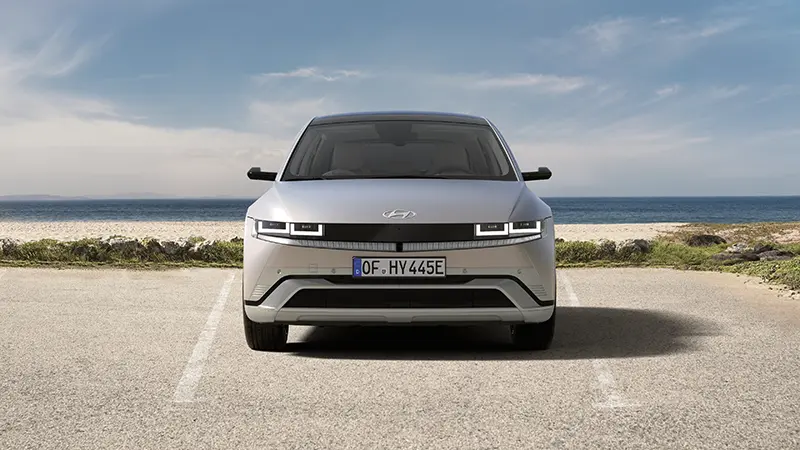
The Ioniq 5’s efficiency tops out with the extended-range RWD (19-inch wheels), which the EPA rates at up to around 115 MPGe combined.
AWD versions slide into the mid-90s to low-100s MPGe because of the added weight.
Getting 318 EPA miles out of an 84-kWh pack is a solid result for a compact SUV.
MPGe is the EV equivalent of mpg — it tells you how far you travel on the energy equal to a gallon of gas.
The higher the number, the farther you go on the same electricity. EVs tend to be more efficient the slipperier their shape, and the Ioniq 5 is a boxy crossover.
So its efficiency comes less from aerodynamics and more from the powertrain and regenerative braking.
On top of E-GMP’s efficient motor and inverter, the regen braking — adjustable via paddles, with full one-pedal driving — claws back a lot of energy, especially in the city.
Even though EV-Database puts curb weight at around 4,540 pounds, efficiency stays respectable.
Just know that efficiency is sensitive to wheel size, road surface, season, and speed.
The 19-inch figures are the best; 20-inch wheels, rough roads, and cold weather all knock it down.
Because aerodynamics aren’t its strong suit, efficiency drops further on the highway, where air resistance dominates.
It’s realistic to treat the official rating as a best-case number.
5. Ioniq 5 Android Auto and Infotainment
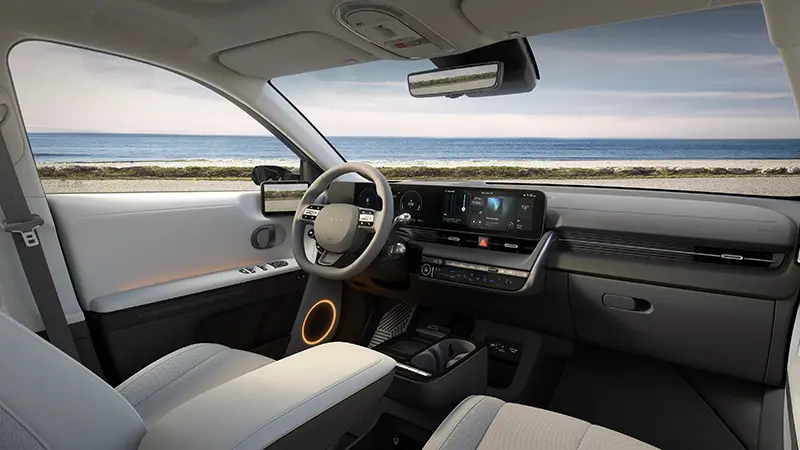
Since the March 2024 refresh (the “New Ioniq 5”), the Hyundai Ioniq 5 supports wireless Android Auto and wireless Apple CarPlay out of the box.
You can mirror your phone on the car’s display with no cable.
It’s built around Hyundai’s next-gen ccNC infotainment system, with two 12.3-inch screens that split the duties.
The cluster behind the wheel handles driving info — speed, range, efficiency — while the center screen takes navigation, media, and vehicle settings.
The two are joined into a single wide panel angled slightly toward the driver, so you can take everything in without moving your eyes much.
This is a big deal for US drivers.
Unlike Tesla, which supports neither CarPlay nor Android Auto, the Ioniq 5 lets you run the apps you already use — Google Maps, Waze, Spotify, Apple Music — right on the car’s screen.
☑️ Wireless CarPlay and Android Auto
Wireless wasn’t standard from day one.
Hyundai and Kia first rolled out wireless ccNC connectivity via an OTA update in September 2023, then made it standard starting with the refreshed models.
Both wired and wireless work reliably, so you can pick whichever suits your setup.
☑️ The Return of Physical Buttons
The refresh added physical buttons for the heated and ventilated seats.
You can adjust them by feel without digging through on-screen menus, which improves both safety and convenience on the move.
It’s a refreshingly practical call that bucks the recent trend of burying every function in a touchscreen.
6. How Much Does the Ioniq 5 Cost?
The 2026 Ioniq 5 price ranges from $35,000 for the SE Standard Range to about $48,975 for a top Limited AWD (MSRP, before the $1,600 destination charge).
Here’s how the lineup breaks down, per Hyundai.
☑️ Ioniq 5 Price by Trim
| Trim | MSRP (before destination) |
|---|---|
| SE Standard Range (RWD) | $35,000 |
| SE (RWD) | $37,500 |
| SEL (RWD) | $39,800 |
| Limited (RWD) | $45,075 |
| XRT (AWD) | $46,275 |
AWD is a roughly $3,500 option on the SE and SEL, and the top Limited AWD runs about $48,975.
Final pricing may vary based on destination charges, local taxes, and trim selection.
7. Ioniq 5 Pros and Cons: The Quick Verdict
The Ioniq 5’s pros and cons are clear.
Charging, space, and build quality are the strengths; ICCU reliability, a large turning circle, and limited rear visibility are the weak spots.
Edmunds scored it 8.3 out of 10 and called it a benchmark for the class.
The praise centers on 800V fast charging, ample real-world range, and an intuitive UI.
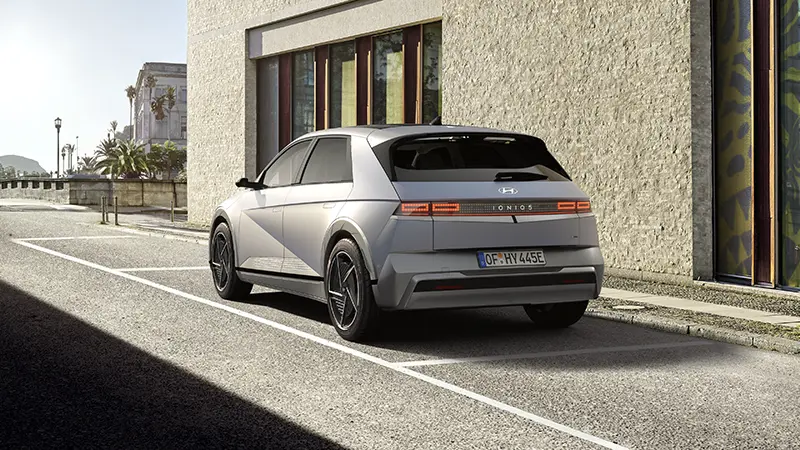
On the flip side, thick C-pillars pinch rear visibility (so you’ll lean on the cameras), and the wide turning circle draws repeated complaints in parking lots.
☑️ The Biggest Weakness: ICCU Reliability
The Ioniq 5’s most-cited weakness is the reliability of its ICCU (Integrated Charging Control Unit).
The ICCU is the key part that charges and manages the 12V accessory battery from the high-voltage pack, so when it fails, you can lose power while driving or be unable to start the car.
In 2024, NHTSA oversaw two ICCU recalls (campaigns 24V204 and 24V868) covering roughly 170,000 E-GMP vehicles, including the Ioniq 5.
But the software-focused fixes didn’t fully solve it: recurrences were reported even on cars built after the recall, and many point to the hardware design as the root cause.
Hyundai has extended ICCU warranty coverage to 15 years / 180,000 miles in the US, but per Electrek, that extension applies to the affected vehicles — the recalled 2022–2024 cars — not the latest model year.
So a new 2026 model isn’t covered by that extension — it gets the standard EV component warranty (10 years / 100,000 miles).
In other words, new-car buyers aren’t direct beneficiaries of the beefed-up coverage.
That said, 10 years / 100,000 miles is still robust coverage, and Hyundai maintains that recent production has been improved.
Its US dealer network handles service nationwide, so support is within reach.
Even so, the prevailing view is that a true fix waits on next-gen parts and platforms — so even new-car buyers should go in aware of this history.
☑️ How Does It Stack Up Against Rivals?
Line it up against same-price rivals and its position gets clear.
| Spec | Ioniq 5 (Ext. Range) | Kia EV6 | Model Y RWD |
|---|---|---|---|
| Starting MSRP | $37,500 (SE) | from $37,900 | $39,990 |
| Range (EPA) | 318 mi | up to 319 mi | 321 mi |
| Charging | 800V · 350 kW | 800V · 350 kW | 400V · up to 250 kW |
| Phone projection | Wireless | Wireless | Not supported |
The Tesla Model Y RWD is the entry trim, and in the US its EPA range is now 321 miles — essentially matching the 84-kWh Ioniq 5 and EV6 rather than trailing them.
Where it does give ground is charging speed: the Model Y runs a 400V system capped around 250 kW, so it can’t keep pace with the Ioniq 5’s 800V, 350-kW capability at high-power stations.
The Model Y counters with constant over-the-air (OTA) software updates and generous cargo room — a deep trunk plus a front trunk (frunk).
Its Supercharger access used to be a clear edge, but with the Ioniq 5 now carrying a native NACS port, that gap has largely closed.
Personally, if you care about charging speed, phone projection, and interior versatility, I think the Ioniq 5 is the most balanced pick here.
Against its sibling, the EV6, the range gap is small enough that it really comes down to design and interior taste.
💡 FAQ
Q1. How much range does the Ioniq 5 have?
The extended-range model is EPA-rated at 318 miles (RWD, 19-inch wheels) and the Standard Range at 245 miles; Europe’s WLTP cycle rates them higher at 354 miles.
The EPA figure is conservative enough that many owners beat it in real driving. Cold weather trims 20–30%, but the heat pump keeps that loss in line with other EVs in the class.
Q2. Does the Ioniq 5 support Android Auto?
Yes — since the 2024 refresh, it supports wireless Android Auto and wireless Apple CarPlay as standard.
You can run familiar apps like Google Maps, Waze, and Spotify right on the screen, a clear advantage over Tesla, which supports neither.
Q3. How long does the Ioniq 5 take to charge?
About 18–20 minutes from 10% to 80% on a 350-kW fast charger.
The 800V platform makes it one of the quickest in its class, and it charges effectively at both 800V and 400V stations.
Q4. There’s an ICCU recall — is it safe to buy?
The ICCU recalls were issued but, being software-focused, didn’t fully resolve the issue.
A new 2026 model isn’t covered by the warranty extension (15 years / 180,000 miles, limited to recalled vehicles) — it gets the standard 10-year / 100,000-mile warranty.
With Hyundai’s US dealer network handling service, weigh this history and decide accordingly.
✨ Final Thoughts
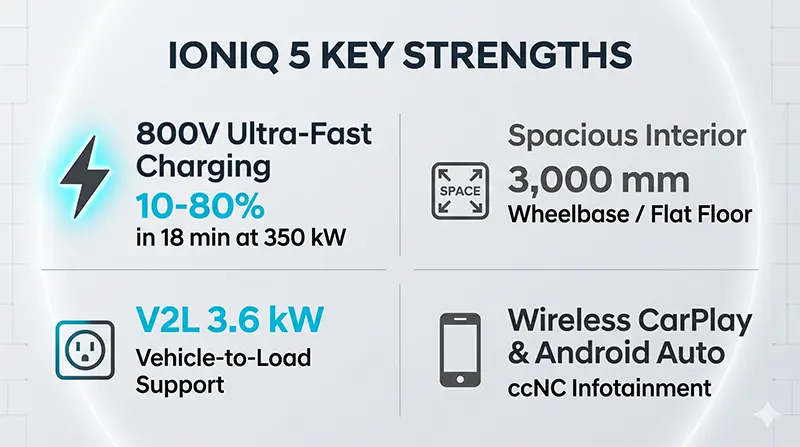
The Ioniq 5 has become a benchmark EV with 800V fast charging, a roomy cabin, and wireless CarPlay and Android Auto.
It’s easy to see why the “global bestseller” label isn’t hype.
That said, ICCU reliability is the one variable worth weighing before you buy.
Personally, if you value a spacious cabin and solid dealer support, it’s a satisfying choice.
It’s an especially good fit if you’ll lean on the 3.6-kW V2L for camping and the outdoors, want to cut waiting time on long trips with 800V charging, or want your familiar apps through wireless Android Auto and CarPlay.
On the other hand, the Model Y RWD brings one thing no Ioniq 5 trim can: Tesla’s Full Self-Driving (Supervised).
It’s a paid, subscription-based driver-assist system — not true hands-off autonomy, since you still have to stay attentive and ready to take over — but in everyday US driving it manages both highway and city routes about as close to self-driving as this segment gets.
So if that capability, maximum cargo space, or Tesla’s broader software ecosystem is the deciding factor, weigh the Model Y RWD; if every last mile of range matters, the EV6 on the same platform is worth a look too.
So where do you land — Ioniq 5, EV6, or Model Y?
Drop your thoughts in the comments, and bookmark this one for whenever you’re ready to pull the trigger.
![Split-screen comparison banner featuring Tesla Model Y and Hyundai Ioniq 5 electric SUVs side by side [AI Concept]](https://smartleadertech.com/wp-content/uploads/2026/06/model-y-ioniq-5-comparison-banner-300x169.webp)
![Side-by-side comparison marketing banner featuring Tesla Model Y and BYD Sealion 7 electric SUVs with central VS graphic highlighting their distinct design philosophies [AI Concept]](https://smartleadertech.com/wp-content/uploads/2026/06/tesla-model-y-vs-byd-sealion-7-comparison-300x168.webp)