
At the bottom of this post, a two-minute video explains it in an easy-to-follow way, with illustrations and side-by-side comparisons. Watch the video ▶
The Galaxy Fold8 Wide and the Fold8 Ultra use the same chip, the Snapdragon 8 Elite Gen 5 for Galaxy. But the Galaxy Fold8 Wide graphics score is 14.1% lower. It is the same chip, so why is there a difference?
First, the Galaxy Fold8 Wide graphics numbers. These are the scores the tech site Tom’s Guide measured with 3DMark, a graphics test app. The Wide scores 26,608. The Ultra scores 30,980. That puts the Wide 14.1% below the Ultra and 29.6% above the previous Fold7.
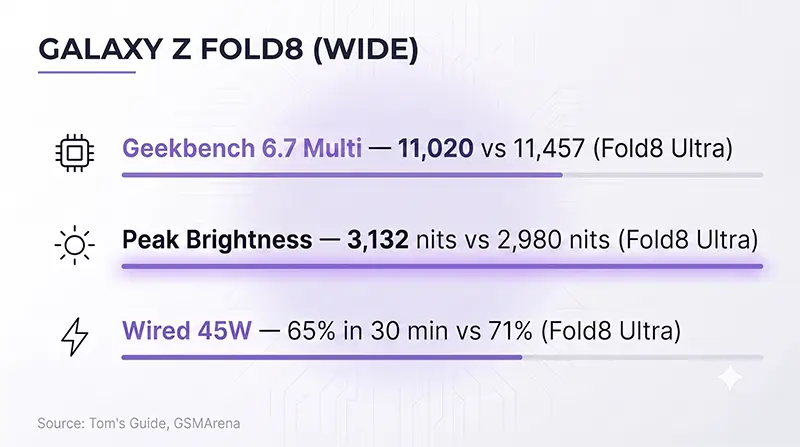
The CPU, on the other hand, is effectively the same. In Geekbench, a performance test app, the Wide is 2% below in single-core and 3.8% below in multi-core. That is too small to notice in daily use. The real gap is in graphics.
The reason is heat. Start with what both models share. GSMArena, a phone review site, points out that an open foldable is only about 4.5mm thick, so heat has little room to escape. So Samsung sets the chip’s maximum performance a little lower from the start, and the same chip scores lower than in a bar-type phone.
Then why does the Ultra, also a foldable, score higher in graphics? The difference is how each phone removes heat. The Ultra has an expanded cooling structure. In GSMArena’s Ultra review, the temperature you feel in your hand was lower than on the Wide. The phone that removes heat better keeps more performance in reserve.
What you notice is a different matter. Launching apps, browsing the web, or starting the camera, you will almost never notice a difference. Personally, unless you play demanding games for long sessions, I think the performance difference is close to nothing. For more on the Galaxy Fold8 Wide, watch the full videos.
Galaxy Fold8 Wide graphics Key numbers
- 3DMark Wild Life Unlimited: Fold8 Wide 26,608 / Ultra 30,980 (14.1% lower)
- 29.6% above the Fold7 (20,529)
- Geekbench 6.7: single-core 3,659, multi-core 11,020 (2.0% and 3.8% below the Ultra)
💡 FAQ
Q1. Is the CPU slower than the Ultra’s too?
Only slightly. In Tom’s Guide’s Geekbench 6.7 testing, the Fold8 Wide scored 3,659 single-core and 11,020 multi-core against the Ultra’s 3,733 and 11,457, 2.0% and 3.8% lower. The CPU gap with the Ultra is too small to pick out in daily use.
Q2. Does performance drop under long loads?
In GSMArena’s stress test, the Fold8 Wide lost roughly half its initial performance after an extended load, and surface temperatures climbed clearly higher than on the S26 Ultra. Halving under sustained load happens to the S26 Ultra too, so temperature is where they part ways.
Q3. Will I notice it in games?
Launching apps, browsing the web or firing up the camera, you’ll almost never notice a difference. Run a demanding game for 30 minutes straight or shoot long video sessions, and frame stability and heat will show you the gap.
Watch next
- 📝 Full specs and details 👉 Galaxy Fold8 Wide Specs In Depth, 4 Differences from the Ultra
- Full video (11 min) 👉 Galaxy Fold8 Wide: Brighter Than the Ultra, Slower to Charge? Brightness, Heat, Battery, Real Tests