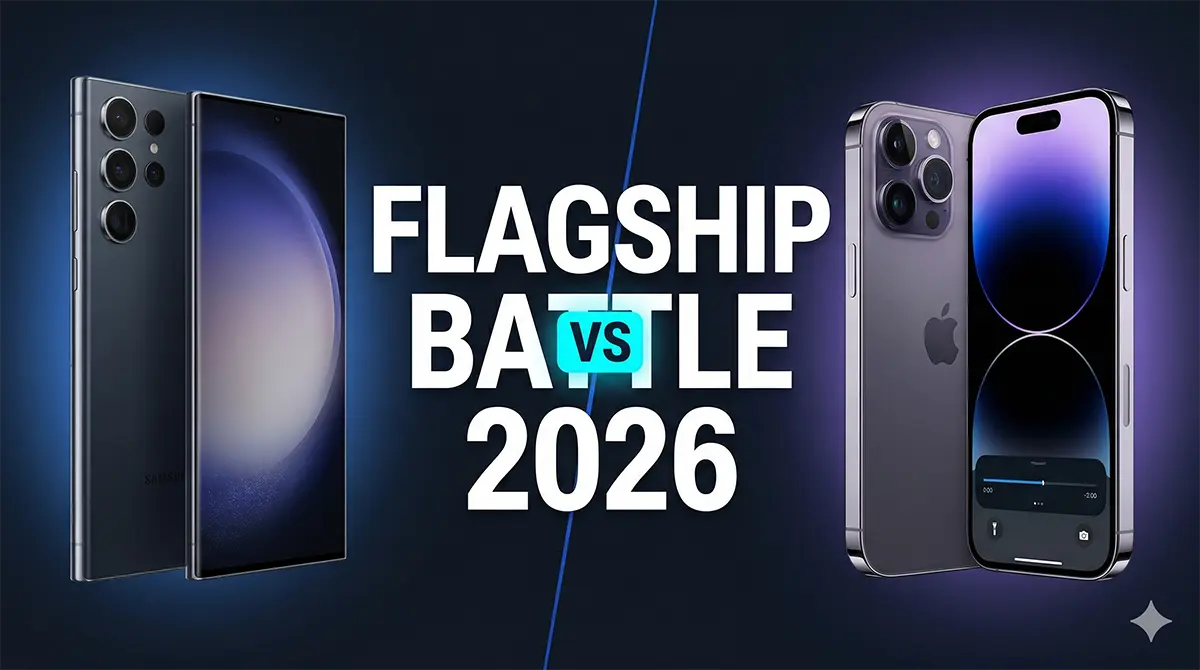
The two biggest flagships of 2026 are finally here, and this is the matchup everyone’s been waiting for: Samsung S26 Ultra vs iPhone 17 Pro Max.
On paper, both phones look nearly flawless.
But spend a few days with each one, and the differences become obvious fast.
Wondering what actually changed this year — and which one fits the way you use a phone? You’re not alone.
The iPhone 17 Pro Max and Galaxy S26 Ultra specs may look similar on paper, but the philosophies behind them couldn’t be more different.
In this post, we’re breaking down the real-world differences across design, camera, battery, AI, pricing, and more — so you can make a decision you won’t second-guess.
ℹ️ This post contains spec-based informational images and AI-generated concept images. Concept images may differ from the actual product.
📌 Key Takeaways
- Design & Display: The Galaxy S26 Ultra is 19g lighter and features a first-of-its-kind built-in Privacy Display. The iPhone edges ahead in outdoor brightness and water resistance depth (20ft vs 5ft).
- Performance & Thermals: Day-to-day feel is nearly identical, but the iPhone holds a slight edge in sustained performance under heavy loads.
- Camera: Photos (zoom and low-light) favor the Galaxy S26 Ultra. Video and in-app social media shooting favor the iPhone 17 Pro Max. Color science comes down to personal preference.
- Battery: The iPhone lasts longer per charge; the Galaxy charges dramatically faster.
- AI: Galaxy AI is clearly ahead in both range and real-world usefulness.
- Real-World Opinions: It’s no longer about “which is better” — it’s about which strengths matter more to you.
- Price & Long-Term Support: At the same storage tier, the iPhone 17 Pro Max is $100–$200 cheaper. But Samsung officially guarantees 7 years of updates — a concrete commitment Apple hasn’t matched on paper.
- 📌 Key Takeaways
- 1. Design and Display — You'll Feel the Difference the Moment You Pick Them Up
- 2. Performance and Thermals — Similar Day-to-Day, but Stamina Tells a Different Story
- 3. Camera — Photo Lovers Pick the Galaxy, Video Creators Pick the iPhone
- 4. Battery and Charging
- 5. AI Features — The Widest Gap Between These Two
- 6. Real-World User Reactions — The "Which One Is Better" Era Is Over
- 7. Price and Long-Term Support — When They Cost This Much, the Details Matter
- 💡 FAQ
- ✨ Final Verdict
1. Design and Display — You’ll Feel the Difference the Moment You Pick Them Up
| Spec | Galaxy S26 Ultra | iPhone 17 Pro Max |
|---|---|---|
| Weight | 214g | 233g |
| Thickness | 7.9mm | 8.8mm |
| Frame Material | Armor Aluminum 2 (glass sandwich) | Aluminum alloy unibody |
| Peak Brightness | 2,600 nits | 3,000 nits |
| Privacy Display | ✅ (first built-in on any mobile) | ❌ |
| Front Glass | Gorilla Armor 2 | Ceramic Shield 2 |
| Back Glass | Gorilla Armor 2 | Ceramic Shield |
| Water Resistance | IP68 (1.5m / 30 min) | IP68 (6m / 30 min) |
The 19g weight difference and 0.9mm thickness gap between these two feel bigger than the numbers suggest.
The Galaxy S26 Ultra is noticeably lighter and thinner in hand, whether you’re gripping it one-handed or sliding it into a pocket.
Both companies ditched titanium for aluminum this generation — but their engineering approaches are polar opposites.
Samsung went with a glass sandwich design, reducing the proportion of metal to shed weight.
Apple, on the other hand, committed to a unibody aluminum build that maximizes heat dissipation but adds heft.
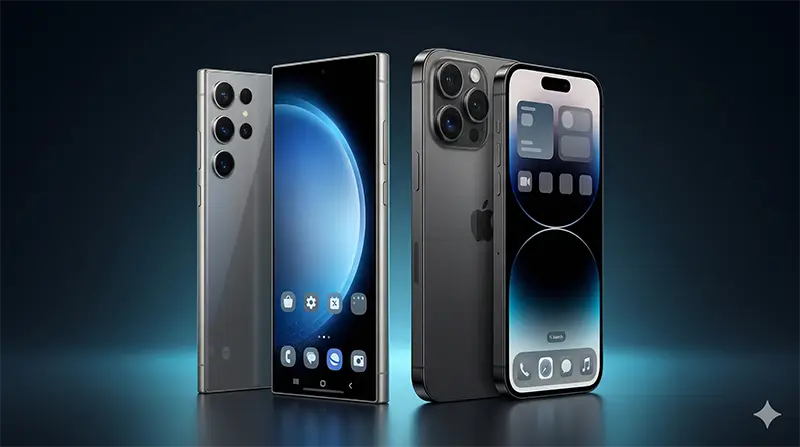
☑️ Privacy Display — A Weapon Only the Galaxy Has
The standout feature of this generation’s Galaxy S26 Ultra is its Privacy Display.
It’s the first built-in privacy screen on any mobile device, using specific pixels that emit light at a narrow angle so the screen appears dark when viewed from the side.
You can enable it on a per-app basis, and it activates automatically during PIN entry or when you open banking apps.
The consensus from early reviews is that it works exactly as intended — especially useful on public transit or in coffee shops when you’re pulling up a banking app or password manager.
That said, there’s a trade-off in image quality when the privacy mode is active.
Some users also report a subtle but noticeable dip in overall display quality even with the mode turned off, compared to previous Galaxy displays.
Since you can choose which apps trigger it, keeping it enabled only where it matters is the practical move.
But if display quality is your top priority above all else, seeing it in person before buying is a smart call.
The iPhone 17 Pro Max has no hardware equivalent to this feature.
When it comes to outdoor visibility, the iPhone 17 Pro Max takes the lead.
Peak brightness hits 3,000 nits versus 2,600 nits — a 400-nit gap — and Apple’s new anti-reflective coating (twice as effective as the previous generation) gives it a real advantage under direct sunlight.
That said, the Galaxy S26 Ultra’s Gorilla Armor 2 has its own anti-reflective properties, so both phones hold up just fine for typical outdoor use.

☑️ Durability and Water Resistance
The Galaxy S26 Ultra uses Gorilla Armor 2 on both the front and back for consistent protection, while the iPhone 17 Pro Max features Ceramic Shield 2 (3x better scratch resistance) on the front and standard Ceramic Shield on the back.
One thing to note: some reviewers have flagged paint chipping on the iPhone 17 Pro Max’s aluminum sides, and scratch concerns have been a recurring topic in online communities.
Both phones carry an IP68 rating, but the Galaxy S26 Ultra is rated for 1.5m/30 minutes while the iPhone 17 Pro Max handles 6m/30 minutes — meaning the iPhone can survive four times the depth.
Personally, the Privacy Display alone makes the Galaxy S26 Ultra’s display package more compelling.
2. Performance and Thermals — Similar Day-to-Day, but Stamina Tells a Different Story
☑️ Snapdragon 8 Elite Gen 2 vs A19 Pro
Both chipsets are top-tier for 2026, and in everyday tasks like app switching, scrolling, and video streaming, the real-world difference is essentially zero.
By the benchmarks, the Galaxy S26 Ultra leads in multi-core and AnTuTu scores, while single-core performance is a toss-up.
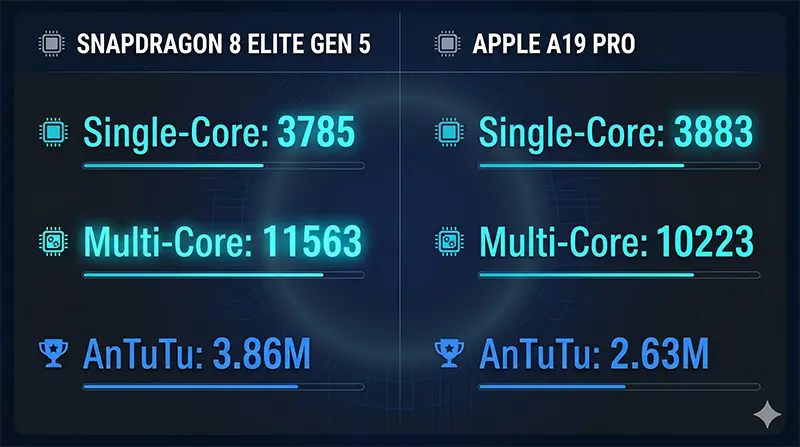
| Benchmark | Galaxy S26 Ultra | iPhone 17 Pro Max |
|---|---|---|
| Geekbench 6 Single | 3,648–3,785 | 3,500–3,883 |
| Geekbench 6 Multi | 10,898–11,563 | 9,968–10,223 |
| AnTuTu v10 | ~3.72M–3.86M | ~2.59M–2.63M |
☑️ The Real Gap Shows Up Under Sustained Heavy Loads
Apple introduced an entirely new thermal architecture this generation — a laser-welded vapor chamber (a cooling system that spreads heat across a wide surface area) integrated into the aerospace-grade aluminum unibody.
The result is a 40% improvement in sustained performance over the previous generation.
In practice, games like Warframe consistently hold 60fps over extended sessions.
The Galaxy S26 Ultra also improved with a larger vapor chamber and the return of an aluminum frame for better heat conductivity, but some user tests have reported throttling (automatic performance reduction to prevent overheating) during prolonged heavy loads.
Peak performance is undeniably strong, but the iPhone has a structural advantage when it comes to endurance.
On the flip side, the Galaxy S26 Ultra’s NPU (neural processing unit) is 39% more powerful than the previous generation, giving it a clear edge in on-device AI processing for Galaxy AI features.
It comes down to what matters more to you: sustained gaming performance, or the AI capabilities you’ll actually use every day.
3. Camera — Photo Lovers Pick the Galaxy, Video Creators Pick the iPhone
The camera comparison is the hottest topic in the Samsung S26 Ultra vs iPhone 17 Pro Max debate.
The bottom line: photos (especially zoom and low-light) favor the Galaxy S26 Ultra, while video and in-app social media shooting favor the iPhone 17 Pro Max.
| Spec | Galaxy S26 Ultra | iPhone 17 Pro Max |
|---|---|---|
| Main Camera | 200MP, f/1.4, 1/1.3″ | 48MP, f/1.78, 1/1.28″ |
| Ultrawide | 50MP, f/1.9, 120° | 48MP, f/2.2, 120° |
| Telephoto Setup | 3x + 5x dual telephoto | 4x tetraprism (up to 8x optical-quality) |
| Max Zoom | 100x (5x optical) | 16x (8x optical-quality) |
| Main Aperture | f/1.4 (collects more light) | f/1.78 |
| Color Profile | Muted and true-to-life | High saturation, punchy |
| DxOMark Overall | 157 (18th) | 168 (3rd) |
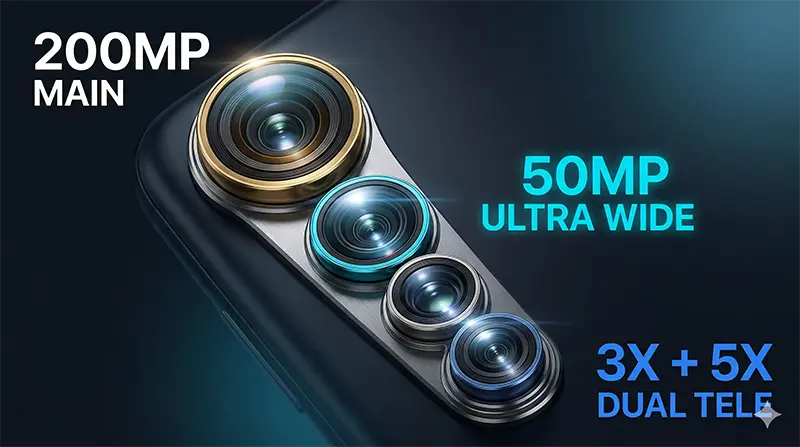
☑️ 200MP vs 48MP — Don’t Let the Numbers Fool You
The spec gap looks massive — over 4x on paper — but both cameras output around 12MP in standard shooting mode.
The 200MP sensor’s real strength shows up in crop-zoom detail retention and large-format prints.
In everyday shooting, the resolution difference is hard to notice. What is immediately obvious is the difference in color science.
☑️ The Color Difference Is Unmistakable
In a 200-shot comparison test, the iPhone consistently produced more saturated, punchier images, while the Galaxy delivered a more muted look that’s closer to what your eyes actually see.
If you want photos that pop on social media right out of the camera, the iPhone wins.
If you prefer capturing a scene as it actually looks, the Galaxy S26 Ultra is your pick.
☑️ S26 Ultra iPhone 17 Camera Comparison — Zoom, Ultrawide, and Night Shots
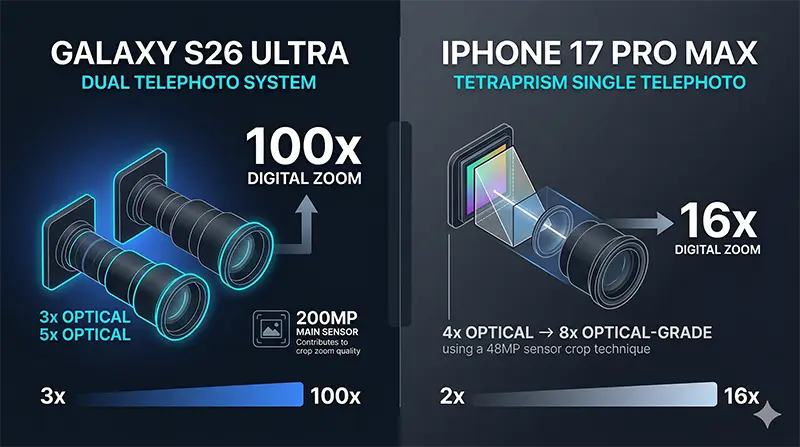
The Galaxy S26 Ultra packs two telephoto lenses at 3x and 5x, giving it a wider zoom range.
It particularly excels at extreme zoom levels beyond 10x — starting from a 5x optical lens means less digital cropping is needed, and the 200MP main sensor’s pixel surplus helps preserve fine detail.
The trade-off: you may notice shifts in image quality or color tone during the transition between the 3x and 5x lenses.
The iPhone 17 Pro Max uses a single 4x tetraprism telephoto.
Its native optical reach is 4x, but by cropping into the center of the 48MP sensor, it maintains optical-level quality up to 8x.
With a single lens, there’s no switching — zoom is smooth, and image quality stays consistent across the 2–8x range.
Beyond 10x, though, the iPhone falls behind because it’s digitally stretching from a 4x optical base, resulting in more quality loss compared to the Galaxy.
In short: long-range zoom goes to the Galaxy; everyday zoom (2–8x) with rock-solid consistency goes to the iPhone.
The ultrawide camera gives a slight edge to the iPhone 17 Pro Max.
Both use 48–50MP sensors, but the iPhone delivers better contrast and sharpness in side-by-side comparisons.
The Galaxy S26 Ultra tends to look slightly washed out in bright sunlight — not because of the sensor itself, but due to differences in computational image processing.
In low-light shooting, the Galaxy S26 Ultra’s f/1.4 aperture delivers a real physical advantage.
Compared to the iPhone’s f/1.78, it gathers roughly 60% more light, giving the Galaxy a meaningful edge in dim environments.
That said, the actual results diverge based on post-processing.
The Galaxy applies aggressive AI-based noise reduction, producing clean and bright images — but sometimes at the cost of smudged fine detail.
The iPhone takes a lighter touch with processing, leaving a bit more noise but preserving texture and atmosphere for a more natural look.
If you want clean results, go Galaxy. If you want natural mood, go iPhone.
☑️ Video and In-App Social Media Shooting Still Favor the iPhone
The iPhone 17 Pro Max’s professional video codec ecosystem is hard to beat — ProRes, Apple Log 2, Dolby Vision, and 4K 120fps.
The raw data retention is significantly higher, which gives you far more flexibility in post-production for color grading and exposure adjustments.
That difference translates directly into smoother, more cinematic footage.
For creators who prioritize video capture and editing, the iPhone remains the more compelling choice.
In-app camera quality on platforms like Instagram and TikTok also favors the iPhone.
iOS apps tap into the camera API more directly, so when you’re shooting within the app itself, the quality gap is noticeable.
This is consistently one of the first things users mention after switching from iPhone to Galaxy.
The Galaxy S26 Ultra fights back with Horizon Lock (automatic leveling that keeps your footage stable even during heavy movement), 8K recording, and the APV (Advanced Professional Video) codec.
Stabilization has clearly improved.
DxOMark’s overall score puts the iPhone 17 Pro Max at 168 (3rd place) and the Galaxy S26 Ultra at 157 (18th).
However, when you look at major review outlets, the Galaxy consistently earns praise for zoom performance and low-light main camera quality — so judging by composite score alone doesn’t tell the full story.
Comparing by use case is far more realistic.
4. Battery and Charging
Battery capacity is nearly identical: the Galaxy S26 Ultra packs 5,000mAh and the iPhone 17 Pro Max comes in at roughly 5,088mAh.
But the real differences are in power efficiency and charging behavior.
☑️ The iPhone Outlasts It on a Single Charge
| Test | Galaxy S26 Ultra | iPhone 17 Pro Max |
|---|---|---|
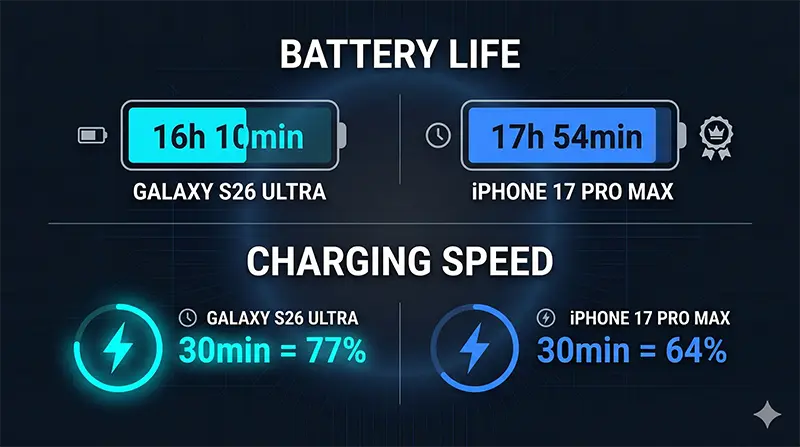
| Tom’s Guide Web Browsing (150 nits) | 16h 10min | 17h 54min |
| GSMArena Active Use | 16:23h | 17:58h |
| PhoneArena Gaming | 9h 17min | 11h 34min |
The iPhone 17 Pro Max generally lasts 1–2 hours longer across the board.
The A19 Pro’s power efficiency outperforms the Snapdragon, and the gap widens in gaming — some tests show over 2 hours of difference.
This is the combined result of the A19 Pro’s efficiency and the superior thermal management discussed earlier.
☑️ Charging Speed Goes Decisively to the Galaxy
On the flip side, the Galaxy S26 Ultra charges significantly faster.
With 60W wired charging, you hit 77–78% in 30 minutes, and a full 0-to-100% charge takes about 49 minutes.
The iPhone 17 Pro Max, with approximately 42W charging, reaches 64% in 30 minutes and needs 1 hour 16 minutes for a full charge.
☑️ Wireless Charging: iPhone Wins
For wireless charging convenience, Apple’s MagSafe 2.0 (25W magnetic-attach charging) has a clear advantage.
The snap-on magnetic system extends to chargers, stands, wallets, and a rich accessory ecosystem that’s ready to use right out of the box.
The Galaxy S26 Ultra supports Qi 2.2 but lacks built-in magnets — so getting the full 25W wireless charging experience requires a separate magnetic case.
Even with Samsung’s official case, some users have reported being capped at 15W instead of 25W, suggesting that wireless charging compatibility still has some kinks to work out.
5. AI Features — The Widest Gap Between These Two
This is the category where the Samsung S26 Ultra vs iPhone 17 Pro Max comparison produces the clearest winner.
Galaxy AI is ahead of Apple Intelligence in feature range, real-world usefulness, and execution speed across the board.
☑️ Galaxy AI — AI You’ll Actually Use Every Day
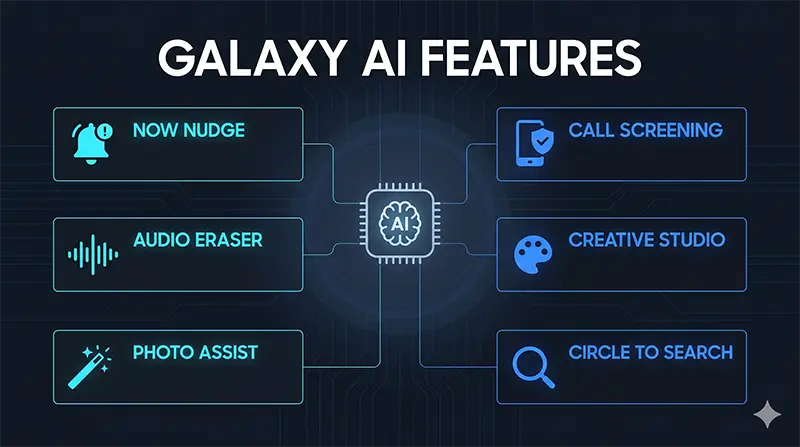
The Galaxy S26 Ultra, powered by a 39% more powerful NPU, goes all-in on agentic AI. Here are the key features:
Now Nudge: AI analyzes your schedule, location, and habits to surface contextual alerts automatically.
For example, it might suggest a relevant file before a meeting or push traffic info ahead of your commute.
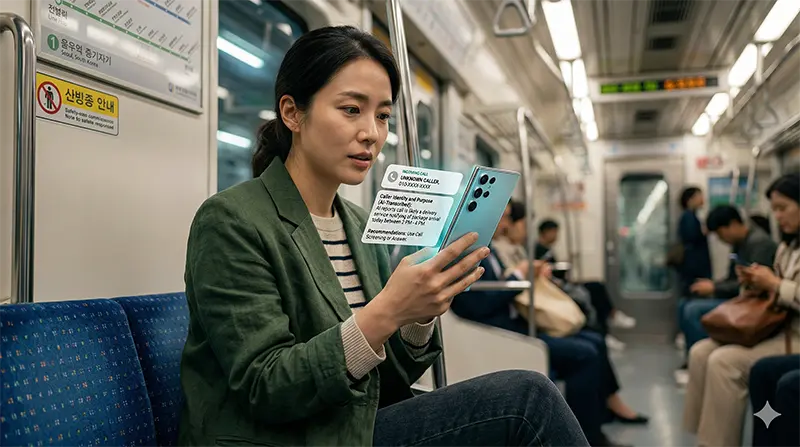
Call Screening: When an unknown number calls, AI answers on your behalf, identifies the caller and their reason for calling, then displays the information as text on your screen.
You decide whether to pick up or decline.
Audio Eraser: Isolates and selectively removes specific sounds — wind, background music, ambient noise — from videos in third-party apps like YouTube, Netflix, and Instagram.
Creative Studio: Combines text descriptions, quick sketches, and existing images to generate stickers, wallpapers, invitations, and cards with AI.
No design tools needed — personalized content, created on the spot.
Photo Assist: An AI editing tool that lets you add, remove, or transform elements within your photos.
Improved Circle to Search: Draw a circle on your screen and it now recognizes multiple objects at once — text, images, products — and searches them simultaneously.
Auto Screenshot Sorting: Take a screenshot and AI recognizes the content, then automatically organizes it into categorized albums in your Gallery.
Samsung also offers three AI assistant options — Bixby, Gemini, and Perplexity — letting you pick whichever fits your style and needs.
Not being locked into a single AI assistant is another strength of the Galaxy AI approach.
☑️ Apple Intelligence — Big Promises, Slow Delivery
Apple made a splash at WWDC 2024 by unveiling Apple Intelligence — announcing a major Siri overhaul, smart notification summaries, cross-app automation, and advanced summarization features.
But the real-world execution hasn’t lived up to the hype.
Multiple major outlets have repeatedly noted that priority notification accuracy is inconsistent and the summarization feature’s reliability falls short.
The most anticipated upgrade — Siri’s AI-powered transformation — still hasn’t fully materialized.
Apple’s privacy-first strategy — processing as much as possible on-device and applying Private Cloud Compute when the cloud is needed — is a genuine strength.
But the gap between what was promised and what’s actually been delivered remains significant as of right now.
Private Cloud Compute — Apple’s own secure servers that process data in an encrypted state, so user information is never exposed.
If you’re someone who actively uses AI features day-to-day, the Galaxy S26 Ultra is the clear pick.
6. Real-World User Reactions — The “Which One Is Better” Era Is Over
After launch, aggregating feedback from Reddit, YouTube reviews, and tech communities paints a clear picture: both sides have distinct wins and frustrations.
☑️ Galaxy S26 Ultra User Reactions
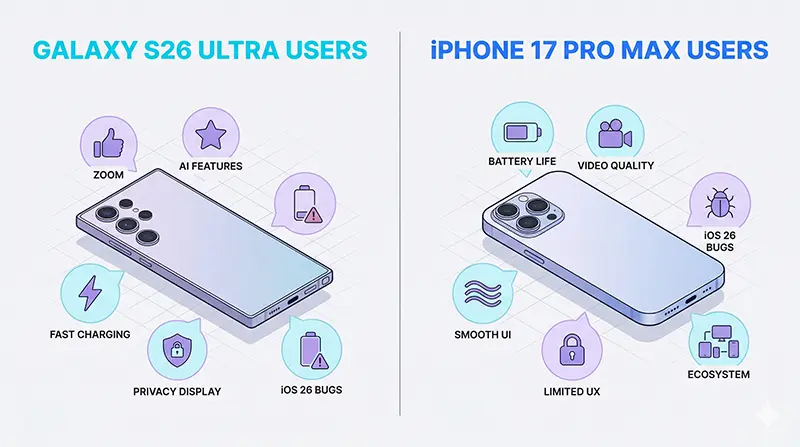
The zoom camera, Privacy Display, customization freedom, fast charging, and Galaxy AI are the most frequently praised features.
Users who switched from iPhone appreciate the added functionality and freedom, while long-time Samsung power users feel the hardware leap doesn’t quite justify the Ultra price tag this year.
Battery inconsistency has been reported by some, but the community consensus points to initial setup or Smart Switch migration as the likely culprit rather than a hardware issue.
☑️ iPhone 17 Pro Max User Reactions
Battery life, camera consistency, smooth UI, app optimization, and Apple ecosystem integration earned the most praise.
But the biggest complaint has been iOS 26’s early stability issues.
From launch through several months after, users repeatedly reported random reboots, scroll stuttering, app freezing, and CarPlay bugs.
The hardware is excellent, but the software has been holding it back — that’s been the dominant sentiment.
As updates progressed through iOS 26.3, more users have reported improvements, but some still encounter intermittent bugs — worth keeping in mind.
Users who switched from Samsung frequently mention frustration with text editing, multitasking, and keyboard flexibility within iOS.
☑️ The Verdict from People Who’ve Used Both
The most insightful reactions come from users who’ve spent 3+ months with both phones. Their conclusion: the real battle isn’t hardware anymore — it’s a difference in OS philosophy.
The iPhone’s strengths are rock-solid battery, camera consistency, and a seamless app experience.
The Galaxy’s strengths are AI, zoom, fast charging, and customization freedom.
Ultimately, the most consistent takeaway is that it’s no longer about “which one is better” — it’s about “which strengths matter more to you.”
7. Price and Long-Term Support — When They Cost This Much, the Details Matter
Price and long-term support are essential factors in any Samsung S26 Ultra vs iPhone 17 Pro Max pros and cons breakdown.
☑️ Price Comparison
| Storage | Galaxy S26 Ultra | iPhone 17 Pro Max |
|---|---|---|
| 256GB | $1,299.99 | $1,199 |
| 512GB | $1,499.99 | $1,399 |
| 1TB | $1,799.99 | $1,599 |
| 2TB | — | $1,999 |
At US MSRP (unlocked, pre-tax), the iPhone 17 Pro Max is actually $100–$200 less expensive at every comparable storage tier.
Apple held the line from the iPhone 16 Pro Max, keeping the 256GB entry at $1,199 for the third year running.
Samsung kept the $1,299.99 entry point for the 256GB S26 Ultra, but the 512GB tier rose from $1,419.99 to $1,499.99 (an $80 increase) and the 1TB tier jumped from $1,659.99 to $1,799.99 (a $140 increase) compared to the S25 Ultra.
That said, carrier trade-in deals, installment plans, and promotions can shift the actual out-of-pocket cost dramatically — so MSRP alone doesn’t tell the full value story.
One important detail: the Galaxy S26 Ultra ships with 12GB of RAM on the 256GB and 512GB models, but the 1TB model gets 16GB of RAM.
The iPhone 17 Pro Max comes with 12GB across all storage options.
If you want to get the most out of AI features long-term, the Galaxy’s 16GB RAM on the 1TB model gives it a meaningful advantage.
On-device AI loads data into RAM for processing, so as AI models continue to grow in size, that 4GB gap could make a real difference down the road.
The iPhone 17 Pro Max also offers an exclusive 2TB option ($1,999).
It’s a steep price, but for users who regularly shoot 4K ProRes video or other large-format content, it’s worth considering.
☑️ Software Updates — If You Plan to Keep It for Years
The Galaxy S26 Ultra officially guarantees 7 years of OS updates + 7 years of security updates (through 2033).
Apple hasn’t publicly committed to a specific support window for the iPhone 17 Pro Max, but historically, iPhones have received 5–7+ years of updates.
Both will likely be supported for a long time in practice, but the Galaxy has the edge in transparency — you know exactly what you’re getting at the time of purchase.
💡 FAQ
✨ Final Verdict
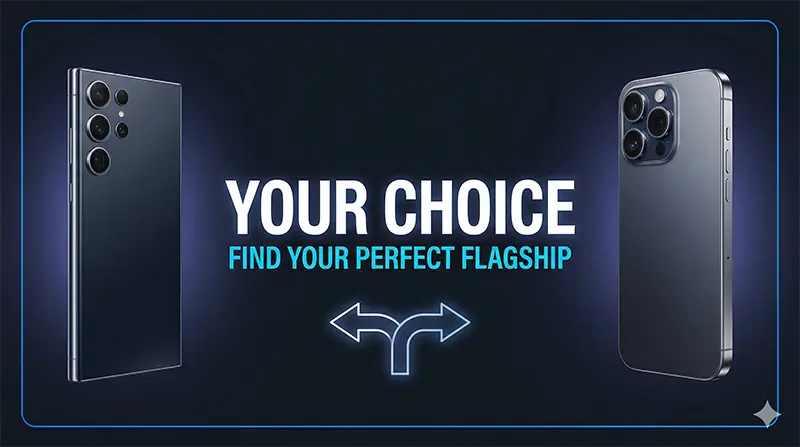
Here’s how the iPhone 17 Pro Max vs Samsung S26 Ultra stacks up, category by category:
| Category | Edge |
|---|---|
| Design & Display | Galaxy S26 Ultra |
| Performance & Thermals | iPhone 17 Pro Max (slight) |
| Camera | Tie (photos → Galaxy / video & social → iPhone) |
| Battery & Charging | iPhone 17 Pro Max (slight) |
| AI | Galaxy S26 Ultra |
| Real-World Opinions | Split by use case |
| Price & Long-Term Support | iPhone is cheaper per tier / Galaxy guarantees longer updates |
Looking at it category by category, the Galaxy S26 Ultra racks up notable wins with the Privacy Display, AI, camera zoom, and fast charging.
But the iPhone 17 Pro Max holds undeniable ground in Apple ecosystem integration, video shooting quality, battery endurance — and it comes in at a lower MSRP this year.
That’s actually a testament to both phones — each has pushed completeness so high in 2026 that neither has a glaring weakness.
Figure out your priorities and usage patterns first, then pick accordingly — that’s how you avoid buyer’s remorse.
So which one are you leaning toward? Drop your pick in the comments.