
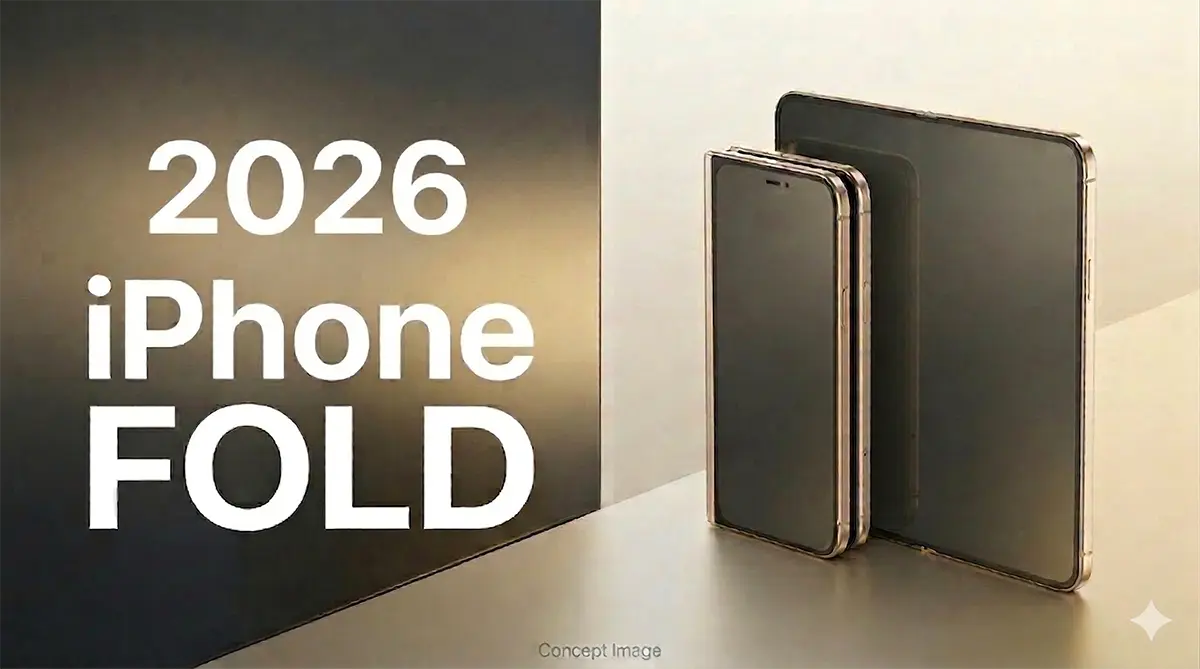
“Apple is making a foldable?”
The rumors have been swirling for years, but this time it’s different.
The chances of an iPhone Ultra actually happening have never been higher. Multiple credible sources are all pointing to the second half of 2026.
Samsung has been building the foldable market for years — so why is Apple only making its move now?
📌 Key Takeaways
- iPhone Fold release date → Likely announced alongside the iPhone 18 Pro in September 2026. However, actual sales could be delayed to October–December (per Bloomberg’s Mark Gurman, Barclays’ Tim Long, and other sources).
- Design → A book-style form factor similar to the upcoming Galaxy Z Fold Wide, unfolding into a 7.8-inch tablet-sized display.
- Key tech → An ultra-low-crease panel where the fold is nearly invisible, paired with a Liquid Metal hinge.
- iPhone Ultra price → Starting at roughly $1,999, with the 1TB model exceeding $2,399.
- Standout features → Touch ID returns in place of Face ID, with iPad-style multitasking powered by iOS 27.
- 📌 Key Takeaways
- iPhone Fold Release Date — September Reveal Is Certain, but the Wait Isn't Over
- Design — An iPhone When Folded, an iPad When Opened
- Display — Can a Crease-Free Foldable Screen Actually Happen?
- Hardware Specs — The Biggest Battery in iPhone History
- Camera — Dual Rear Setup, but No Telephoto
- iPhone Ultra Price — Starting at $1,999, the Most Expensive iPhone Ever
- Software — It Runs iOS 27, but It Works Like an iPad
- Hinge & Durability — Where Apple Invested the Most
- Why Is Apple Entering the Foldable Game Now?
- The iPhone Flip Is Coming Too — A Clamshell Foldable Teased for 2027
- 💡FAQ
- ✨ Final Thoughts
iPhone Fold Release Date — September Reveal Is Certain, but the Wait Isn’t Over

The biggest question on everyone’s mind: when is it coming out?
Bloomberg’s Mark Gurman, analyst Ming-Chi Kuo, and other major sources are all pointing to the same scenario — a September 2026 reveal alongside the iPhone 18 Pro.
But here’s the thing: “announced” and “available to buy” might not be the same date.
During a Bloomberg Q&A on March 26, Gurman said there’s “no doubt” the iPhone 18 Fold will ship later than the Pro models, citing the extreme difficulty of foldable manufacturing.
Think back to 2017, when the iPhone X went on sale weeks after the iPhone 8.
A similar staggered launch pattern could very well repeat here.
So here’s the most realistic timeline right now:
- Announcement: September 2026 (alongside iPhone 18 Pro)
- Actual sales: October–December 2026 (depending on production complexity)
- Comfortable stock availability: Early 2027
The supply chain is already moving to match this schedule.
Samsung Display’s foldable panel mass production is set to begin in May, with Foxconn’s final assembly kicking off in early October.
There’s also a major shakeup in Apple’s overall iPhone launch strategy this year.
Fall 2026 will only feature the iPhone 18 Pro, Pro Max, and Fold.
The standard iPhone 18, 18e, and Air 2 are being pushed to March 2027. It’s a bold new approach — Apple is going all-in on its premium lineup first.
Design — An iPhone When Folded, an iPad When Opened
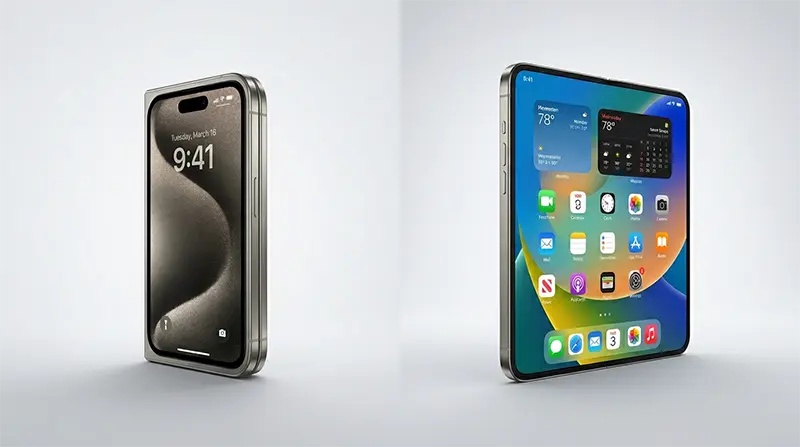
The iPhone foldable is shaping up as a book-style infolding design, similar to the Galaxy Z Fold Wide, Samsung’s upcoming new form factor model.
Early rumors pointed to a clamshell design like the Galaxy Z Flip — folding top to bottom — but the direction has clearly settled on a book-style that opens left to right.
Here are the expected screen sizes and dimensions:
| Spec | Details |
|---|---|
| Inner main display | ~7.76–7.8 inches (2,713 × 1,920, 4:3 ratio) |
| Outer cover display | ~5.49–5.5 inches (2,088 × 1,422) |
| Folded thickness | ~9–9.5mm |
| Unfolded thickness | ~4.5–4.8mm |
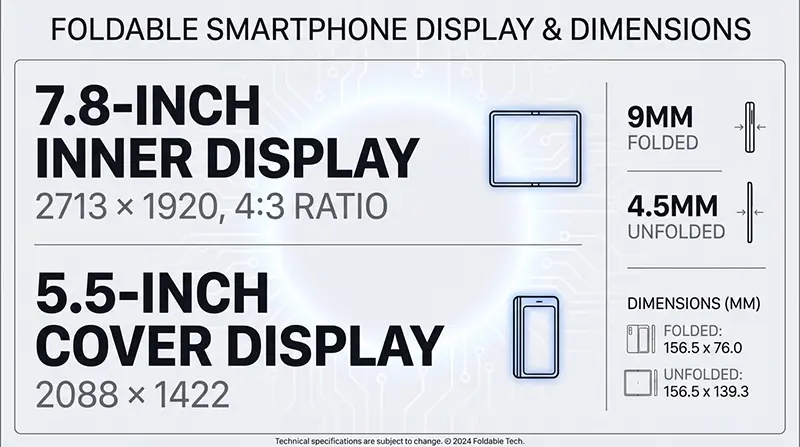
That 4:3 aspect ratio when unfolded gives you a display that’s slightly smaller than the iPad mini (8.3 inches) but perfectly optimized for video and split-screen app usage.
The frame uses a titanium and aluminum hybrid for both strength and lightweight handling.
The volume buttons move to the upper right side, and the left frame has no physical buttons at all.
It’s the same button layout as the iPad mini, likely to maximize internal design space. (Source: 9to5Mac, Feb 2026)
Color options are expected to include a dark Space Gray/Black and a light Silver/White.
Display — Can a Crease-Free Foldable Screen Actually Happen?

The biggest reason Apple took so long to enter the foldable game was the screen crease problem.
Reports indicate the crease depth is engineered to stay below 0.15mm with a crease angle under 2.5 degrees — pushing visual and tactile distraction to an absolute minimum.
If this holds true at launch, it could genuinely be a landmark achievement.
Samsung Display is the exclusive panel supplier for Apple’s foldable, and its CoE technology is expected to deliver a thinner, brighter, and more energy-efficient screen.
What’s especially telling is that Apple recently ramped up its initial foldable panel orders from Samsung Display significantly.
The original order of 13–15 million units has reportedly been increased to as many as 20 million.
For context, Samsung’s own total foldable sales target for 2026 is around 7 million units — meaning Apple is gearing up with roughly three times that volume in its very first year. (Source: Android Authority, Mar 2026)
The Galaxy Fold 8, also launching later this year, is touting its own creaseless panel technology as one of its biggest innovations.
Once both devices hit the market, comparing which one actually eliminates the crease better should be one of the most interesting head-to-head matchups of the year.
Hardware Specs — The Biggest Battery in iPhone History
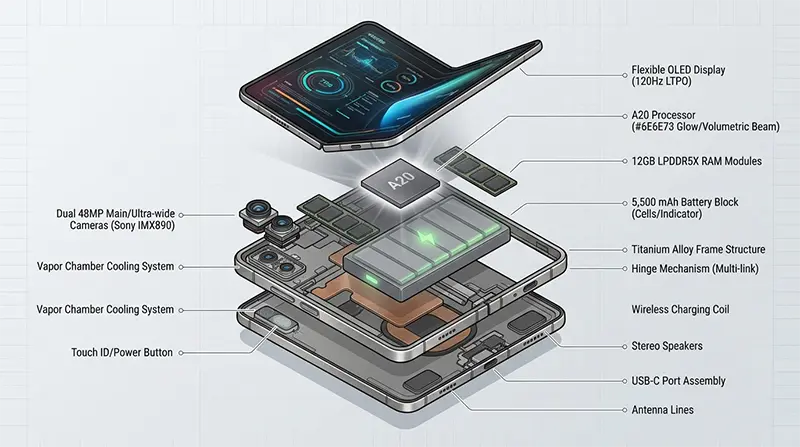
| Spec | Expected Details |
|---|---|
| Processor | A20 Pro or A20 (TSMC 2nm process) |
| RAM | 12GB LPDDR5X (Samsung-supplied) |
| Storage | 256GB / 512GB / 1TB |
| Battery | ~5,000–5,800mAh (most likely around 5,500mAh) |
| Modem | Apple’s in-house C2 modem (eSIM only, mmWave 5G) |
| Authentication | Side-mounted Touch ID (no Face ID) |
The battery capacity immediately stands out.
At an estimated 5,000–5,800mAh range (most likely around 5,500mAh), it surpasses the iPhone 17 Pro Max (5,088mAh) to become the largest battery ever in an iPhone.
This is another area where the comparison with the upcoming Galaxy Fold 8 gets really interesting — Samsung is also promising a record-breaking battery for its Fold series.
The Fold 8 is expected to pack 5,000mAh, a 600mAh jump from the Fold 7’s 4,400mAh.
The iPhone foldable is projected to go even bigger on raw capacity.
But numbers alone don’t tell the full story — what really matters is battery efficiency relative to weight.
With neither device’s weight officially confirmed yet, the real winner will only be decided through real-world usage reviews after launch.
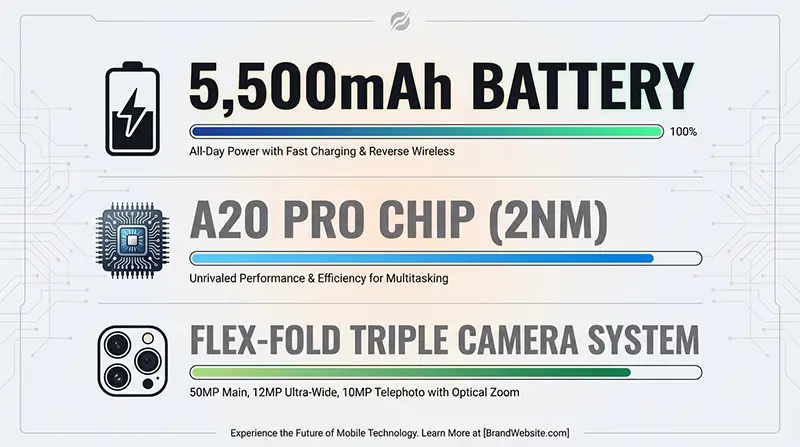
So who takes the battery crown? That’s still anyone’s game.
The two devices may also take different approaches to battery technology.
The Galaxy Fold 8 is expected to stick with conventional lithium-ion (Li-Po) batteries, likely without silicon-carbon technology.
The iPhone Ultra, on the other hand, has supply chain reports pointing to a silicon-carbon anode battery supplied by CATL (ATL) — though some analysts believe Apple may still go with a traditional approach.
The final call hasn’t been made yet.
The chipset will likely be a next-gen A20-series chip built on TSMC’s 2nm process.
Supply chain analyst Jeff Pu expects the same A20 Pro found in the iPhone 18 Pro, but some sources suggest the Pro lineup might get the A20 Pro exclusively, with the iPhone Ultra receiving the standard A20 chip.
Either way, both performance and power efficiency are set to take a meaningful step forward.
RAM is 12GB, with storage options of 256GB, 512GB, and 1TB. (Source: 9to5Mac, Feb 2026)
Touch ID making a comeback in place of Face ID is another notable shift.
With the device prioritizing an ultra-thin profile, there simply isn’t enough room for the Face ID module — so Apple opted to integrate a fingerprint sensor into the power button instead.
Camera — Dual Rear Setup, but No Telephoto
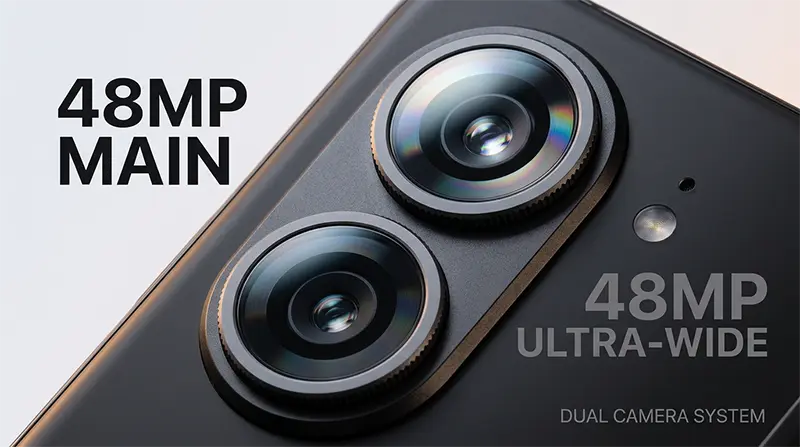
The iPhone foldable is expected to carry a total of four cameras:
- Rear: 48MP main + 48MP ultrawide dual setup
- Outer front: 18MP punch-hole camera
- Inner front: 18MP camera (some sources mention a possible 24MP upgrade)
There’s still debate over how the inner display’s front camera will be implemented.
Apple originally planned to use a UDC (Under Display Camera), but multiple reports indicate it was switched to a punch-hole design after image quality fell short of Apple’s standards.
That said, some of the latest sources still mention the possibility of UDC on the inner screen, so the final decision could remain fluid right up until mass production.
The disappointing news is that the telephoto lens is missing.
While the iPhone 17 Pro rocks a triple camera setup (main + ultrawide + telephoto), the iPhone Ultra ships with just a main + ultrawide dual configuration due to space constraints.
On a device approaching $2,000, the absence of a telephoto is definitely a letdown.
On the bright side, you’ll be able to shoot with the 48MP rear main camera while using the 5.5-inch cover display as a viewfinder — or flip the phone open and use the 7.8-inch inner screen as a mirror for rear-camera-quality selfies.
iPhone Ultra Price — Starting at $1,999, the Most Expensive iPhone Ever
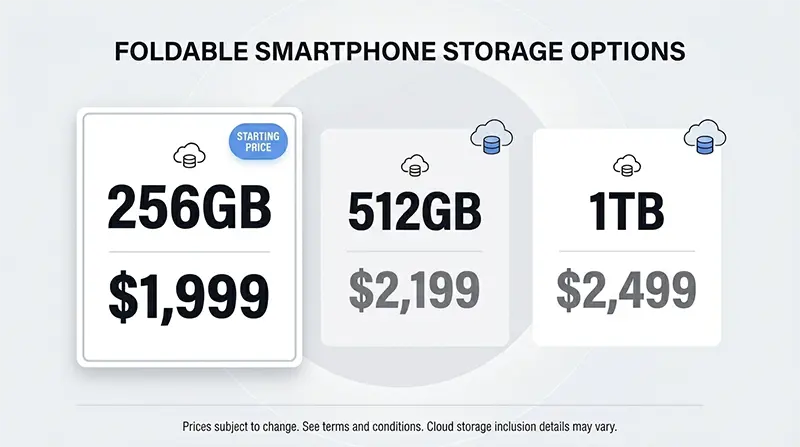
Here’s the expected pricing breakdown by storage tier:
| Storage | Expected Price (USD) |
|---|---|
| 256GB | ~$1,999 |
| 512GB | ~$2,199 |
| 1TB | ~$2,399 |
The latest reports are converging on a $1,999 starting price, with each storage bump adding $200.
Earlier rumors that suggested a $2,399 starting price now look increasingly unlikely. (Source: PhoneArena, Feb 2026)
Bloomberg’s Mark Gurman has also noted that Apple may classify the Apple Fold iPhone under the ‘Ultra’ tier — positioning it as a top-of-the-line premium product, much like the Apple Watch Ultra.
The 1TB model at $2,399 is lower than the initial $2,900 rumor, but it’s still MacBook Air money.
It’ll be fascinating to see how many people are willing to open their wallets at this price point — early sales numbers should tell us a lot.
Market projections, though, are surprisingly optimistic.
IDC forecasts that Apple could capture over 22% of foldable unit share and 34% of market value in its first year entering the foldable space.
Ming-Chi Kuo projects 3–5 million units shipped in 2026, with that number potentially scaling to 20 million by 2027 when the second-generation model launches.
Software — It Runs iOS 27, but It Works Like an iPad

The iPhone Ultra runs on iOS 27 — not iPadOS.
But once you unfold the screen, the experience changes entirely.
iPad-style multitasking is supported.
According to Bloomberg’s Mark Gurman, Apple is dedicating significant iOS 27 resources to foldable-specific features.
Smooth transitions between folded and unfolded states, responsive layouts — these are all signals that a foldable-optimized UI is in the works.
Split-view for running two apps side by side and an in-app sidebar on the left are both expected, making this the first iPhone to offer genuinely serious multitasking. (Source: Bloomberg, Mar 2026)
That said, don’t expect full Stage Manager-level windowed multitasking like on iPads.
It’s not quite iPad-level, but compared to every iPhone before it, the multitasking experience will be on a completely different plane.
Developers will also receive tools to optimize existing iPhone apps for the new interface.
Hinge & Durability — Where Apple Invested the Most
The hinge is the single most critical engineering challenge in Apple’s foldable iPhone.
It’s built using Liquid Metal through a die-casting process, designed to maximize durability while keeping the crease to a minimum.
The structure combines titanium with flexible polymer materials, and leaked test data suggests it can withstand over 200,000 folds.
If you fold it 100 times a day, that’s roughly over 5 years of use.
According to Ming-Chi Kuo, the hinge’s mass production cost is projected at around $70–80, lower than the market’s initial estimate of $100–120.
Here’s hoping that cost savings actually trickles down to the consumer price.
However, this very hinge is also being flagged as the biggest bottleneck for early supply.
Liquid Metal die-casting is an incredibly demanding process with tight component sourcing — it’s the price Apple is paying for that level of build quality.
Why Is Apple Entering the Foldable Game Now?
Samsung has been shipping foldables since 2019, and Huawei and Xiaomi are already in the market.
So why is Apple just now making its move?
The answer is simple: Apple finally reached a level it’s comfortable shipping.
Apple is famous for its “if it’s not ready, it doesn’t ship” philosophy.
Early foldables were plagued with crease issues, hinge durability problems, and battery life shortcomings.
Apple waited until these problems were sufficiently solved — and it looks like that moment has arrived.
The market timing lines up too.
The foldable market has been growing steadily, but it hasn’t gone mainstream yet.
Apple’s entry could be the catalyst that takes foldables from niche to fully mainstream.
Here’s a thought worth considering: Samsung spent seven years of trial and error building up the technology and data that, in a way, helped raise the bar for Apple’s very first foldable.
If the iPhone foldable succeeds, Samsung might ironically deserve a good chunk of the credit.
The iPhone Flip Is Coming Too — A Clamshell Foldable Teased for 2027
The foldable story doesn’t end with the iPhone Fold.
Apple is also working on a clamshell-style “iPhone Flip” that folds top to bottom — separate from the book-style iPhone Fold.
The expected launch window is 2027, with a projected price of around $1,099 — putting it in direct competition with Samsung’s Galaxy Z Flip series.
In other words, the iPhone Fold is the $2,000+ premium foldable, while the iPhone Flip serves as a more accessible entry point into foldable territory.
The two products are designed to coexist at different price tiers.
The fact that Apple is going in with both feet — not just one — signals that this isn’t a one-off experiment.
It’s a long-term strategic commitment to the foldable category.
💡FAQ
✨ Final Thoughts
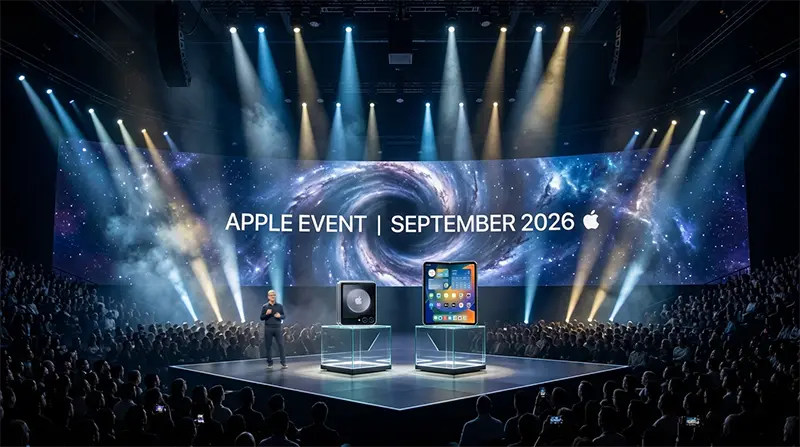
If there’s one product that perfectly embodies Apple’s “we ship it when it’s ready” philosophy, it’s the Fold iPhone.
A book-style form factor with a 7.8-inch 4:3 display, an A20-series chip, and the largest battery ever in an iPhone at 5,000–5,800mAh.
The iPhone fold release date points to a September 2026 announcement, with actual sales likely between October and December.
The iPhone Ultra price starts at roughly $1,999, making it the most expensive iPhone in history.
While Samsung spent seven years pioneering the foldable market, Apple watched, waited, and prepared its answer.
Whether that patience justifies a $2,000 price tag — that’s the question only you can answer.
Drop your take in the comments below, and bookmark this page — we’ll keep it updated as new details drop.
ℹ️ The images used in this post are concept images, and the figures and details within the images are based on rumors. They may differ from reality.